1-855-452-6224 (Customer Support Available 24/7)


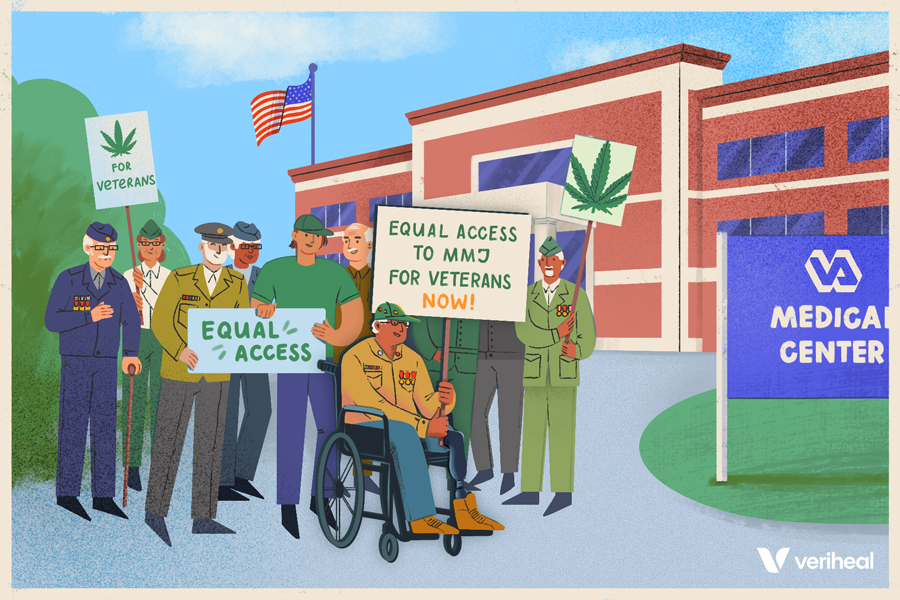
Two bipartisan House lawmakers—Rep. Earl Blumenauer, a Democrat from Oregon, and Florida Republican Rep. Brian Mast—recently introduced the Veterans Equal Access Act. If passed by Congress and signed into law, the Veterans Equal Access Act would allow doctors at the U.S. Department of Veterans Affairs (VA) healthcare facilities to issue recommendations for state-legal medical cannabis. This issue hits home for Mast, who lost both legs while serving in the Army in Afghanistan.
This is not the first time the Veterans Equal Access Act has been presented to Congress with bipartisan support, but it has never gained enough support to pass it. Blumenauer stated that the VA does not support the legislation but that several veteran groups, including the AMVETS (American Veterans) and Veterans of Foreign Wars (VFW), support the act. The cannabis industry supports this act, including the National Organization for the Reform of Marijuana Laws (NORML) and the Drug Policy Alliance.
Cannabis’ federal status is still a Schedule I substance, making it illegal at the federal level. Because of this, VA doctors cannot provide or recommend medical marijuana for veterans. This also means that veterans have prohibited from bringing any type of marijuana into a VA facility, even if it has been provided by a state-regulated medical marijuana program.
Veterans who participate in state-regulate medical marijuana programs will not be denied VA benefits, according to the Department of Veterans Affairs. While VA providers are not allowed to prescribe medical marijuana, providers are able to discuss cannabis use with veteran patients to provide education and adjust treatment plans. This is kept confidential as part of veterans’ medical records.
While the Department of Veterans Affairs cannot assist veterans in obtaining medical cannabis, the VA has outlined what it is and is not able to do regarding cannabis:
Multiple studies have shown that Veterans who suffer from PTSD have reported that cannabis helps manage their PTSD. These studies also have been examining the relationship between cannabis and PTSD symptoms, not just in veterans but with the larger public.
One study found that cannabis reduced the severity of intrusions, which are described as returning thoughts of a traumatic event, by about 62%, irritability by 67%, flashbacks by 51%, and anxiety by 57%. The study suggested that cannabis does reduce PTSD symptoms acutely, but it might not have longer-term beneficial effects. A study from 2020 showed that people with PTSD saw a greater reduction in their symptoms, but they were 2.57 times more likely to recover from PTSD than those who were not using cannabis.
Unfortunately, because cannabis is federally illegal, research is still limited. With limited research, it makes it difficult to assess the potential for cannabis as a method of treatment for PTSD. On the other hand, other studies show inconclusive results on the effectiveness of cannabis in treating PTSD symptoms.
The average cost of obtaining a medical marijuana card varies from state to state. It can cost anywhere from $50 to $200 to get your medical marijuana card. This is if your healthcare provider, covered by your insurance, cannot provide a medical marijuana prescription or approval. The cost of medical marijuana cards depends on several factors, like the state you live in, the type of card you need, whether you are a new or renewing applicant, and other factors.
Along with a medical marijuana card, some states require registration with a state-maintained registry of medical marijuana patients. Again, the cost of this varies from state to state, and for some states, it is optional. Colorado currently charges $35 for registration, and Rhode Island charges $75. Medical marijuana status registration can cost anywhere from $35-$200.
As of 2022, the VA disability compensation rate has been broken down into the following:
Below are examples of how the VA classifies disabilities and what veterans are entitled to as financial compensation. While the financial amount may seem sufficient enough to cover the cost of living, it leaves very little for anything else. For those who rely on VA benefits, obtaining a medical marijuana card outside of insurance coverage is not an option. Aside from the cost, being able to discuss medical needs with a trusted provider is crucial. Most providers who work with the VA are veterans themselves. This provides more compassionate and familiar care.
| Injury/Disability | Percentage |
| Complete amputation of the leg, including removal of the femur and any portion of pelvic bones | 100% |
| Complete amputation of the leg, including removal of the femur and intrinsic pelvic musculature only | 90% |
| Amputation of the upper third of the leg, from the perineum to the knee joint | 80% |
| Amputation of the middle or lower third of the leg | 60% |
| When a defective stump is present, thigh amputation is recommended | 60% |
| When an amputation is not improved by a prosthesis or the retention of natural knee action | 60% |
| Amputation of the leg underneath the knee, allowing for a prosthesis | 40% |
| Loss of foot | 40% |
Sign up for our newsletter

Learn the process in your state
All Rights Reserved Veriheal Inc. ©
Terms Privacy Policy Advertising Agreement Content Disclamer


Get your medical marijuana card today
Sign up in under 5 minutes
Start By Selecting Your State
 Alabama
Alaska
Arizona
Arkansas
California
Colorado
Connecticut
Delaware
Florida
Georgia
Hawaii
Idaho
Illinois
Indiana
Iowa
Kansas
Kentucky
Louisiana
Maine
Maryland
Massachusetts
Michigan
Minnesota
Mississippi
Missouri
Montana
Nebraska
Nevada
New Hampshire
New Jersey
New Mexico
New York
North Carolina
North Dakota
Ohio
Oklahoma
Oregon
Pennsylvania
Rhode Island
South Carolina
South Dakota
Tennessee
Texas
Utah
Vermont
Virginia
Washington
West Virginia
Wisconsin
Wyoming
Puerto Rico
Alabama
Alaska
Arizona
Arkansas
California
Colorado
Connecticut
Delaware
Florida
Georgia
Hawaii
Idaho
Illinois
Indiana
Iowa
Kansas
Kentucky
Louisiana
Maine
Maryland
Massachusetts
Michigan
Minnesota
Mississippi
Missouri
Montana
Nebraska
Nevada
New Hampshire
New Jersey
New Mexico
New York
North Carolina
North Dakota
Ohio
Oklahoma
Oregon
Pennsylvania
Rhode Island
South Carolina
South Dakota
Tennessee
Texas
Utah
Vermont
Virginia
Washington
West Virginia
Wisconsin
Wyoming
Puerto Rico