1-855-452-6224 (Customer Support Available 24/7)

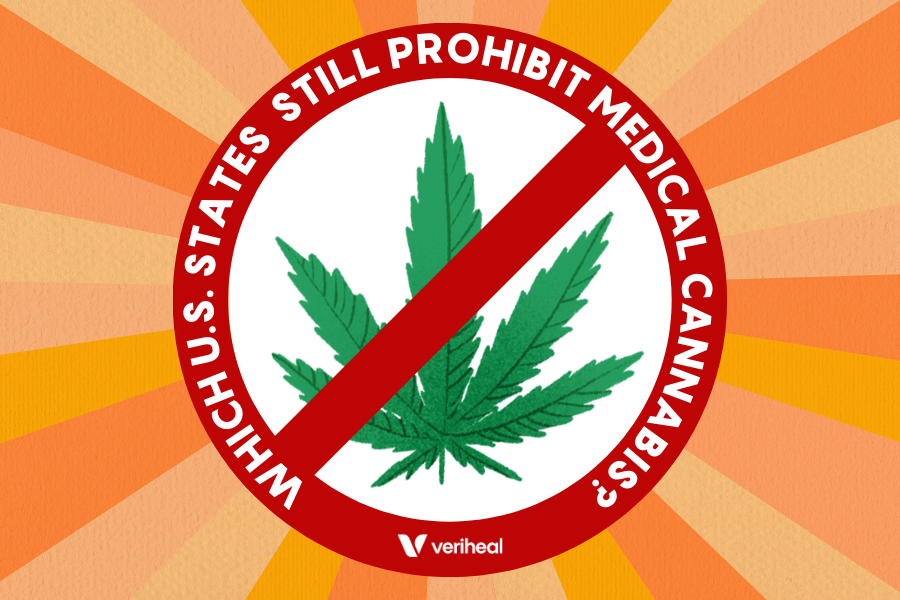
Forty U.S. states and the District of Columbia currently have legal cannabis, medical or recreational. Despite this massive shift in cannabis policy, however, a few states are still dragging their feet on cannabis legalization. For example, there are some states where only CBD-based products are allowed. Others like Idaho, meanwhile, consider even simple CBD possession a crime.
Sounds like a lot to keep track of? Don’t worry, that’s why we created the following list for you. Whether you’re planning a long road trip or flying to see family over the holidays — the following will ensure you stay on the right side of the law.
>> Learn more: Where is Cannabis Legal?
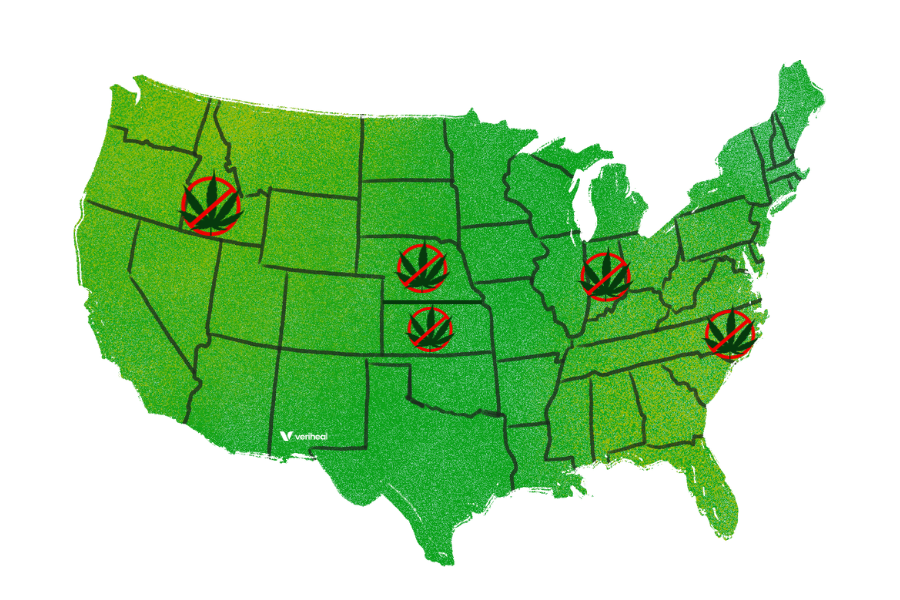
Idaho is one of the staunchest anti-cannabis states. It prohibits cannabis possession, use, purchase, sale, or cultivation, whether for recreation or medical purposes. Breaking the law here, even with only small amounts of cannabis, will result in misdemeanor charges. Subsequent violations or larger amounts of cannabis, meanwhile, will lead to felony charges.
To its credit, the state does seem to be making minor strides toward cannabis legalization lately. In 2015, Idaho state legalized CBD with a THC concentration of less than 3%. Further, after several failed attempts to legalize medical cannabis, there’s is finally enough steam to put an initiative on the state’s 2024 ballot.
Indiana prohibits the possession, use, purchase, sale, or cultivation of marijuana for both medical and recreational purposes. Possession of any quantity results in a misdemeanor for first-time offenders. Subsequent offenses and larger quantities result in felony charges.
Like Idaho, CBD with less than .3% THC is legal for treating qualifying health conditions and even recreationally.
Around 12 marijuana-related bills were proposed in the 2021 Legislative Session. Over a quarter of these focused on medical cannabis. This showed just how strong the bipartisan support for medical cannabis is in Indiana. That level of bipartisan support all but ensures the state will see some sort of legalization in the near future.
Kansas prohibits cannabis use for both medical and recreational purposes.
Here, possession-only offenses are classified as misdemeanors. Cannabis sale and delivery, meanwhile, are treated as felonies.
Despite this strict stance on cannabis, CBD is legal for both medical and recreational purposes. In Kansas, medicinal CBD entails a THC concentration under 5%. Recreational CBD, meanwhile, must be entirely THC-free.
Cannabis is illegal for both recreational and medical use in Nebraska. The state goes as far as punishing the mere possession of pipes and bongs with a fine.
Nebraska legislators pushed an initiative to establish a regulated framework for the cultivation and distribution of medical cannabis on the state’s 2020 ballot. Sadly, the Nebraska Supreme Court struck down the initiative.
Pro-medical cannabis lawmakers are preparing to introduce medical legalization to the state’s 2024 ballot.
North Carolina imposes strict prohibitions on cannabis for both medical and recreational purposes. Possession of up to 1.5 ounces leads to a misdemeanor. Larger quantities will get you a felony. Cannabis sale and delivery offenses are felonies.
In 2014, CBD with under 0.9% THC was legalized for qualifying conditions.
Earlier in March, the Compassionate Care Act made its way to North Carolina’s Senate. The Act aimed to provide patients access to smokable flower for 15 medical conditions. Unfortunately, the bill faced stiff opposition and failed.
In South Carolina, cannabis is illegal for both medical and recreational use. Possession gets you a misdemeanor charge. Sale and Delivery, meanwhile, result in felony charges.
However, the state’s legislative landscape is evolving, with the passage of a bill to fully legalize medical cannabis in 2022. This progressive legislation, once implemented, means a brand new slew of patients will have access to cannabis medicine.
In the meantime, the state allows CBD extracts for treating qualifying health conditions with less than 0.9% THC.
Tennessee is strict on cannabis, regardless of its purpose. Possession of any quantity is categorized as a misdemeanor, while sale and delivery offenses are considered felonies.
Despite these strict regulations, in 2014, the state legalized the use of CBD-rich cannabis extracts to treat intractable seizures. The only stipulation is that the extract has less than 0.9% THC.
Tennessee was close to medical cannabis legalization in 2020. Unfortunately, the Senate postponed it until the federal government removes cannabis from Schedule I.
Wisconsin has no state medical cannabis program and no licensed medical Marijuana dispensaries. However, there is an exception for low-THC/high-CBD oil. “Low-THC” means products with less than 0.3% delta-9 THC, similar to hemp-derived CBD oils.
Marijuana possession, regardless of the amount, is a misdemeanor, punishable with up to six months in jail, and a $1,000 fine. Subsequent possession is a felony and attracts a 3.5-year prison sentence. Selling up to 200 grams or growing up to four plants is punishable by a 3.5-year prison sentence.
Wyoming is among the few states without a medical cannabis program. Medical users here face the same legal consequences as recreational users. Even a mere gram of high-THC cannabis can lead to misdemeanor charges. Attempts at getting a medical cannabis initiative on the state’s ballot failed to get enough signatures.
In 2019, HB 197 was introduced into the state legislature. It aimed to reduce possession penalties to a maximum fine of $200 and a 20-day prison term. Unfortunately, the bill failed before it could get anywhere close to becoming a reality.
According to a 2022 survey, 54% of Wyoming’s residents endorse cannabis legalization for recreational use. 86% of Wyomingites, meanwhile, expressed support for medical cannabis.
While currently, 40 states and the District of Columbia have medical cannabis programs, each state with its unique rules and regulations.
These states include Alaska, Alabama, Arizona, Arkansas, California, Colorado, Connecticut, Delaware, Florida, Georgia, Hawaii, Illinois, Kentucky, Louisiana, Maine, Maryland, Massachusetts, Michigan, Minnesota, Mississippi, Missouri, Montana, Nevada, New Hampshire, New Jersey, New Mexico, New York, North Dakota, Ohio, Oklahoma, Oregon, Pennsylvania, Rhode Island, South Dakota, Texas, Utah, Vermont, Virginia, Washington, and West Virginia.
Despite the evolution of state-level cannabis legalization, marijuana remains classified as a Schedule I drug under the Controlled Substances Act of 1970, as defined by the Drug Enforcement Agency (DEA).
Schedule I drugs are categorized as substances with “no currently accepted medical use and a high potential for abuse.” In this classification, cannabis is grouped with substances like heroin and LSD, while cocaine is designated as a Schedule II drug.
You left Iowa off of your list of states that have legalized medical marijuana. Iowa has three medical marijuana dispensaries located around the state. The dispensaries offer cannabis in pill, vape, and topical cream forms, but edibles are illegal in Iowa.
Hi Lisa! This article is about states who are currently still waiting to legalize. Iowa has already done so and you can find out more state specific information here.
Sign up for our newsletter
Learn the process in your state
All Rights Reserved Veriheal Inc. ©
Terms Privacy Policy Advertising Agreement Content Disclamer

Get your medical marijuana card today
Sign up in under 5 minutes
Start By Selecting Your State
 Alabama
Alaska
Arizona
Arkansas
California
Colorado
Connecticut
Delaware
Florida
Georgia
Hawaii
Idaho
Illinois
Indiana
Iowa
Kansas
Kentucky
Louisiana
Maine
Maryland
Massachusetts
Michigan
Minnesota
Mississippi
Missouri
Montana
Nebraska
Nevada
New Hampshire
New Jersey
New Mexico
New York
North Carolina
North Dakota
Ohio
Oklahoma
Oregon
Pennsylvania
Rhode Island
South Carolina
South Dakota
Tennessee
Texas
Utah
Vermont
Virginia
Washington
West Virginia
Wisconsin
Wyoming
Puerto Rico
Alabama
Alaska
Arizona
Arkansas
California
Colorado
Connecticut
Delaware
Florida
Georgia
Hawaii
Idaho
Illinois
Indiana
Iowa
Kansas
Kentucky
Louisiana
Maine
Maryland
Massachusetts
Michigan
Minnesota
Mississippi
Missouri
Montana
Nebraska
Nevada
New Hampshire
New Jersey
New Mexico
New York
North Carolina
North Dakota
Ohio
Oklahoma
Oregon
Pennsylvania
Rhode Island
South Carolina
South Dakota
Tennessee
Texas
Utah
Vermont
Virginia
Washington
West Virginia
Wisconsin
Wyoming
Puerto Rico