1-855-452-6224 (Customer Support Available 24/7)

A new report from the Pew Research Center has found that eight out of every ten Americans (or about 79%) now live in a county with at least one medical or recreational dispensary. More than 15,000 dispensaries are currently open across the United States despite cannabis remaining a federally illegal substance.
California is the top state for dispensaries, with more than 3,600 available to residents. The California cannabis market accounts for 25% of all dispensaries in the United States, and nearly 100% of state citizens have access to a dispensary in their county. Researchers wrote, “In fact, a single county in California—Los Angeles County—has more dispensaries (1,481) than any state other than California itself.”
The top five states in the nation for dispensaries are California, Colorado, Michigan, Florida, and, interestingly enough, Oklahoma.
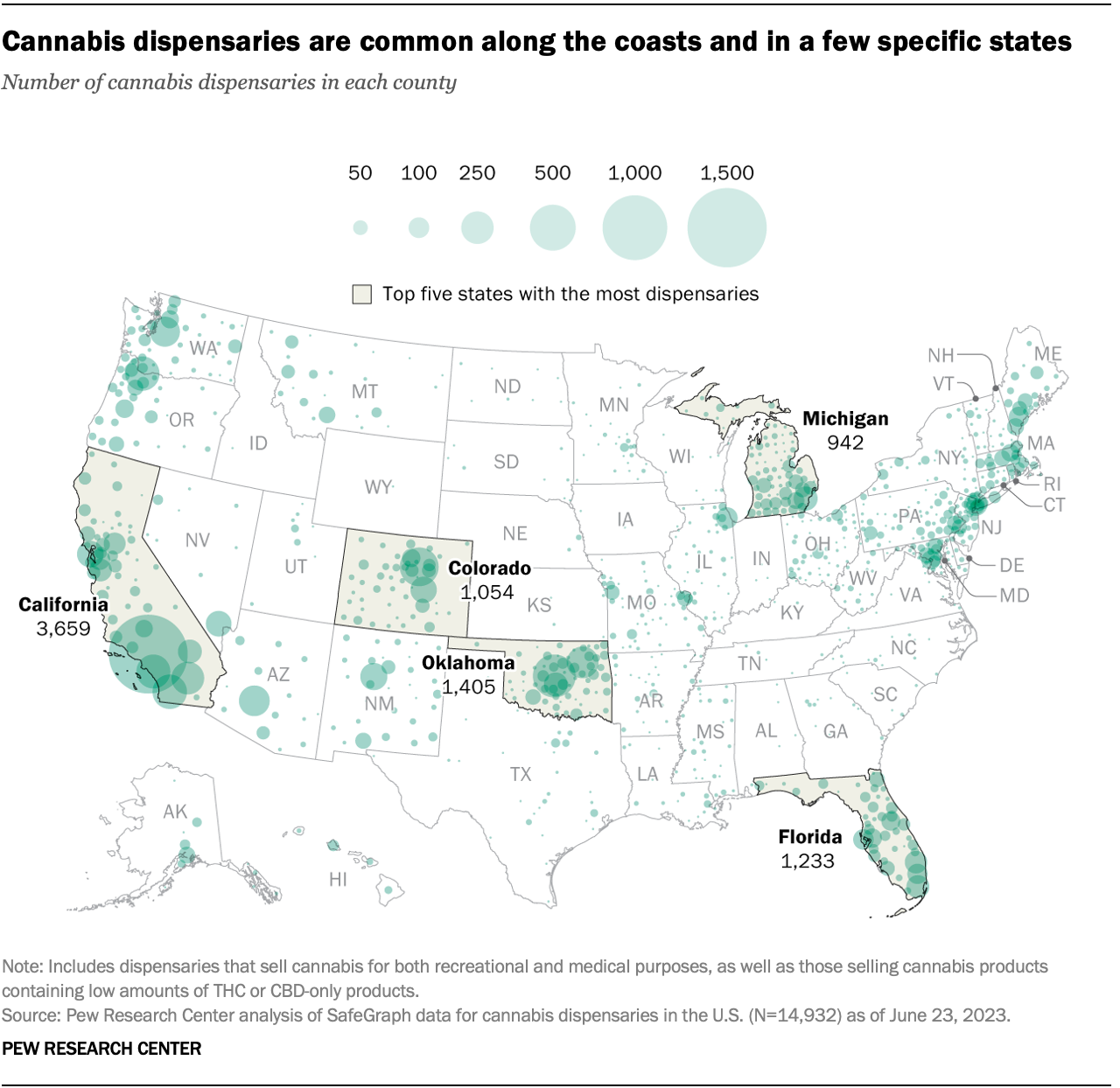
Thirty-eight states currently have some form of legalized medicinal marijuana, and 24 have adult-use (recreational) cannabis legalized. States with legal cannabis sales that border illegal states often have “clusters” of dispensaries near the state lines, allowing people in illegal states to easily cross their borders and pick up cannabis. In fact, one in five dispensaries are located within 20 miles of a state border. This discrepancy highlights the hodgepodge of legality around the nation, demonstrating a clear need for federal reform.
“For example, Indiana, Kansas, and Texas all have restrictive marijuana laws but are bordered by multiple states that have legalized the drug for recreational or medical purposes,” Researchers stated in their report. “In fact, a person residing in one of these three states can find more than 100 dispensaries within 20 miles of the state’s borders.”
The increasing amount of dispensaries in the United States points to an inevitable conclusion backed by research: Americans want access to cannabis. Eighty-four percent of the country currently supports legalizing recreational cannabis, and 71% think it would be beneficial for the economy. Marijuana has bipartisan support from Republicans, Democrats, and independent voters alike.
Federal legislators are currently considering rescheduling cannabis from Schedule I to Schedule III, but it is currently unclear when the Drug Enforcement Administration (DEA) will move forward with their decision.
Sign up for our newsletter
Learn the process in your state
All Rights Reserved Veriheal Inc. ©
Terms Privacy Policy Advertising Agreement Content Disclamer


Get your medical marijuana card today
Sign up in under 5 minutes
Start By Selecting Your State
 Alabama
Alaska
Arizona
Arkansas
California
Colorado
Connecticut
Delaware
Florida
Georgia
Hawaii
Idaho
Illinois
Indiana
Iowa
Kansas
Kentucky
Louisiana
Maine
Maryland
Massachusetts
Michigan
Minnesota
Mississippi
Missouri
Montana
Nebraska
Nevada
New Hampshire
New Jersey
New Mexico
New York
North Carolina
North Dakota
Ohio
Oklahoma
Oregon
Pennsylvania
Rhode Island
South Carolina
South Dakota
Tennessee
Texas
Utah
Vermont
Virginia
Washington
West Virginia
Wisconsin
Wyoming
Puerto Rico
Alabama
Alaska
Arizona
Arkansas
California
Colorado
Connecticut
Delaware
Florida
Georgia
Hawaii
Idaho
Illinois
Indiana
Iowa
Kansas
Kentucky
Louisiana
Maine
Maryland
Massachusetts
Michigan
Minnesota
Mississippi
Missouri
Montana
Nebraska
Nevada
New Hampshire
New Jersey
New Mexico
New York
North Carolina
North Dakota
Ohio
Oklahoma
Oregon
Pennsylvania
Rhode Island
South Carolina
South Dakota
Tennessee
Texas
Utah
Vermont
Virginia
Washington
West Virginia
Wisconsin
Wyoming
Puerto Rico