1-855-452-6224 (Customer Support Available 24/7)

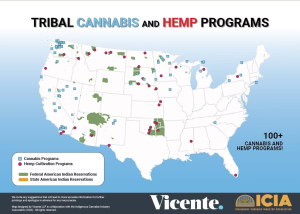
Earlier this year, the Indigenous Cannabis Industry Association (ICIA) and cannabis law firm Vicente LLP put out the first-ever map of tribal cannabis and hemp operations around the country. Showcasing more than 100 operations, the map highlights the significant growth and potential opportunities for Indigenous-owned operations in the growing cannabis and hemp industries.
The Squaxin Island Tribe in Washington State made history when it became the first in the nation to open a tribal-owned cannabis shop in 2015. Since then, dozens of sovereign communities have joined the industry through cultivation, production, and retail.
The ICIA and Vicente LLP report that about 26% of Indigenous communities in the continental U.S. operate some form of cannabis or hemp program. Many of these communities have a unique advantage because their businesses operate on sovereign land, allowing them to establish their rules separate from their states’ governing cannabis bodies.
Let’s take a closer look at what’s happening around the country:
Although tribal sovereignty plays a big role in the establishment of cannabis operations, much more is at play, including restrictions from state and federal laws. This means communities generally need to work together with overlapping governments to operate in ways that honor Indigenous sovereignty while adhering to certain state and federal regulations.
In 2013, the U.S. Department of Justice published a memo titled the Cole Memorandum, which instructed state attorneys not to pursue cannabis-related convictions unless they included violations of state law, such as providing cannabis to a minor or providing revenue to criminal enterprises, among other violations.
The following year, officials released a memo clarifying the rules of enforcement for tribal cannabis operations. Built on the framework of the Cole Memorandum, it reaffirmed that federal law enforcement, including cannabis, requires consultation with tribal partners. It also reinforced that tribal governments have a right to establish cannabis regulatory systems, so long as they stay aligned with federal enforcement priorities.
Both memos were later rescinded by a subsequent attorney general, but according to Vicente LLP, federal enforcement has not returned to pre-2013 levels. As a result, some tribes continue to negotiate compacts with their states to align their cannabis operations with outside enforcement priorities.
Washington state passed House Bill 2000 in 2015, allowing the state government to enter into cannabis agreements with tribal governments. In 2023, Michigan Governor Whitmire signed Senate Bill 179 and 180, allowing tribal governments to enter compacts with the state government for cannabis operations. Minnesota made similar strides in 2023, and in 2025, the White Earth Band of the Minnesota Chippewa Tribe became the first to sign the compact.
Additionally, some tribal governments conduct cannabis operations on their sovereign land without any formal agreement with the state government. For example, Indigenous-owned cannabis dispensaries were booming in New York a few years back because while the state retail regulations sat in limbo, tribes made their own regulations allowing them to begin retail sales before the rest of the state.
Cannabis operations can bring in lots of employment and revenue opportunities for tribes. Although tribes with cannabis operations generally follow established requirements like age and purchasing limits, their sovereign status can provide unique benefits as well, such as the ability to reinvest some tax revenue back into the community itself.
Sovereignty also allows some tribes to grow and sell cannabis in states without a legal cannabis market. For example, the Eastern Band of Cherokee Indians (ECBI) recently approved a cannabis ordinance amendment allowing adult-use recreational sales. In April, the tribe opened a medical dispensary. However, North Carolina has not legalized medical or recreational cannabis.
The ICIA also notes that many of the clusters of programs on their map showcase Indigenous operations that are actively working together to create supply chains and distribution networks. Because the communities can establish their own rules and systems on their land, tribal cannabis enterprises can also create their own unique tribe-to-tribe networks.
READ: Understanding Cannabis Use on Native American Reservations
While Indigenous cannabis operations may present unique advantages due to self-governance, entering and operating in the industry also comes with unique challenges.
Tribal attorney Paul Mooney says that tribes wanting to enter the cannabis industry are faced with unique barriers around obtaining licensing, financing, and banking. (While these are common problems among all cannabis businesses, Mooney argues that tribes face additional risk.)
He points out that tribes can be effectively locked out of the industry because of its complex, highly regulated nature. If an Indigenous grower sells their product to a state-licensed retailer, for example, they may face prosecution for off-reservation transportation. Additionally, state-licensed retailers could risk their license should they purchase from a tribally owned, non-state-licensed grower. Because of these risks, Mooney suggests tribes enter state compacts.
On top of typical banking-related challenges, cannabis operators face, tribes may also face additional challenges due to federal restrictions. Many Indigenous communities have historically faced challenges in securing access to financial resources because of their complexities.
While there are plenty of common themes across all tribal cannabis ventures in the United States, particularly around economic opportunities and challenges, it’s important to note that no two tribes operate the same way.
Each self-governing tribe has its own way of operating and the ability to self-determine. This means that for the 26% Indigenous communities in the continental US involved in cannabis or hemp operations, each may have its own set of rules specific to the tribal government.
Cannabis operations provide a unique pathway to economic development, presenting job opportunities and massive potential for tax revenue among Indigenous communities. Because tax revenue can be collected and reinvested back into the tribal economy, cannabis operations can boost crucial infrastructure like healthcare, housing, and education.
MJ Biz Daily reported earlier this year that the total number of tribal-owned cannabis stores has increased by 24% between 2024 and 2025. With the knowledge that more than 100 Indigenous tribes are involved in cannabis or hemp operations today, we can expect to see the number rise in the coming years.
Sign up for our newsletter
Learn the process in your state
All Rights Reserved Veriheal Inc. ©
Terms Privacy Policy Advertising Agreement Content Disclamer


Get your medical marijuana card today
Sign up in under 5 minutes
Start By Selecting Your State
 Alabama
Alaska
Arizona
Arkansas
California
Colorado
Connecticut
Delaware
Florida
Georgia
Hawaii
Idaho
Illinois
Indiana
Iowa
Kansas
Kentucky
Louisiana
Maine
Maryland
Massachusetts
Michigan
Minnesota
Mississippi
Missouri
Montana
Nebraska
Nevada
New Hampshire
New Jersey
New Mexico
New York
North Carolina
North Dakota
Ohio
Oklahoma
Oregon
Pennsylvania
Rhode Island
South Carolina
South Dakota
Tennessee
Texas
Utah
Vermont
Virginia
Washington
West Virginia
Wisconsin
Wyoming
Puerto Rico
Alabama
Alaska
Arizona
Arkansas
California
Colorado
Connecticut
Delaware
Florida
Georgia
Hawaii
Idaho
Illinois
Indiana
Iowa
Kansas
Kentucky
Louisiana
Maine
Maryland
Massachusetts
Michigan
Minnesota
Mississippi
Missouri
Montana
Nebraska
Nevada
New Hampshire
New Jersey
New Mexico
New York
North Carolina
North Dakota
Ohio
Oklahoma
Oregon
Pennsylvania
Rhode Island
South Carolina
South Dakota
Tennessee
Texas
Utah
Vermont
Virginia
Washington
West Virginia
Wisconsin
Wyoming
Puerto Rico