Your medical cannabis journey simplified: find partnered dispensaries, explore pricing options, earn rewards, and get answers to FAQs, all in one spot.
Educational only—this isn’t medical or legal advice. Workplace and school policies vary by employer, state, and program.
Drug testing is still a fact of life for many workers, students, and athletes—and it raises a stressful but straightforward question: Does CBD (cannabidiol) show up on drug tests?
Standard workplace panels don’t look for CBD; they look for cannabis metabolites (THC-COOH or simply Δ9-carboxy-tetrahydrocannabinol). The catch is that some CBD products—especially full-spectrum formulas or mislabeled “hemp” items—can contain enough THC (delta-9-tetrahydrocannabinol) to trigger a positive.
In this guide, we’ll break down which tests are most likely to flag THC exposure, how different CBD types (full-spectrum, broad-spectrum, isolate) affect risk, how long cannabinoids can linger, and practical steps you can take to minimize the chance of an unexpected result.
Can CBD Make You Fail a Drug Test?
Short answer: CBD itself isn’t what standard workplace tests look for. Most panels screen for cannabis metabolites—especially THC-COOH, the inactive metabolite of THC, not CBD.
That said, people can fail a drug test while using CBD if their product contains trace THC. Risk is highest with full-spectrum CBD (legal hemp products may contain up to 0.3% Δ9-THC by dry weight – however, this definition is scheduled to change next November).
Why failures still happen:
Trace THC in products. “Full-spectrum” CBD can legally contain up to 0.3% Δ9-THC by dry weight. With repeated dosing, that small amount can accumulate and trigger a positive cannabis-metabolite result.
Rare lab issues. A false positive from CBD alone is considered unlikely (sometimes quoted around 1–2%), but not impossible.
Real-world evidence: In a small study, 3 of 18 participants tested positive for THC metabolites after vaping CBD-dominant cannabis (10.5% CBD, 0.39% THC) using a confirmatory cutoff of ≥15 ng/mL. Researchers concluded CBD isolate shouldn’t trigger positives, but full-spectrum products may—especially with frequent use.
What Type of Drug Test Is Most Likely to Detect CBD?
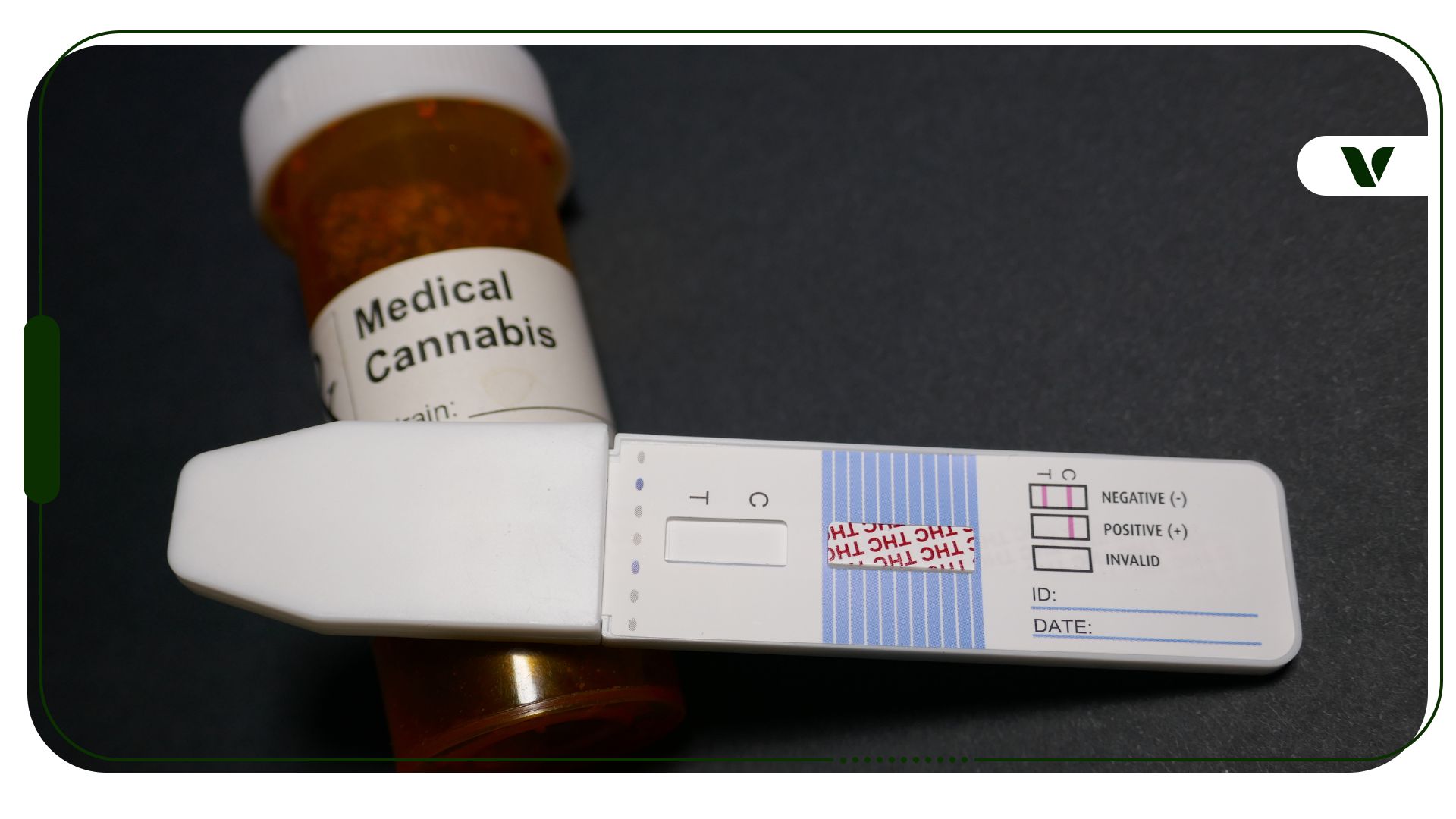
Employment tests typically don’t measure CBD at all. They look for THC exposure. Here’s how common methods differ in flagging THC-COOH (or recent THC):
Urine (most common): Screens for THC-COOH with standard immunoassay cutoffs (often 50 ng/mL, then lab confirmation at lower cutoffs typically around 15 ng/mL). Detection can range from a few days to 30+ days, depending on frequency, dose, and metabolism.
Oral fluid (saliva): Targets recent use—often 12–24 hours, sometimes a bit longer, up to 48 hours for active THC. THC metabolites may be excreted and detected in saliva up to 2 weeks after.
Blood: Used more for impairment contexts (DUI). Active THC is typically short-lived in the blood – anywhere from 0 to 30 hours – but median times are around 1–4 hours depending on frequency. Metabolites can persist longer (varies widely with usage patterns).
Hair: Captures long-term exposure (often up to ~90 days) using the newest 1.5 inches of hair. Even small, repeated THC amounts may be detectable.
Bottom line: If you’re concerned about testing, assume urine and hair present the highest long-term risk for THC-related positives.
Does the Type of CBD Product Matter?
Yes—the extract type is crucial:
Full-spectrum CBD: Contains a range of hemp cannabinoids, including trace THC. Best for people not subject to testing or those with employer documentation that acknowledges cannabinoid metabolites.
Broad-spectrum CBD: Formulated to be THC-free, although data suggest a slight risk of contamination or labelling inaccuracy. Choose brands that publish a batch-matched COA (certificate of analysis) showing “non-detect (ND)” THC with a stated detection limit.
CBD isolate: 99%+ CBD and no THC by design—the lowest-risk choice for testing, assuming clean manufacturing and reporting.
Topicals (creams/lotions): There’s no strong evidence that THC from topicals alone causes employment test failures. Theoretical risk rises only with full-spectrum topicals used heavily and repeatedly, but for most users, systemic absorption is minimal to negligible.
See If You Qualify For Medical Marijuana -Select Your State!
Select Your State
Alabama
Alaska
Arizona
Arkansas
California
Colorado
Connecticut
Delaware
Florida
Georgia
Hawaii
Idaho
Illinois
Indiana
Iowa
Kansas
Kentucky
Louisiana
Maine
Maryland
Massachusetts
Michigan
Minnesota
Mississippi
Missouri
Montana
Nebraska
Nevada
New Hampshire
New Jersey
New Mexico
New York
North Carolina
North Dakota
Ohio
Oklahoma
Oregon
Pennsylvania
Rhode Island
South Carolina
South Dakota
Tennessee
Texas
Utah
Vermont
Virginia
Washington
West Virginia
Wisconsin
Wyoming
Never miss a post
Get updates on cannabis culture, new research, and expert insights
Why COAs matter: A JAMA analysis of online CBD products found labeling inaccuracy was common—about 26% had less CBD than labeled, 43% had more, only 30% were accurate, and THC was detected in 18 of 84 samples. Always verify third-party COAs (lab name, lot number match, date, methods, and detection limits).
How Long Does CBD Stay in Your System?
Think of two tracks:
CBD itself (no standardized testing):
Occasional use: ~1–2 days in many matrices.
Regular use:several days, depending on dose, body fat, and metabolism.
One study noted urinary CBD was more detectable after oral dosing than after vaporized dosing.
THC-COOH from trace THC (what employers actually flag):
Standard urine drug screen (UDS):
Occasional exposure: about 3–7 days in urine
Regular exposure: roughly 7–15 days
Heavy/chronic exposure:30+ days is possible
Oral fluid: typically <48 hours
Hair: up to ~90 days
Because bodies and products differ, give yourself more time than you think you need—especially if you use full-spectrum items regularly.
What Can You Do to Avoid Failing a Drug Test?
Choose low-risk CBD products. Prefer CBD isolate or broad-spectrum with clearly labeled ND THC on a recent, batch-matched COA.
Skip hemp THC variants. Avoid Δ8/Δ10 or any “hemp-derived THC” products if you’re subject to testing.
Mind dose and frequency. Smaller, less frequent doses reduce the chance that trace THC builds up.
Time your usage. If a test is coming up, consider pausing or switching to isolate well in advance.
Know your policy. Read your employer/school rules. If you’re a medical cannabis patient, talk with HR and carry physician documentation (it won’t erase a positive, but it provides context in protected states).
Save receipts & COAs. Keeping proof of THC-free purchases shows good-faith compliance if questions arise.
Remember the debate. Civil-liberties groups have argued that random testing can police off-duty, private behavior, but until policies change, plan conservatively.
Key takeaway: Standard drug tests look for cannabis metabolites (e.g., THC-COOH), not CBD. To minimize risk, choose verified THC-free products, check batch COAs, avoid hemp-derived THC variants, and plan your timing—especially if your job or program tests regularly. If you’re a medical patient who needs low-risk product guidance or documentation (e.g., workplace or insurance letters), Veriheal’s licensed clinicians can help via secure telehealth.
CBD itself usually doesn’t show up on standard employment drug tests over 98% of the time because they target cannabis metabolites (THC-COOH), not CBD.
Will CBD make you fail a drug test?
CBD products can indirectly make you fail if your product contains THC (common with full-spectrum or mislabeled products). The test flags cannabis metabolites, not CBD.
Does full-spectrum CBD show up on a drug test?
Full-spectrum CBD can lead to a positive result because it includes trace THC that may accumulate, especially with daily use.
How long does CBD stay in your system?
CBD remains for hours to several days, depending on dose and frequency, but employment tests don’t look for active CBD or its metabolites. The THC-COOH from trace THC can be detectable for days to weeks, depending on the test and cutoffs, and up to ~90 days in hair.
Can CBD make you fail a drug test?
Yes—not due to CBD, but because THC in some CBD products (including Δ8/Δ10) can trigger a cannabis-metabolite positive.
Does CBD oil show on a drug test?
CBD oil itself isn’t measured on standard panels, but THC in the oil can cause a positive THC-COOH result.
What is a CBD isolate drug test?
CBD isolate is the lowest-risk option for drug testing because it contains no THC when properly manufactured—always confirm with a third-party COA.
Kenneth Bancale is an avid traveler, always seeking to immerse himself in new cultures and experiences that embody the essence of life and freedom. His passion for writing extends beyond mere expression; it serves as a vehicle for education and truth. Kenneth finds solace in the simple pleasures of coffee and the joy of singing. An innovator at heart, he constantly seeks new ways to push boundaries and challenge the status quo. When he’s not on the road or at his desk, you can find Kenneth exploring the great outdoors, indulging his love for hiking and connecting with nature.
In the confusing landscape of state-by-state medical marijuana legalization and federal prohibition lies a patient’s pursuit of a better quality of life, balanced with an unrestricted financial livelihood. In workplaces across many different medical marijuana legal states, no law guarantees that a valid, card-carrying MMJ patient status exempts an employee from termination or discrimination stemming…
It feels like every other day, a fresh slang term pops up in the cannabis lexicon, and today, we’re looking at an entry that’s all over TikTok and Reddit – Yart! Spoiler alert: it has everything to do with the humble vape cart (and how challenging it is to talk about cannabis on social media). …
The final stage of life often brings profound challenges for both patients and their families. For patients in hospice and palliative care, common symptoms not only affect the physical body but also their mental well-being. While traditional medications may dull pain, they often come with heavy sedation, confusion, and loss of clarity. Fortunately, medical cannabis…
If you’re planning to get a medical marijuana card in 2026, you might be wondering whether you need to meet with a certified cannabis doctor—either online or in person. Still, finding a qualified medical marijuana doctor near you can feel overwhelming and confusing if you’re not sure where to start. This guide shows you exactly…
Cannabis consumers in the legal market rely on proper analysis and testing as a matter of knowledge and safety regarding the composition of the weed they’re purchasing. One of the main differences between the state-run legal market and the black and gray cannabis markets is how they handle testing. Those of us in medical and…
The statements made regarding cannabis products on this website have not been evaluated by the Food and Drug Administration (FDA). Cannabis is not an FDA-approved substance and is still illegal under federal law. The information provided on this website is intended for educational purposes only and is not intended to diagnose, treat, cure, or prevent any disease. It is not intended as medical advice and should not be considered as a substitute for advice from a healthcare professional. We strongly recommend that you consult with a physician or other qualified healthcare provider before using any cannabis products. The use of any information provided on this website is solely at your own risk.