1-855-452-6224 (Customer Support Available 24/7)



Europe’s modern cannabis story started in the 1970s when the Netherlands became the first to allow its sale. Decades later, Malta led the charge toward full legalization and inspired several other E.U. nations to follow. Today, Europe’s medical cannabis market is worth over $2 billion and expected to exceed $12 billion by 2033.
Several factors are driving this growth, especially legalization, evolving public perception, and a better understanding of marijuana’s potential health benefits. From Portugal to Germany, the E.U.’s medical cannabis map is changing fast. Here’s how some of the region’s biggest markets are shaping its future.
Let’s start with Germany, the country leading Europe’s medical cannabis revolution and the continent’s largest demand center. Since legalizing medical cannabis in 2017, Germany has become the driving force behind Europe’s market growth. It’s the largest single cannabis market in Europe and accounts for almost half of the region’s total sales.
German doctors can prescribe cannabis for conditions like chronic pain and multiple sclerosis, with many patients covered through public health insurance. In 2024, Germany took a historic step by partially legalizing recreational use, marking a major cultural shift. The following year, it raised its medical cannabis import quota to keep up with rising demand.
Still, progress hasn’t come without hurdles. Proposed legislative changes in 2025 could restrict prescriptions to in-person doctor visits and limit access to pharmacy pickups instead of mail deliveries.

The Netherlands has long influenced Europe’s approach to cannabis reform, serving as both a testing ground and a policy model. Its medical cannabis program, legalized in 2003, laid the groundwork for regulated production across the continent. Overseen by the Office of Medicinal Cannabis (OMC), the program ensures strict standards for quality and distribution, allowing patients with chronic pain, nausea, or similar conditions to access products.
In April 2025, the country took another pioneering step with the Closed Coffee Shop Chain Experiment. This program requires selected coffee shops in ten municipalities to sell only regulated cannabis sourced from government-approved growers. By ending the long-standing “backdoor policy,” which tolerated sales but illegalized cultivation, the initiative gives consumers safer, more transparent access and sets a new benchmark for legal cannabis markets.
The Netherlands’ phased reforms aim to create a fully regulated supply chain that ensures product safety, quality, and accountability. With further OMC updates planned for 2026 to strengthen oversight and supply stability, the Netherlands continues to influence how Europe envisions the future of cannabis regulation.
Portugal has built its reputation as one of Europe’s most progressive countries on drug reform, and its approach to medical cannabis reflects that spirit. After decriminalizing all drugs in 2001, Portugal took another bold step by legalizing medical cannabis in 2018, establishing a tightly regulated framework.
Under this system, doctors can prescribe cannabis for chronic pain, epilepsy, multiple sclerosis, and chemotherapy-related nausea when conventional treatments fail. Favorable climate conditions and low production costs have also transformed the country into Europe’s cannabis cultivation and exportation powerhouse. Some of its biggest buyers include Germany, Spain, Poland, and Israel.
By 2025, Portugal began revising its medical cannabis laws to improve patient access and streamline licensing. This marks a shift from an export-driven cannabis economy to a more patient-centered approach. These efforts not only strengthen Portugal’s national market but also shape how Europe might balance access, regulation, and supply.
Poland has quickly become one of Europe’s fastest-growing medical cannabis markets, driven by rising patient demand and rapidly increasing import caps. Since legalizing medical cannabis in 2017, the country has steadily expanded access, allowing doctors to prescribe it for chronic pain, multiple sclerosis, chemotherapy-related nausea, and more.
Rising patient demand has driven the government to nearly double import limits, making Poland one of Europe’s fastest-growing medical cannabis markets. Imports primarily come from Portugal, Canada, and Germany, ensuring a steady supply.
At the same time, lawmakers are debating decriminalizing small-scale possession and home cultivation, though conservative and religious opposition has slowed progress. This rapid medical expansion amid cautious social reform defines Poland’s unique position in Europe’s cannabis landscape.
With soaring demand, higher import quotas, and a steadily growing patient base, Poland is emerging as a top-tier European medical cannabis hub. Its growth trajectory signals a shift toward broader acceptance and could influence future policies across Central and Eastern Europe.
READ: Cannabis and Europe: Which Countries Have Legal Cannabis?
In 2025, the Czech Republic is driving one of Europe’s boldest cannabis reforms. The country legalized medical cannabis in 2013, but for years, only specialists could prescribe it, limiting access to about 8,000 patients. That changed on April 1, 2025, when general practitioners gained prescribing rights, giving thousands more patients with chronic pain and other conditions easier access to treatment.
More change followed in May 2025 when Parliament passed a landmark legalization bill. Starting January 1, 2026, adults aged 21 and over can grow up to three plants, carry up to 25 grams in public, keep up to 100 grams at home, and share cannabis privately without profit. This marks a major step forward for personal freedom and responsible cannabis use in the Czech Republic.
By expanding medical access, legalizing personal cultivation, and regulating low-THC sales, the Czech Republic is setting the tone for Europe’s next phase of balanced, patient-focused cannabis reform.
After pioneering full cannabis legalization in 2021, Malta continues to shape Europe’s cannabis future through its community-based, health-first approach. Instead of a commercial retail system, Malta lets adults join non-profit Cannabis Harm Reduction Associations (CHRAs). Members can grow and share limited amounts of weed for personal use, learn from each other, and promote safe, responsible consumption.
In 2025, Malta refined this framework with stricter quality standards for cultivation, stronger oversight of associations, and new public health campaigns promoting responsible use. The government also boosted funding for medical cannabis research, focusing on chronic pain and mental health treatments.
By putting education, responsibility, and public health at the heart of its reform, Malta is showing the rest of Europe how to do legalization right. Its balanced approach gives other E.U. countries a roadmap for expanding access without losing sight of safety or letting profit and greed dictate the future.
In 2025, Spain took a big but cautious step toward regulating medical cannabis. The government approved Royal Decree 903/2025 in October, creating the country’s first clear framework for medical use. For now, only specialist doctors in hospitals can prescribe standardized cannabis oils or extracts (not flower) for conditions like chronic pain, epilepsy, multiple sclerosis, and cancer when other treatments fail.
Patients will get their medicine from hospital pharmacies under close supervision, ensuring safety and consistency. Though access remains limited, the law opens the door for gradual expansion as research grows.

Still, not all of Europe is on board with medical cannabis reform. Several countries remain cautious, with strict drug laws and limited access programs. In places like France, Slovakia, Romania, Estonia, and Hungary, medical cannabis is either heavily restricted, available only through narrow pilot schemes, or outright prohibited.
These governments often point to a lack of clinical evidence, fears of misuse, or lingering stigma as reasons to delay legalization. This stance contrasts sharply with their more progressive neighbors. It’s especially frustrating for patients in countries like Sweden and Finland, where interest in medical cannabis keeps growing, yet strict rules and limited access leave many without options for relief.
Furthermore, political opposition from conservative parties in countries like Germany slows expansive reforms, often limiting pilot programs or broader legalization efforts. The resulting fragmented landscape means that while several European countries embrace medical cannabis either through public health insurance subsidies or legal frameworks, others resist due to ideological or regulatory hurdles.
Public opinion across Europe tells a mixed story. On forums like Reddit, many users share divided views about legalization. One user, kuldan5853, put it bluntly, “I personally would prefer to keep it forbidden – if just because I can’t stand the smell…”
Another, Jaqian from Ireland, added, “I have no problem with it for medicinal use but don’t want to see it in general use. I already see enough scrotes taking it and smell it everywhere, if it became legal it would be way worse.”
Others like Anaptyso take a balanced view, saying, “…Logically speaking I think it should be treated the same as alcohol i.e. legal, taxed, and heavily regulated. However the smell is vile, and very strong. It only takes one person to be smoking in my neighbourhood and I can smell it in every room in my house. I don’t look forwards to a future where it is more common.”
Still, some, like allgodsarefake2, remain more libertarian, “Really don’t care what other people do with their lives as long as it is consensual and not harmful to those not involved…”
And finally there’s tifasi from Greece, “I personally hate weed. But I still think that all drugs should be decriminalized at minimum. We don’t want the fentanyl/nitazene epidemic in Europe and it’s slowly gonna come because Talibans have destroyed all their opium fields and seized production. Demand exists and you can always trust an addict to find a way to cure their pain. There will be a worse monster to fill that market and as we have seen it will only cause more death and destruction. Prohibition doesn’t work. And addiction is a far deeper issue than just having access to the substance.”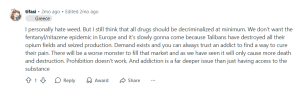
These contrasting voices highlight Europe’s ongoing struggle to reconcile cultural attitudes with scientific progress and public health priorities.
From patients to investors, the future looks bright for Europe’s cannabis scene. Over the next decade, experts expect the E.U.’s medical cannabis market to grow nearly fivefold. Increased legalization, expanding patient demand, and cannabis exportation will drive most of this growth.
Countries like Germany, Spain, and the Czech Republic are progressively adapting their laws to increase patient access through improved prescription rights and insurance subsidies. We can also expect advancements and growth in the industry to create more jobs, improve product quality, and breed new specialists and niches.
Additionally, as more doctors learn about the benefits and research expands, medical cannabis use will likely grow even more. This steady momentum points to a promising future for medical cannabis across much of Europe.
Sign up for our newsletter

Learn the process in your state
All Rights Reserved Veriheal Inc. ©
Terms Privacy Policy Advertising Agreement Content Disclamer


Get your medical marijuana card today
Sign up in under 5 minutes
Start By Selecting Your State
 Alabama
Alaska
Arizona
Arkansas
California
Colorado
Connecticut
Delaware
Florida
Georgia
Hawaii
Idaho
Illinois
Indiana
Iowa
Kansas
Kentucky
Louisiana
Maine
Maryland
Massachusetts
Michigan
Minnesota
Mississippi
Missouri
Montana
Nebraska
Nevada
New Hampshire
New Jersey
New Mexico
New York
North Carolina
North Dakota
Ohio
Oklahoma
Oregon
Pennsylvania
Rhode Island
South Carolina
South Dakota
Tennessee
Texas
Utah
Vermont
Virginia
Washington
West Virginia
Wisconsin
Wyoming
Puerto Rico
Alabama
Alaska
Arizona
Arkansas
California
Colorado
Connecticut
Delaware
Florida
Georgia
Hawaii
Idaho
Illinois
Indiana
Iowa
Kansas
Kentucky
Louisiana
Maine
Maryland
Massachusetts
Michigan
Minnesota
Mississippi
Missouri
Montana
Nebraska
Nevada
New Hampshire
New Jersey
New Mexico
New York
North Carolina
North Dakota
Ohio
Oklahoma
Oregon
Pennsylvania
Rhode Island
South Carolina
South Dakota
Tennessee
Texas
Utah
Vermont
Virginia
Washington
West Virginia
Wisconsin
Wyoming
Puerto Rico