Your medical cannabis journey simplified: find partnered dispensaries, explore pricing options, earn rewards, and get answers to FAQs, all in one spot.
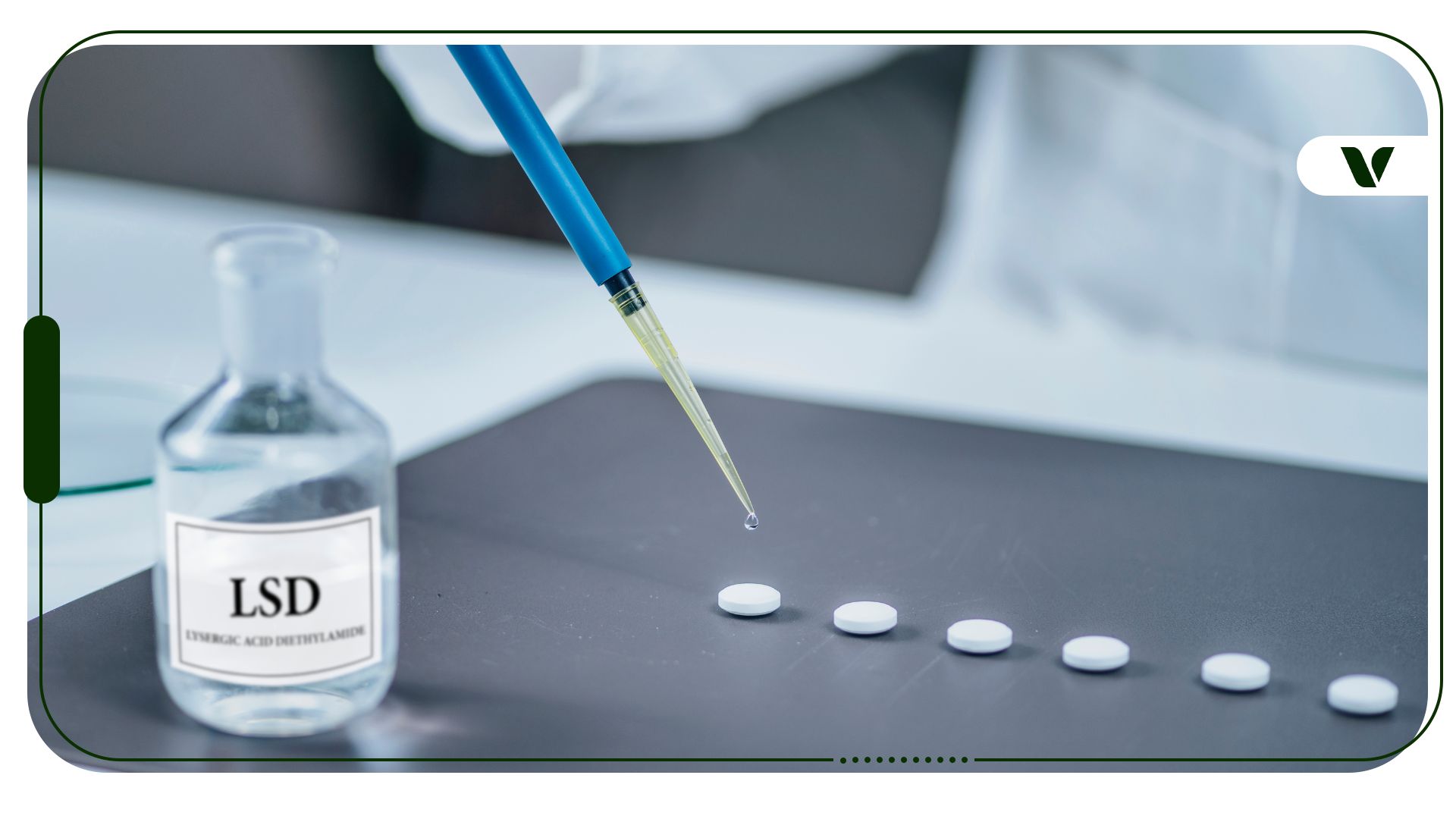
Lysergic acid diethylamide (LSD) didn’t become the psychedelic compound that changed the world just overnight–it took a few important events first. Many folks may not know that LSD usage became widespread because of the U.S. government, specifically the Central Intelligence Agency (CIA). This federal agency’s failed attempt to create a mind-control drug inadvertently sparked America’s counterculture and the modern hippie movement. How did this monumental shift in American culture and human consciousness happen so fast?
Post WW-II, The Cold War, and the Race for Military Superiority
The aftermath of World War II led to a division between the U.S. and the USSR (Union of Soviet Socialist Republics), the two main beneficiaries of the war. These two countries also waged a non-physical war of resources and arms accumulation known as “The Cold War,” ultimately driving military expansion until the USSR collapsed in 1991.
Espionage became the primary method of surveilling the other side’s military capabilities and devising covert ways to undermine them. Intelligence gathering by CIA agents and spies revealed sometime in the 1950s that the USSR was working on a mind-control drug that could create “super soldiers” and aid in enemy interrogation.
Determined to keep up with the Russians in the race for military superiority, the CIA launched its own top-secret mind-control program in the early 1950s. A government chemist named Sidney Gottlieb was a key figure in this program, serving as its creator and operator until the late 1960s.
MK-Ultra, Mind Control, and LSD
The U.S. government, specifically the CIA, codenamed its covert mind control program MK-Ultra. CIA scientists were aware of a drug created by a Swiss chemist named Albert Hofmann called LSD, which lent itself to new ways of human consciousness, as well as vividly intense hallucinations at higher doses. Gottlieb went all-in, persuading the CIA to purchase the world’s entire supply of LSD, totaling about $240,000, for use in MK-Ultra experiments.
Gottlieb and the CIA created fake institutions and research firms to administer LSD to hospitals, universities, and prisons under the guise of laboratory research. Both parties also desired to unleash LSD, along with other psychedelics, on unsuspecting parties to see how they could be used for nefarious purposes.
Who Was Experimented On During MK-Ultra & How?
Doctors working for the CIA administered prisoners, one of the largest groups the experiments preyed on, with high doses of LSD, isolation, and electroshock against their will. MK-Ultra researchers and doctors also subjected mental patients in psychiatric hospitals and clinics to psychological extremes for the sake of military dominance. These same bad actors recruited university volunteers who willingly signed up to earn a few extra bucks. Some of those volunteers ultimately became the proverbial Johnny Appleseeds responsible for psychedelia and counterculture itself.
LSD Leaves the Lab with Ken Kesey & Friends
Ken Kesey was a young writer working for Stanford University’s creative writing center who volunteered for a “study” at the Veterans Hospital in nearby Menlo Park, CA, around 1960. These studies were eventually revealed to be MK-Ultra experiments under the guise of clinical studies. Human test subjects like Kesey took very large doses of LSD, along with other psychedelics, including mescaline, psilocybin, and dimethyltryptamine (DMT), while researchers would observe and record them. The potent and mind-altering psychedelics given to test subjects in these “clinical studies” often permanently harmed their nervous systems and mental well-being.
However, Ken Kesey enjoyed his LSD experiences so much that he began secretly stealing large amounts of the drug from the study to share with his friends. He managed this because he worked nights as a hospital aide in the mental health ward of the same Veterans Hospital where the MK-Ultra experiments took place. This stint as a mental health aide, along with his early LSD experiences, formed the basis of his famous book One Flew Over the Cuckoo’s Nest.
LSD soon made its way to Kesey’s fellow test subjects, friends, and neighbors–including Allen Ginsberg, Robert Hunter, Jerry Garcia, and other key figures of the Beat movement and emerging counterculture. Owsley Stanley, Kesey’s friend and renowned LSD chemist, eventually created a stronger, purer version than the government’s. By the mid-1960s, his “White Lightning” LSD was widely available across California.
See If You Qualify For Medical Marijuana -Select Your State!
Select Your State
Alabama
Alaska
Arizona
Arkansas
California
Colorado
Connecticut
Delaware
Florida
Georgia
Hawaii
Idaho
Illinois
Indiana
Iowa
Kansas
Kentucky
Louisiana
Maine
Maryland
Massachusetts
Michigan
Minnesota
Mississippi
Missouri
Montana
Nebraska
Nevada
New Hampshire
New Jersey
New Mexico
New York
North Carolina
North Dakota
Ohio
Oklahoma
Oregon
Pennsylvania
Rhode Island
South Carolina
South Dakota
Tennessee
Texas
Utah
Vermont
Virginia
Washington
West Virginia
Wisconsin
Wyoming
Never miss a post
Get updates on cannabis culture, new research, and expert insights
Source: Wikipedia
Acid Culture Takes Shape
Mass gatherings organized by Kesey and his psychedelic troupe, known as the Merry Pranksters, began to take shape around the same time. For a small fee, attendees entered a ballroom or dance hall, drank from a barrel of Kool-Aid spiked with Owsley’s super pure LSD, and experienced synesthesia and sensory overload through strobe lights, performance art, and projector shows.
Organizers called these performances “Acid Tests,” which included lots of music from Jerry Garcia and his band, the Grateful Dead—a group that continues to carry on the psychedelic counterculture tradition to this day. Acid Tests were precursors to the psychedelic era that would ensue for the next couple of years and ultimately leave their legacy in the form of modern concert lighting, sound, and public address systems.
Changes in Societal Culture & Norms
The psychedelic attitude of free love, flower power, and a general proclivity towards peace and non-violence also shaped society and culture. LSD can reportedly make the user feel “at one” with the rest of the universe, potentially spurring feelings of peace and tranquility for all mankind. The “hippies” bolstered the anti-war movement with their desire for a world not constantly in conflict in the pursuit of the almighty dollar.
The hippies and their ideals birthed anti-consumerist, organic, and mindful living, which stood in stark contrast to the conservative establishment firmly rooted in the U.S. This right-leaning establishment would become known as “the Man”, a capitalistic police state responsible for systemic harm and prejudice. Mainstream society had rarely questioned authority before, but now a growing number, especially young people, were holding those in power accountable for inequality and destruction.
Some social scholars argue that Women’s rights, black rights, and gay rights wouldn’t have been able to take hold if it weren’t for LSD. The substance had opened American society’s eyes to the cruelty and control of “the Man” and the conservative establishment.
LSD changed the general consciousness so rapidly that the government quickly created federal laws to ban it and classify it as a Schedule I drug. However, by then, psychedelics had already saturated popular culture through music, television, literature, and film with new perspectives and artistic directions. Producers and advertisers also diluted popular culture with watered-down “hippy dippy” psychedelia, which they eagerly exploited for profit.
The counterculture lost much of its momentum due to arrests, law enforcement scare tactics, and violent incidents involving figures like Charles Manson in 1969 and the Hells Angels at Altamont in 1970. However, to this day, those seeking to connect with the world and beyond in unconventional ways continue to use LSD.. Rock bands like the Grateful Dead toured the country for decades as meeting places for the counterculture to assemble and vibe, while chemists continued to create LSD and “turn on” the next generations.
Worldwide fashion, art, culture, and even politics have shifted in so many ways since the days when LSD reigned supreme, with roots in the freedom of expression and unconventional thinking that LSD spurred. The next time you scroll your phone or laptop, remember that LSD played a role in creating the World Wide Web, thanks to Merry Prankster Stewart Brand and his Whole Earth Catalog, which inspired a worldwide digital community. Thank you, CIA!
The Unveiling Of and Grand Irony of MK-Ultra
A congressional investigation in 1975 sought to uncover dubious and illegal activities of federal agencies, including the CIA. Former MK-Ultra participants testified about what happened during the experiments, while investigators used any remaining documents that survived destruction to shed light on the CIA’s illegal activity. Public trust in the government became eroded significantly due to the abusive and malicious nature of many of the experiments that left many subjects never the same again. Federal laws and oversight were then put into place to protect Americans from such clandestine abuses by their government. The fact remains that no one knows the full extent of the damage MK-Ultra inflicted in vain, since Gottlieb had shut the program down due to his inability to achieve his goals of mind control.
The uncovering of MK-Ultra was also news to people like Kesey, who was eventually told by Allen Ginsberg that it was the CIA giving them LSD and psychedelics all those many years before. This revelation helped cement the idea that MK-Ultra spurred one of the greatest modern shifts in human consciousness. “What we hoped was that we could stop the coming end of the world”, said Kesey in a 1988 interview with Stanford magazine.
The grand irony of MK-Ultra made a tool for control and manipulation spark a global awakening–breaking the powers-that-be’s hold on human spirit, consciousness, and our connection to the universe.
Anthony DiMeo is a Southern New Jersey-based journalist and cannabis advocate whose work and advocacy have been featured in Leafly, DOPE Magazine, and the Philadelphia Inquirer. Hobbies include navigating interdimensional psychedelic energy vortexes and tennis.
In the confusing landscape of state-by-state medical marijuana legalization and federal prohibition lies a patient’s pursuit of a better quality of life, balanced with an unrestricted financial livelihood. In workplaces across many different medical marijuana legal states, no law guarantees that a valid, card-carrying MMJ patient status exempts an employee from termination or discrimination stemming…
It feels like every other day, a fresh slang term pops up in the cannabis lexicon, and today, we’re looking at an entry that’s all over TikTok and Reddit – Yart! Spoiler alert: it has everything to do with the humble vape cart (and how challenging it is to talk about cannabis on social media). …
The final stage of life often brings profound challenges for both patients and their families. For patients in hospice and palliative care, common symptoms not only affect the physical body but also their mental well-being. While traditional medications may dull pain, they often come with heavy sedation, confusion, and loss of clarity. Fortunately, medical cannabis…
The old “lazy stoner” stereotype is quickly fading. We now see bodybuilder moms using cannabis for better sleep, runners getting in the zone with the help of weed, and many other examples of cannabis being used in ways that counter the unmotivated stereotypes of the past. As legal access to the plant increases, more people…
If you’re planning to get a medical marijuana card in 2026, you might be wondering whether you need to meet with a certified cannabis doctor—either online or in person. Still, finding a qualified medical marijuana doctor near you can feel overwhelming and confusing if you’re not sure where to start. This guide shows you exactly…
The statements made regarding cannabis products on this website have not been evaluated by the Food and Drug Administration (FDA). Cannabis is not an FDA-approved substance and is still illegal under federal law. The information provided on this website is intended for educational purposes only and is not intended to diagnose, treat, cure, or prevent any disease. It is not intended as medical advice and should not be considered as a substitute for advice from a healthcare professional. We strongly recommend that you consult with a physician or other qualified healthcare provider before using any cannabis products. The use of any information provided on this website is solely at your own risk.