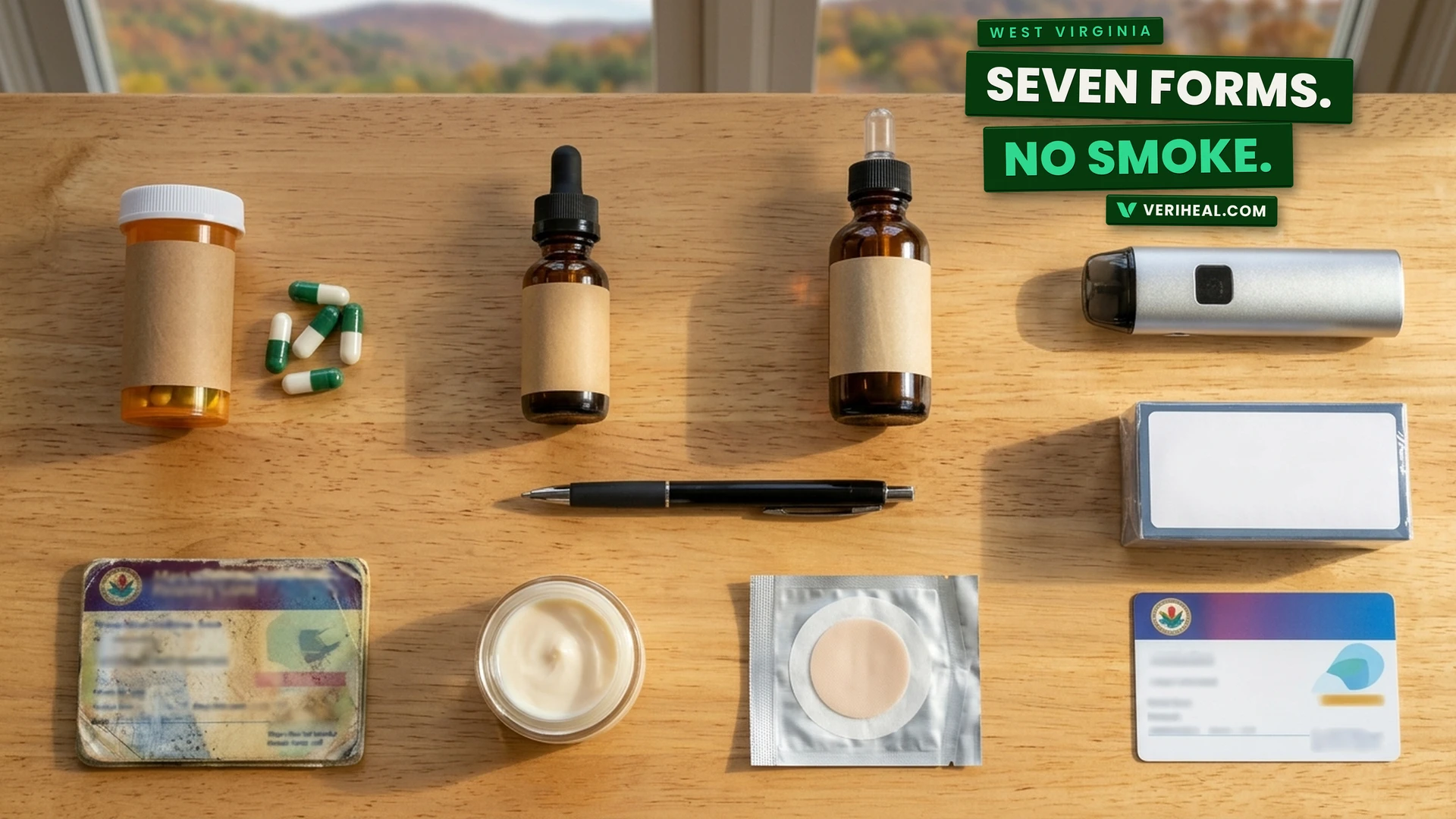
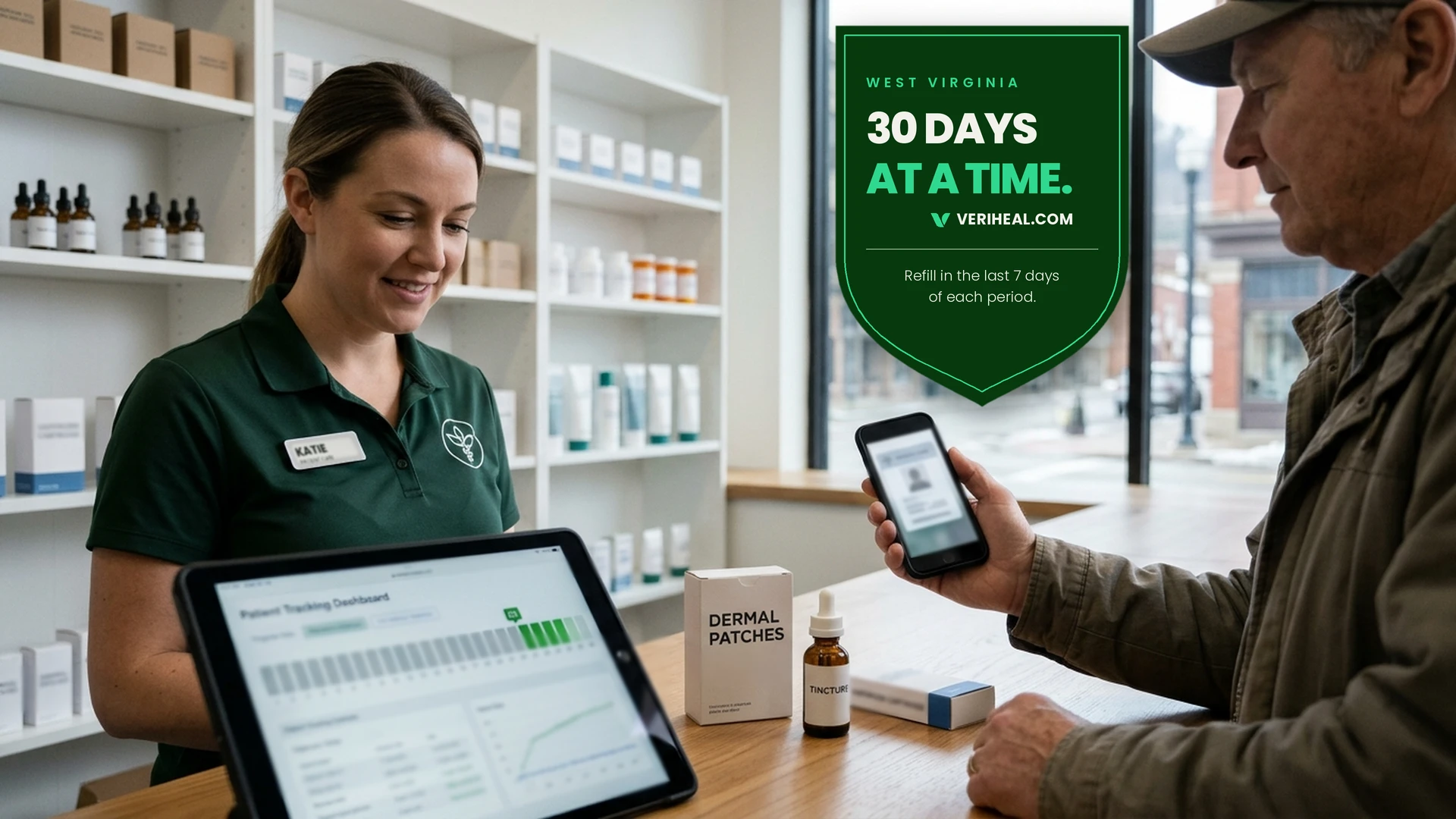
Before you shop, it helps to know that West Virginia approves specific forms of medical cannabis and bans others. Pills, oils, tinctures, topicals, patches, and forms for vaporization are legal, while smoking is not. Veriheal connects you with a West Virginia physician for an online video evaluation if you’re not certified yet via its West Virginia medical card program.
This guide explains each legal form, the rules around smoking and edibles, and how much you can buy.
What Forms of Medical Cannabis Are Legal in West Virginia?
The Office of Medical Cannabis (OMC) lists the approved forms on its FAQ page, and the Medical Cannabis Act limits patients to them. The legal forms are:
- Pills
- Oils
- Topicals: Gels, creams, and ointments.
- Tinctures
- Liquids
- Dermal patches
- Vaporization or nebulization forms: Including dry leaf or plant form.
Dispensaries don’t all carry every approved form, and menus can change from one visit to the next. Call ahead or check the dispensary’s menu to confirm what’s in stock, and ask staff which forms suit your needs before you go.
Why Smoking Is Prohibited Under West Virginia Law
Smoking medical cannabis is unlawful in West Virginia, and holding a card doesn’t change that. The OMC says the rule covers any form of combustion, including rolling papers, water pipes, and pipes. The Medical Cannabis Act limits patients to approved forms, and combustion isn’t among them. Using combusted cannabis puts you outside what your card allows, so confirm current guidance with the OMC if you’re unsure.
What Counts as Vaporization Under West Virginia Law?
Vaporization heats cannabis to release active compounds as vapor, without burning the plant. The OMC lists dry leaf or plant form as part of an approved vaporization or nebulization form. Anything that burns the material, such as a pipe or a rolled cigarette, is smoking. Ask dispensary staff what equipment suits the product you buy. For related reading, see Veriheal’s guides on enjoying cannabis without smoking and what temperature THC degrades.
Vaporization vs. Smoking: What the Difference Means for Dry Leaf Patients
Dry leaf is legal in West Virginia, but only if you vaporize it. That means picking it up at a dispensary isn’t enough, since you also need a way to use it without burning it. Route matters too. The National Cancer Institute notes that inhaled cannabinoids enter the bloodstream quickly, while oral THC passes through the liver first. For how the two routes differ, read Veriheal’s guide on how cannabinoids flow through the body with inhalation vs. ingestion.
What Device Does a West Virginia Patient Need for Dry Leaf?
You need a device made to heat plant material without combustion, such as a dry herb vaporizer. Extract pens and cartridges are a different product form from dry leaf. Dispensary staff can explain what works with the product you choose.
Are Edibles Legal in West Virginia?
Dispensaries can’t sell edibles. It’s unlawful to incorporate medical cannabis into edible form or sell it in edible form, according to the OMC. A patient or caregiver may mix cannabis into food to help the patient take it. If you want an ingested form, pills, oils, tinctures, and liquids are your approved options.
A Closer Look at Each Approved Product Form
Each form works differently, so it helps to know what you’re choosing between. Talk with your physician or a dispensary pharmacist about which fits your needs.
Pills
Pills are taken by mouth. Oral THC passes through the liver first, according to the National Cancer Institute, which is one reason oral and inhaled forms feel different.
Oils
Oils are liquid preparations that you take by mouth. Ask dispensary staff how a particular oil is meant to be used.
Tinctures and Liquids
Tinctures and other liquids are measured preparations, and each product’s label explains how to dose it. Staff can help you read the potency information.
Topicals
Topicals include gels, creams, and ointments you apply to the skin. For background, read Veriheal’s guide on absorbing THC through skin.
Dermal Patches
Patches are applied to the skin. Availability varies by dispensary, so ask before you plan around one.
Dry Leaf or Plant Form
Dry leaf is approved only for vaporization. See the section above on equipment, and ask about the product’s labeled potency before you buy. For how long effects last, read Veriheal’s guide on how long a cannabis high lasts.
How Much Can You Buy?
The limit is 6 ounces of flower or 60 grams of concentrate, or an equivalent combination, per rolling 30-day period, unless your registered physician specifies a different amount. This table shows how the OMC describes it:
| Product |
Limit |
Notes |
| Flower |
6 ounces |
Per rolling 30-day period |
| Concentrate |
60 grams |
Per rolling 30-day period |
| Mix of both |
Equivalent combination |
1 ounce of flower equals 10 grams of processed THC |
| Physician-set limit |
Varies |
Your physician can specify a different amount |
A rolling period starts on the date of a purchase. Whatever you buy is deducted from your allotment and added back after 30 days, so your allotment doesn’t reset on the first of the month. You can check your allotment in the OMC’s registration portal. Confirm current limits with your dispensary when you buy.
How West Virginia’s Approved Forms Compare to Other Medical States
Every state decides which forms of medical cannabis it allows, so West Virginia’s list may look different from the ones in neighboring states. A form you can buy in one place isn’t necessarily legal here, which is worth remembering if you’ve used cannabis elsewhere. The OMC also prohibits patients and caregivers from traveling outside West Virginia with medical cannabis. To see how other states treat out-of-state patients, read Veriheal’s guide on which states allow out-of-state patients to buy medical marijuana.
How Do You Get Access to These Products?
You need to be a registered patient before you can buy anything, and the process is straightforward. The OMC lists each step on its patients page. Here is how it works:
- Certification: A registered physician certifies your condition.
- Application: You apply online and pay the $50 state fee.
- Review: The OMC reviews applications within 30 days, and your digital card is valid for one year.
The physician evaluation is a separate cost, and Veriheal keeps it simple with a $149 fee that can be split into interest-free installments. Once approved, the OMC’s dispensary list shows where to shop, and you’ll need your card to buy. To weigh the value, read Veriheal’s guide on the benefits of a medical marijuana card.
Does Insurance Cover Any of These Forms?
Insurance doesn’t cover any approved form, so plan to pay for your medical cannabis out of pocket. Cannabis itself isn’t an FDA-approved drug, and the April 2026 move to Schedule III for state-licensed medical marijuana didn’t change that. Ask dispensary staff about pricing before you buy, so there are no surprises at the counter.
What Should You Know About Firearms Before You Buy Products?
In plain English: Federal gun rules loosened a little in 2026, but a medical card hasn’t become a clean slate. If you own firearms or plan to buy one, the risk that remains is real, so it’s worth speaking with a licensed attorney before you enroll.
In legal terms:
- Rescheduling: State-licensed medical marijuana moved from Schedule I to Schedule III on April 28, 2026, under Federal Register rule 2026-08176. Marijuana outside a state medical license, and outside FDA-approved products, stays in Schedule I.
- The Supreme Court: In United States v. Hemani, decided June 18, 2026, the Court unanimously held that prosecuting someone under 18 U.S.C. § 922(g)(3) based solely on marijuana use was inconsistent with the Second Amendment. The Court called its decision narrow.
- The ATF: The Bureau of Alcohol, Tobacco, Firearms and Explosives (ATF) rescinded its 2011 open letter, which had told dealers a medical card was grounds to refuse a sale.
- Still in place: Section 922(g)(3) remains federal law, ATF Form 4473 is unchanged, and the ATF hasn’t issued replacement guidance, so dealer practices may vary.
A licensed attorney can explain how these rules apply to you. For more detail, read Veriheal’s guide on medical cannabis patients and gun rights.
How Can Veriheal Help You Get Certified in West Virginia?
Choosing between forms is easier once you know you’re approved, and that begins with a conversation with a registered physician. Your physician decides whether certification fits your care, and Veriheal backs the visit with a “get approved or your money back” policy.
When you’re ready to start, find a medical marijuana doctor online.
Note: The content on this page is for informational purposes only and is not intended to be professional medical advice. Do not attempt to self-diagnose or prescribe treatment based on the information provided. Always consult a physician before making any decision on the treatment of a medical condition.
Note: Veriheal does not support illegally consuming therapeutic substances such as cannabis but acknowledges that it transpires because of the current illicit status, which we strive to change by advocating for research, legal access, and responsible consumption. Always consult a physician before attempting alternative therapies.
Frequently Asked Questions
What forms of medical cannabis are legal in West Virginia?
Medical cannabis patients in West Virginia can choose from several approved forms, including pills, oils, tinctures, liquids, and topicals such as gels, creams, and ointments. Dermal patches and vaporization forms, including dry leaf, are also allowed. Smoking isn’t permitted, so dry leaf is legal only when it’s vaporized.
Can you smoke medical marijuana in West Virginia?
Smoking medical cannabis is unlawful in West Virginia, even for registered patients. The OMC says that includes any form of combustion, such as pipes and rolling papers. Dry leaf is approved only for vaporization.
Are edibles an approved medical cannabis product form in West Virginia?
Dispensaries can’t sell edibles, since the law makes it unlawful to incorporate medical cannabis into edible form or sell it that way. A patient or caregiver may mix cannabis into food to help the patient take it. Pills, oils, and tinctures are the approved ingested forms.
Is flower legal in West Virginia?
Dry leaf or plant form is legal only as part of an approved vaporization or nebulization form. You can’t smoke it.
How much medical cannabis can I buy in West Virginia?
Patients can buy up to 6 ounces of flower or 60 grams of concentrate, or an equivalent combination, per rolling 30-day period. A registered physician can specify a different amount.
What conditions qualify for medical cannabis in West Virginia?
West Virginia recognizes 15 serious medical conditions, and the OMC publishes the current list. For help finding out whether yours qualifies, visit Veriheal’s West Virginia page.
How do I get a medical cannabis card in West Virginia?
A registered physician certifies you, then you apply to the OMC online and pay the $50 fee. The OMC reviews applications within 30 days.
Author, Share & Comments