West Virginia’s Office of Medical Cannabis (OMC) is based in Charleston, but you don’t need to visit it to get your card. A registered physician certifies you, you apply to the OMC online, and the OMC reviews your application in about 30 days. Veriheal connects you with a West Virginia physician for an online video evaluation.
This guide covers the steps, the cost, the products you can buy, and where to find Kanawha County dispensaries. By the end, you’ll be ready to plan your first purchase.
How Do You Get a Medical Cannabis Card in Charleston?
Getting your card takes two stages: your physician certifies your condition, and then you register with the state. The OMC walks through the process on its patients page. Appointments can be in person or online, and the OMC publishes a list of telehealth companies with registered West Virginia physicians. Here is how it looks in practice:
- Confirm your condition: Check that you have one of the serious medical conditions listed below.
- See a registered physician: Choose a West Virginia physician registered with the OMC.
- Get certified: If the physician finds a qualifying condition, they send the certification electronically.
- Apply online: Register through the OMC’s portal and pay the $50 fee.
- Wait for review: The OMC reviews applications within 30 days and emails you updates.
- Download your card: If approved, you download your digital card, which is valid for one year.
For a general timeline, read Veriheal’s guide on how long it takes to get a medical card. To see how online visits work, read Veriheal’s guide on telemedicine for medical cannabis.
What Documents Do You Need?
Most delays come from paperwork, so it helps to have everything ready before you start your application. You’ll upload these:
- A digital photo: Passport quality.
- A photo ID: A current driver’s license, passport, or state ID.
- Proof of West Virginia residency: The OMC lists acceptable documents.
- Your physician’s certification: Your physician submits it electronically, so don’t mail it to the OMC.
The OMC says applications are most often returned for blurred or filtered photos, expired IDs, missing documents or payment, and invalid online certifications. If yours is returned, you can correct it and resubmit without starting over.
Does Charleston Have Medical Cannabis Dispensaries?
Kanawha County has several medical cannabis dispensaries, so you won’t have to travel far once you’re approved. The OMC’s dispensary list shows locations in Charleston, South Charleston, Belle, Cross Lanes, and Dunbar. In Charleston, it lists Kanacare Health and The Landing Dispensary, along with a location on MacCorkle Avenue SE. The OMC asks patients to contact dispensaries for hours and product availability, and you need your approved card to buy.
Do Charleston Dispensaries Offer Delivery?
Delivery is a common question for patients who can’t easily travel, and the OMC’s FAQ and dispensary list don’t describe it. That means you shouldn’t assume it’s available. Call a dispensary and ask whether it delivers to your address, what it charges, and how orders work. If delivery isn’t offered, ask whether a caregiver can help with pickup, and check the OMC’s patients page for how caregiver registration works.
Which Conditions Qualify in Charleston?
West Virginia limits medical cannabis to a defined list of serious medical conditions, which are written into the state’s Medical Cannabis Act and published by the OMC. The list has 15 conditions:
- Cancer
- HIV or AIDS: Positive status.
- ALS: Amyotrophic lateral sclerosis.
- Parkinson’s disease
- Multiple sclerosis
- Spinal cord damage: With objective neurological indication of intractable spasticity.
- Epilepsy
- Neuropathies
- Huntington’s disease
- Crohn’s disease
- Post-traumatic stress disorder (PTSD)
- Intractable seizures
- Sickle cell anemia
- Severe chronic or intractable pain: Including pain of neuropathic origin.
- Terminal illness: A prognosis of about one year or less.
Anxiety and glaucoma aren’t on the list, and West Virginia doesn’t certify unlisted conditions at a physician’s discretion. The OMC does have an application to request that an additional condition qualify. Your physician must be registered with the OMC, hold a valid West Virginia license, and complete a four-hour course.
How Much Does a Medical Cannabis Card Cost in West Virginia?
Two costs apply. This table shows both.
| Fee |
Cost |
Notes |
| State application |
$50 |
Applies to initial and renewal applications |
| Hardship waiver |
$0 |
For income below 200% of the federal poverty level |
| Replacement card |
$25 |
For a lost or defaced card |
| Physician evaluation |
Varies |
Set by your physician and separate from state fees |
The state fee goes to the state, not to Veriheal. Your card expires after one year, and you renew by seeing a registered physician and applying again, which the OMC says you can start up to 60 days before expiration. The physician step is where Veriheal helps, with a $149 evaluation fee you can split into interest-free installments.
What Cannabis Products Can You Buy in West Virginia?
West Virginia limits medical cannabis to approved forms, and smoking isn’t one of them. The OMC lists these:
- Pills and tinctures
- Oils and liquids
- Topicals: Gels, creams, and ointments.
- Dermal patches
- Vaporization or nebulization forms: Dry leaf or plant form.
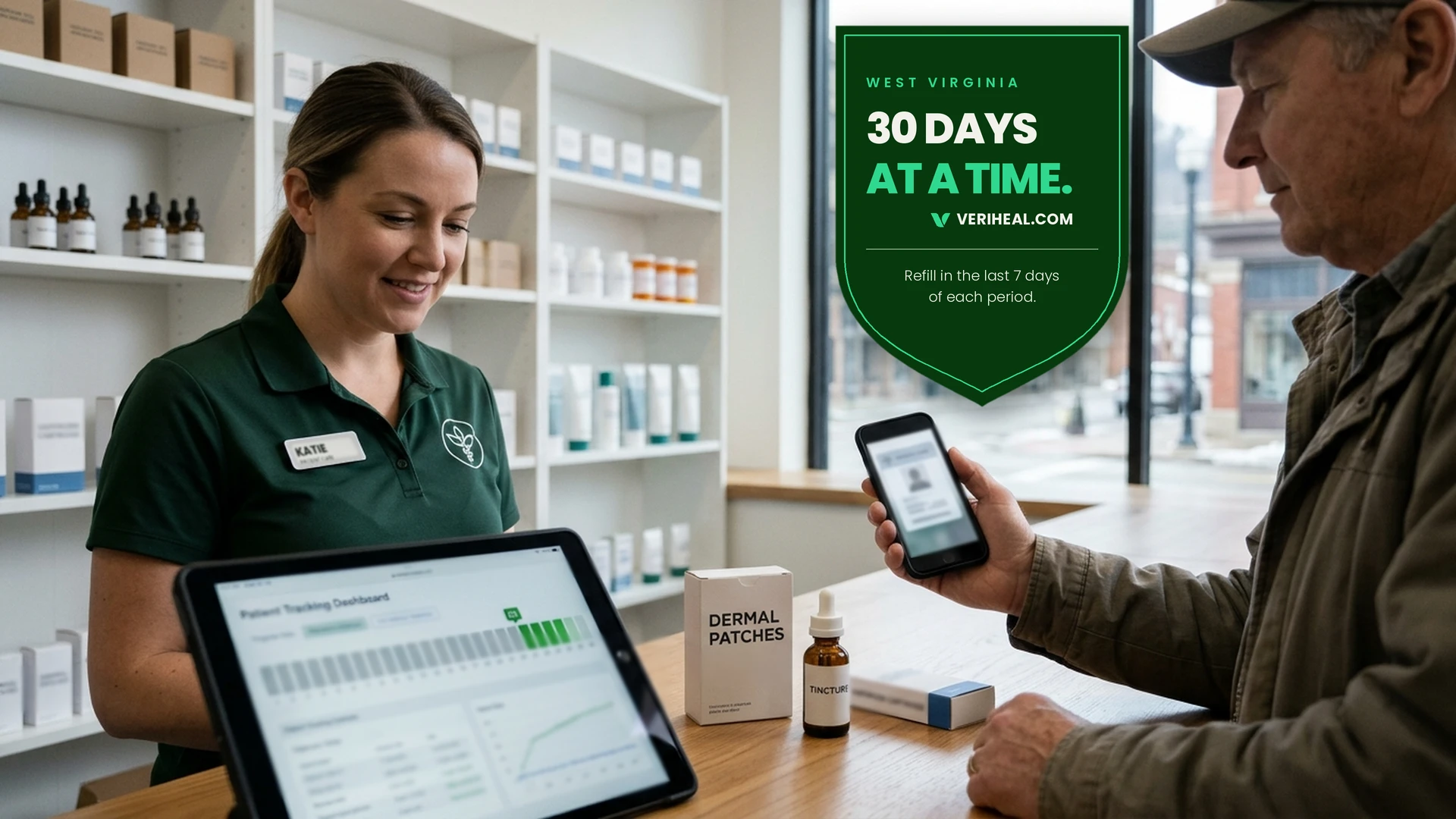
Smoking, including any form of combustion, is unlawful, and so is selling edibles. The key distinction is that dry leaf is approved for vaporization, not smoking. Patients may buy up to 6 ounces of flower or 60 grams of concentrate per rolling 30-day period unless a physician sets a different limit, and you can check your allotment in the OMC’s registration portal. Availability varies by dispensary, so look at menus before you visit.
Can You Use Your West Virginia Card in Other States?
Your West Virginia card works only inside West Virginia. The OMC prohibits patients and caregivers from traveling outside the state with medical cannabis or medical cannabis products, so plan trips accordingly. Other states set their own rules for visiting patients, which is worth checking before you go. To compare states, read Veriheal’s guide on which states allow out-of-state patients to buy medical marijuana.
What Workplace Protections Apply in Charleston?
If you work, you may wonder whether a card puts your job at risk. West Virginia law says an employer cannot discharge, refuse to hire, or otherwise discriminate against an employee solely because of their certified status, under section 16A-15-4. The protection has limits:
- Use at work: Employers don’t have to allow use on their premises.
- Impairment: Employers can discipline an employee who is under the influence at work.
- Federal law: Employers don’t have to violate federal law.
Veriheal covers related questions in its guide on telling your employer about your medical card.
Can a Medical Cannabis Card Affect Your Gun Rights in West Virginia?
Federal firearms rules shifted in 2026, and for medical cannabis patients who own guns, the changes pull in different directions. Marijuana’s federal status loosened for state-licensed medical use, the Supreme Court weighed in, and the ATF withdrew guidance dealers had relied on. None of that settles every case, so it helps to see what moved and what stayed put.
What Moved in 2026
On April 28, state-licensed medical marijuana moved from Schedule I to Schedule III under Federal Register rule 2026-08176. Marijuana outside a state medical license, and outside FDA-approved products, stays in Schedule I.
On June 18, United States v. Hemani came down. The Supreme Court unanimously held that prosecuting someone under 18 U.S.C. § 922(g)(3) based solely on marijuana use was inconsistent with the Second Amendment, and it called its decision narrow.
The Bureau of Alcohol, Tobacco, Firearms and Explosives (ATF) also rescinded its 2011 open letter, which had told dealers a medical card was grounds to refuse a sale.
What Stayed Put
Even with those changes, the core risk remains:
- The statute: Section 922(g)(3) remains federal law.
- The form: ATF Form 4473 is unchanged, so a false answer about drug use still carries real federal risk.
- The guidance: The ATF hasn’t issued replacement guidance, so dealer practices may vary.
A licensed attorney can explain how these rules apply to you before you apply. For more detail, read Veriheal’s guide on medical cannabis patients and gun rights.
How Can Veriheal Help You in Charleston?
Since the OMC is right here in Charleston, it’s easy to assume you need to deal with it in person, but your physician’s certification is what starts everything, and it can happen from home. Your physician decides whether certification fits your care, and Veriheal backs the visit with a “get approved or your money back” policy.
To begin, start your West Virginia evaluation with Veriheal, or find a medical marijuana doctor online if you’d like to compare options first.
Note: The content on this page is for informational purposes only and is not intended to be professional medical advice. Do not attempt to self-diagnose or prescribe treatment based on the information provided. Always consult a physician before making any decision on the treatment of a medical condition.
Note: Veriheal does not support illegally consuming therapeutic substances such as cannabis but acknowledges that it transpires because of the current illicit status, which we strive to change by advocating for research, legal access, and responsible consumption. Always consult a physician before attempting alternative therapies.
Frequently Asked Questions
How do I get a medical cannabis card in Charleston, WV?
Charleston residents get a card through the Office of Medical Cannabis. A registered West Virginia physician certifies your condition, then you apply online with your ID, photo, proof of residency, and the $50 fee. Your digital card is valid for one year.
What conditions qualify for medical cannabis in West Virginia?
West Virginia recognizes 15 serious medical conditions, including cancer, PTSD, epilepsy, and severe chronic or intractable pain. Anxiety and glaucoma aren’t on the list.
How much does a medical cannabis card cost in West Virginia?
The state charges a $50 application fee for initial and renewal applications, and physician evaluations cost extra. Veriheal’s evaluation is $149, with installments available. If your income is below 200% of the federal poverty level, you can request a waiver of the state fee.
How long does the OMC take to review an application?
The OMC reviews applications within about 30 days and emails you updates. If your application needs corrections, you can fix and resubmit it without starting over.
How long is a West Virginia medical cannabis card valid?
A West Virginia medical cannabis card is valid for one year. You can renew up to 60 days before it expires by seeing a registered physician and submitting a renewal application.
Is there a fee waiver in West Virginia?
West Virginia offers a hardship waiver of the $50 state fee for applicants with income below 200% of the federal poverty level. Provide proof of income, and don’t send payment while you request the waiver.
Can I use my West Virginia medical cannabis card in other states?
A West Virginia medical cannabis card works only inside West Virginia, and the OMC prohibits patients and caregivers from traveling outside the state with medical cannabis.
Author, Share & Comments