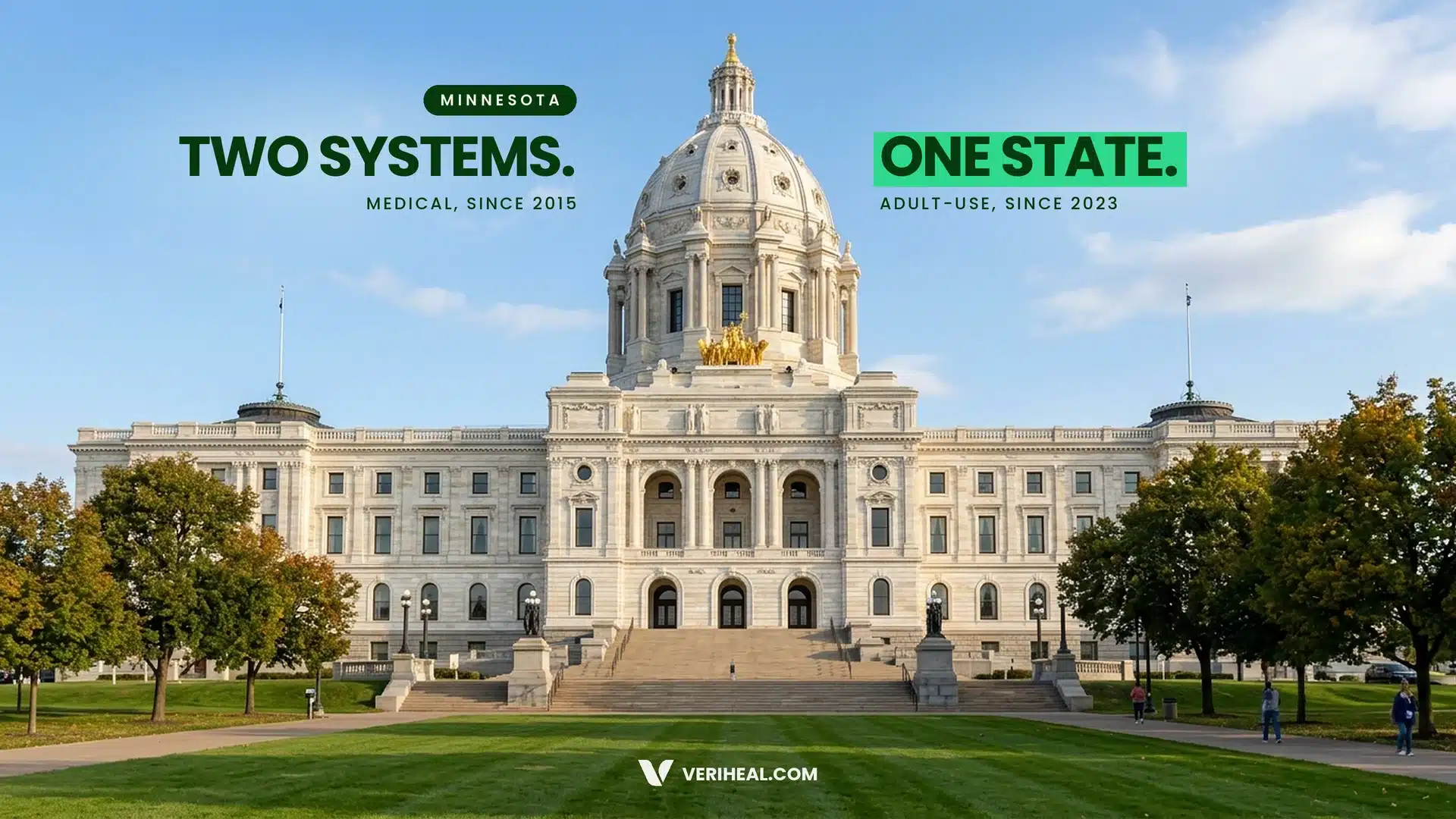
Medical marijuana is legal in Minnesota, and the state has gone further than most by also legalizing adult-use cannabis. Minnesota now operates two parallel systems: a long-running medical program for registered patients and a newer adult-use market for adults 21 and older.
Understanding both systems matters if you are deciding whether to pursue a medical card, want to know your rights as an adult consumer, or are trying to make sense of how a decade of legislative change has shaped where things stand today. This article covers the full arc, from the restrictive 2014 medical cannabis law through the 2023 recreational legalization and into what both systems look like in 2026.
Minnesota Cannabis at a Glance: Medical and Recreational Today
Yes, medical marijuana is legal in Minnesota. The state’s medical cannabis law passed in 2014, and patients began buying in 2015. The program is now run by the Office of Cannabis Management’s (OCM) Division of Medical Cannabis. Registered patients can buy medical cannabis from licensed retailers across the state.
Recreational cannabis is also legal. Governor Tim Walz signed H.F. 100 in May 2023, making Minnesota the 23rd state to legalize adult-use marijuana, and the law took effect August 1, 2023. Tribally owned dispensaries began selling first, and state-licensed retailers followed once OCM began licensing stores, so most Minnesotans 21 and older can now buy cannabis without a medical card.
Both systems coexist, and they are not identical. The medical program still offers registered patients advantages in cost, legal protections, and access for younger patients that adult-use consumers do not receive. The sections below explain how each system works and what the differences mean for you.
A Brief History of Cannabis Law in Minnesota
Minnesota’s path to full legalization was slow and cautious compared to early-adopting states. The history spans decades of incremental change, driven by patient advocates, shifting public opinion, and eventually a Democratic trifecta in state government.
Decriminalization Before the Medical Program
Minnesota decriminalized possession of small amounts of cannabis in 1976, making it a petty misdemeanor rather than a crime. That meant no jail time for minor possession, though fines still applied.
The 2014 Medical Cannabis Act: A Restrictive Start
Minnesota enacted its medical cannabis law on May 29, 2014. The program it created was widely considered one of the most restrictive in the country. Smokable flower was prohibited. Only two licensed manufacturers could produce cannabis products statewide, and patients could access cannabis only as oils, pills, and vaporizable liquids. The first patients began buying in July 2015.
The qualifying condition list at launch was narrow, covering conditions like cancer, glaucoma, HIV/AIDS, Tourette syndrome, amyotrophic lateral sclerosis (ALS), seizures, and severe muscle spasms. Patients had to register with the state and get certified by a registered healthcare practitioner. They could buy only from the two manufacturers’ dispensary locations. Early enrollees faced high costs, limited product options, and significant logistical barriers compared to patients in states with broader programs.
Condition Expansions and Program Changes (2015 to 2023)
After the launch, the qualifying condition list grew steadily. Most additions came through a petition process, in which patients and advocates asked the state health commissioner to consider new conditions. According to the Division of Medical Cannabis, conditions were added in this order:
- 2016: Intractable pain, which significantly broadened eligibility.
- 2017: Post-traumatic stress disorder (PTSD).
- 2018: Obstructive sleep apnea and autism spectrum disorder.
- 2019: Alzheimer’s disease.
- 2020: Chronic pain.
- 2021: Sickle cell disease and chronic motor or vocal tic disorder.
- 2023: Irritable bowel syndrome and obsessive-compulsive disorder.
Product access changed too. In 2021, the Legislature voted to allow smokable flower for registered patients 21 and older. Flower sales began in spring 2022. Dispensary access grew as well, from three locations at launch in 2015 to 15 by 2023.
H.F. 100 and the 2023 Recreational Legalization
The landscape changed fundamentally when Governor Tim Walz signed H.F. 100 on May 30, 2023. Former Governor Jesse Ventura was present at the signing, a moment widely noted as symbolic of Minnesota’s long journey toward legalization. The law did three main things:
- Legalized adult use: Adults 21 and older could possess and grow cannabis at home starting August 1, 2023.
- Set up a retail market: It created the framework for licensed adult-use sales.
- Created a new regulator: It established the Office of Cannabis Management to oversee both the medical and adult-use programs.
Possession and home grow rights took effect first. State-licensed retail took longer, because OCM had to build out licensing before stores could open.
Adult-Use Sales and OCM’s Role
Tribally owned dispensaries began adult-use sales soon after legalization took effect in 2023, and state-licensed retailers opened once OCM issued licenses. OCM now regulates both the medical patient registry and the adult-use market under one agency, which has streamlined some aspects of oversight while creating a more complex dual-track system for operators and patients.
| Milestone |
Year |
Key Detail |
| Decriminalization of minor possession |
1976 |
Petty misdemeanor, no jail time |
| Medical Cannabis Act enacted |
2014 |
Two manufacturers, no smokable flower, narrow conditions |
| First medical sales |
2015 |
Patients begin buying at medical dispensaries |
| Intractable pain added |
2016 |
Significantly expanded patient eligibility |
| PTSD added |
2017 |
Further broadened access |
| Chronic pain added |
2020 |
Opened the program to many more patients |
| Smokable flower allowed |
2022 |
Registered patients 21 and older can buy flower |
| H.F. 100 signed and in effect |
May and August 2023 |
Recreational legalization, OCM established |
| Adult-use retail |
2023 onward |
Tribal dispensaries first, then state-licensed retailers |
The Minnesota Medical Cannabis Program: How It Works Today
Even with recreational access available, the medical program continues to serve patients who need legal protections, cost savings, or access before 21 that adult-use retail does not provide. Here is how the program works for new patients in 2026.
Qualifying Conditions
To qualify as a medical cannabis patient in Minnesota, you need a certification from a practitioner for a qualifying medical condition. Under Minn. Stat. §342.01, subdivision 63, that includes any condition for which your practitioner recommends cannabis, along with these 19 listed conditions:
- Alzheimer’s disease
- Autism spectrum disorder
- Cancer, when it or its treatment causes severe or chronic pain, nausea or severe vomiting, or severe wasting
- Chronic motor or vocal tic disorder
- Chronic pain
- Glaucoma
- HIV/AIDS
- Intractable pain
- Obstructive sleep apnea
- Post-traumatic stress disorder (PTSD)
- Tourette syndrome
- Amyotrophic lateral sclerosis (ALS)
- Seizures, including those characteristic of epilepsy
- Severe and persistent muscle spasms, including those characteristic of multiple sclerosis
- Inflammatory bowel disease, including Crohn’s disease
- Irritable bowel syndrome
- Obsessive-compulsive disorder
- Sickle cell disease
- Terminal illness with a probable life expectancy of under one year, with severe pain, nausea or vomiting, or wasting
The Division of Medical Cannabis is the official source for current program details, so confirm with the office before applying.
How to Register as a Medical Patient
Registration involves two parties: you and a certifying practitioner. The process follows these steps:
- Confirm that your condition qualifies, either on the listed conditions or through your practitioner’s recommendation.
- See a Minnesota-licensed doctor of medicine, physician assistant, or advanced practice registered nurse who is registered to certify patients and who treats your condition.
- Your practitioner submits your certification through the registry.
- Complete your free enrollment application within 90 days of your certification date.
- Receive a decision within 30 days under Minn. Stat. §342.52, along with a patient registry number and registry verification that licensed medical retailers use to confirm your status. Enrollment is valid for three years.
Minnesota does not issue a physical card. Since timing depends on scheduling and processing, check how long it takes to get a medical marijuana card before you begin.
Approved Cannabis Products for Medical Patients
One of the most significant changes since the program launched in 2015 is that cannabis flower is now permitted for registered patients 21 and older. The original program prohibited smokable cannabis entirely, limiting patients to oils, pills, and vaporizable liquids. Today, patients 21 and older can buy flower, and all patients can access a broader range of products, including gummies and chews, tinctures, topicals, and vaporizable concentrates, from licensed medical retailers.
Medical Card vs. Adult-Use: What’s the Difference in 2026?
Recreational legalization does not make the medical card irrelevant. For many patients, medical status still provides measurable advantages. Here is how the two systems compare on the dimensions that matter most.
| Category |
Medical Patient |
Adult-Use Consumer |
| Cannabis tax |
Exempt from the 15% cannabis tax |
Pays the 15% cannabis tax, plus sales taxes |
| Purchase rules |
Governed by medical program rules |
Up to 2 oz in public under §342.09 |
| Legal protections |
Patient-status protections under Minn. Stat. §342.57 |
General protections for lawful off-duty use |
| Age requirement |
Available under 21, with minors enrolling through a caregiver |
21 and older only |
| State enrollment cost |
$0, valid for three years |
No enrollment needed |
The tax exemption is the most immediate financial benefit. According to the Minnesota Department of Revenue, adult-use purchases carry a 15% cannabis tax, and medical cannabis purchased by or for an enrolled patient is exempt from it. For patients who buy regularly, that adds up quickly. For a practical breakdown of how medical vs. recreational cannabis taxes compare, it is worth reviewing how the exemption applies to your purchases.
One nuance worth noting: tribally owned dispensaries operate under tribal authority, and their pricing and tax treatment can differ from state-licensed stores. If you buy mostly at a tribal location, the savings comparison may look different.
The benefits of a medical marijuana card extend beyond tax savings to include legal protections and access for patients under 21. Whether a card is worth getting also depends on your condition, how often you buy, and whether a background check concern applies to your situation. If privacy is a concern, review whether a medical cannabis card shows up on a background check before enrolling.
Possession Limits and What Minnesota Law Still Prohibits
Adult-use legalization changed what is permitted, but it did not remove every restriction. Knowing the limits keeps you on the right side of the law.
Under Minnesota Statutes §342.09, adults 21 and older may:
- Carry in public: Up to 2 ounces of cannabis flower.
- Keep at home: Up to 2 pounds of cannabis flower at their primary residence.
- Grow at home: Up to eight plants, with no more than four mature at one time.
Medical purchases follow the medical program’s own rules, so check with the Division of Medical Cannabis for current patient limits. Where you use cannabis matters too. Use is restricted in many public places and prohibited while driving, and property owners can ban it on their premises. The Division publishes guidance on where patients can use medical cannabis.
How Federal Law Still Applies
The federal picture is worth stating plainly. In April 2026, state-licensed medical marijuana moved from Schedule I to Schedule III under federal law, while recreational cannabis remains Schedule I.
Minnesota’s legalization still does not override federal law. That matters if you work for the federal government, live in federally subsidized housing, or travel across state lines. Taking cannabis across state lines remains a federal offense, regardless of either state’s laws.
Other Rules Worth Knowing
Minnesota’s courts have also addressed cannabis odor and vehicle searches. In State v. Torgerson, 995 N.W.2d 164 (Minn. 2023), decided September 13, 2023, the Minnesota Supreme Court held that the smell of cannabis alone is not enough to justify searching a vehicle.
Cannabis gummies are legal for adults 21 and older and for registered medical patients, subject to possession limits and OCM product rules. To see how Minnesota compares with other states, a medical marijuana card state-by-state overview gives useful context. You can also see how Minnesota’s inclusion of PTSD and OCD fits into the national picture with this breakdown of states that offer medical cannabis for mental health conditions.
Is a Minnesota Medical Card Right for You?
Adult-use legalization gives most Minnesotans 21 and older legal access, but the medical program still offers what recreational shopping cannot. As a registered patient, you are exempt from the 15% cannabis tax, you receive patient protections under state law, and you can enroll before age 21. Enrollment is free and lasts three years, so the only cost is your certification visit.
If you have a qualifying condition, or think you might, the next step is a conversation with a certifying practitioner. When you are ready, explore Minnesota’s medical program with Veriheal and book your evaluation. Every Veriheal evaluation comes with a “get approved or your money back” policy.
Note: The content on this page is for informational purposes only and is not intended to be professional medical advice. Do not attempt to self-diagnose or prescribe treatment based on the information provided. Always consult a physician before making any decision on the treatment of a medical condition.
Note: Veriheal does not support illegally consuming therapeutic substances such as cannabis but acknowledges that it transpires because of the current illicit status, which we strive to change by advocating for research, legal access, and responsible consumption. Always consult a physician before attempting alternative therapies.
Frequently Asked Questions
What qualifies for medical marijuana in MN?
Minnesota lists 19 qualifying conditions, including cancer, chronic pain, PTSD, intractable pain, seizures, ALS, glaucoma, HIV/AIDS, obsessive-compulsive disorder, and autism spectrum disorder. The law also covers any condition for which your practitioner recommends cannabis.
What are the current marijuana laws in Minnesota, and will they change in 2026?
Recreational cannabis has been legal for adults 21 and older since August 1, 2023, under H.F. 100, and registered medical patients enroll through a separate registry with additional protections and a tax exemption. The Legislature amended Minnesota’s cannabis law again in 2026, so check with OCM for the latest rules.
Are marijuana gummies legal in Minnesota?
Yes. Both adult-use consumers 21 and older and registered medical patients can legally buy them, though possession limits and OCM product rules apply either way.
How much does a med card cost in MN?
Minnesota charges no state enrollment fee, and enrollment lasts three years. The only cost is your practitioner’s certification visit, which varies by provider.
Author, Share & Comments