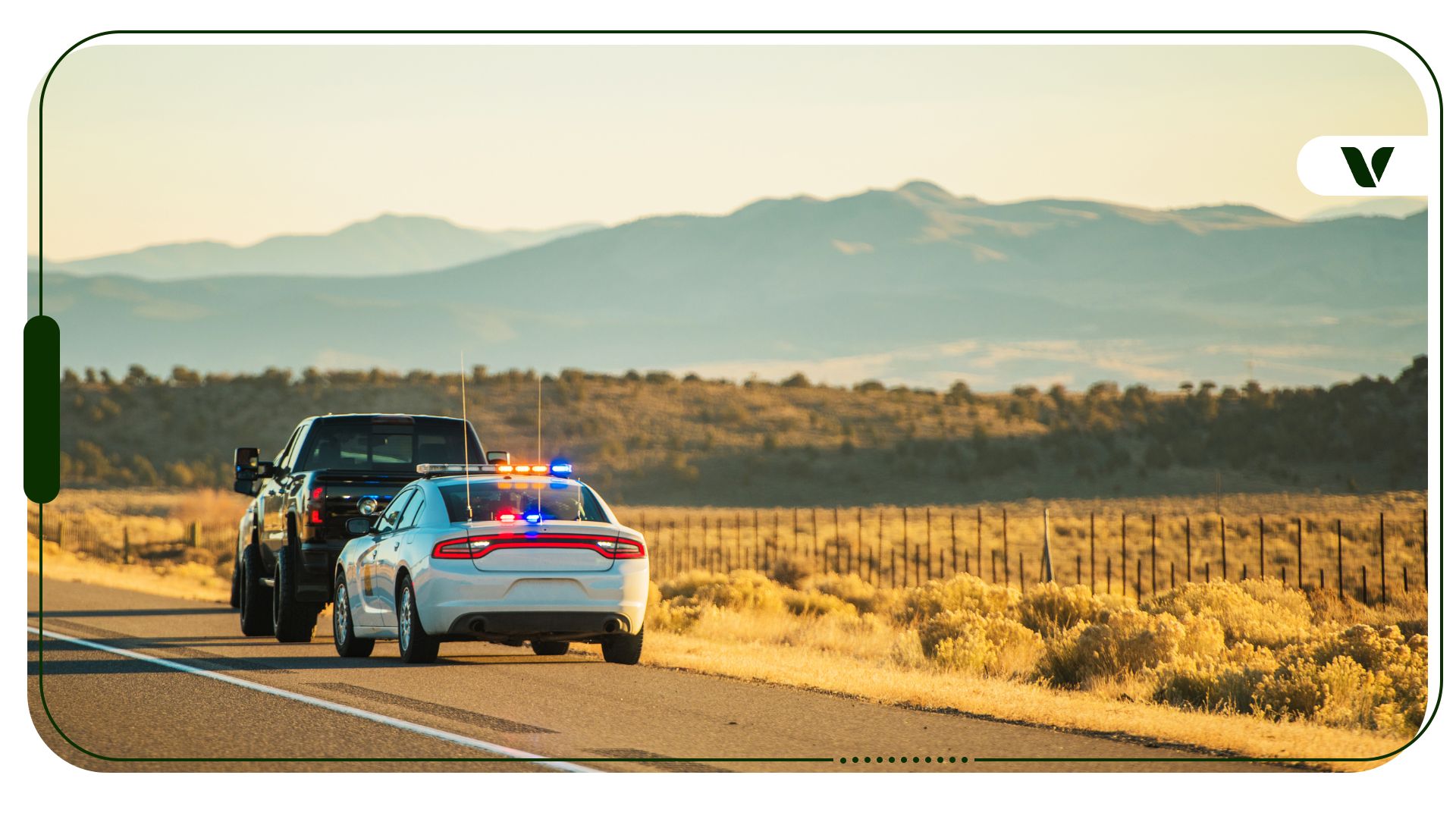
Police can search your vehicle without a warrant under specific circumstances, but the Fourth Amendment protects you from unreasonable searches. Understanding these exceptions and your rights during traffic stops helps you navigate encounters with law enforcement while protecting evidence that could be used against you.
The legal landscape around vehicle searches has become more complex as cannabis laws vary by state and courts reconsider what constitutes probable cause. This guide covers when searches are legal, your constitutional protections, and what to do if your rights are violated.
Your Fourth Amendment Rights During Traffic Stops
The Fourth Amendment protects you from unreasonable searches and seizures, establishing a constitutional barrier between you and law enforcement. During a traffic stop, this protection means police cannot search your vehicle simply because they pulled you over – they need either your consent, a warrant, or a recognized legal exception.
A legal traffic stop occurs when an officer has reasonable suspicion that you violated a traffic law or committed a crime. During this stop, you are detained but not under arrest, which limits what police can do. The officer can ask for your license, registration, and insurance, but cannot automatically search your vehicle or belongings.
Your basic rights during any traffic stop include:
- Right to remain silent – You must provide identification but do not have to answer questions about where you are going or what you have been doing
- Right to refuse consent searches – You can clearly state “I do not consent to a search” if asked
- Right to ask if you are free to leave – If the traffic violation is resolved, you have the right to go
- Right to record the interaction – You can film or audio record police encounters in public spaces
Understanding these protections helps you recognize when a search crosses constitutional boundaries and becomes an unlawful search and seizure.
When Police Can Search Without a Warrant
While the Fourth Amendment requires a search warrant for most searches, vehicle searches operate under established exceptions that allow police to search your vehicle without obtaining a warrant first. These exceptions exist because vehicles are mobile and evidence could be destroyed or moved before a warrant arrives.
The five main warrant exceptions that apply to vehicle searches are:
- Automobile Exception – Police can search your vehicle if they have probable cause to believe it contains evidence of a crime. This exception requires specific, articulable facts that would lead a reasonable person to believe criminal evidence is present.
- Plain View Doctrine – Officers can seize evidence they observe in plain sight during a lawful traffic stop. If contraband or illegal items are visible through your windows, police can search based on what they directly observe.
- Search Incident to Arrest – Once you are under arrest, police can search your vehicle’s passenger compartment for weapons or evidence related to the arrest. This search must occur contemporaneously with the arrest.
- Consent Searches – If you voluntarily agree to let police search your vehicle, no warrant is required. However, you have the absolute right to refuse consent, and refusal cannot be used as evidence against you.
- Exigent Circumstances – Emergency situations where evidence might be destroyed, officer safety is threatened, or a suspect might escape allow warrantless searches. The circumstances must be immediate and compelling.
Each exception has specific requirements that law enforcement must meet. An officer may search your vehicle if any of these conditions are satisfied, but the search must stay within the bounds of the exception that justifies it.
Can Police Search a Parked Car?
Police face different legal standards when searching parked vehicles compared to vehicles stopped for traffic violations. The location where your vehicle is parked significantly affects what search authority law enforcement has and whether they need a warrant.
When your vehicle is parked on public property – streets, parking lots, or public garages – police generally have the same search authority as during traffic stops. The automobile exception still applies if officers have probable cause to believe your vehicle contains evidence of a crime. However, they cannot search based solely on the vehicle being parked in a public area.
Private property creates stronger Fourth Amendment protections. When your vehicle is parked in your driveway, garage, or other areas within the curtilage of your home, police typically need a warrant to search it. Curtilage refers to the area immediately surrounding your home where you have a reasonable expectation of privacy.
Location-based factors that affect search authority include:
- Distance from your residence – Vehicles parked closer to your home receive stronger protection
- Enclosed areas – Garages and carports generally require warrants for vehicle searches
- Gated or fenced areas – Physical barriers that indicate private space strengthen privacy expectations
- Overnight parking – Extended parking in residential areas may indicate established privacy rights
The key difference is that parked vehicles often involve more time for officers to obtain a warrant, reducing the exigent circumstances that justify many warrantless vehicle searches. If police have time to get judicial approval, they generally must seek it rather than relying on warrant exceptions.
Cannabis Odor as Probable Cause by State
Courts across different states have reached varying conclusions about whether the smell of cannabis alone provides sufficient probable cause to search a vehicle. These differences reflect changing attitudes toward cannabis legalization and evolving legal interpretations of what constitutes evidence of criminal activity.
| State |
Legal Standard |
Key Case/Statute |
Current Status |
| California |
Odor alone insufficient |
*People v. Strasburg* (2007) |
Smell cannot justify search since legalization |
| Colorado |
Odor alone insufficient |
*People v. McKnight* (2019) |
Must be combined with other evidence |
| Illinois |
Varies by circumstance |
*People v. Redmond* (2020) |
Recent cases limit odor-based searches |
| Pennsylvania |
Odor provides probable cause |
*Commonwealth v. Barr* (2021) |
Smell alone can justify vehicle search |
| Minnesota |
Odor alone insufficient |
*State v. Trant* (2021) |
Requires additional suspicious circumstances |
| Kansas |
Odor provides probable cause |
*State v. Alcoholic* (2019) |
Maintains traditional probable cause standard |
| Texas |
Odor provides probable cause |
*Steele v. State* (2020) |
Smell alone sufficient for search |
| Florida |
Mixed precedent |
*State v. Discipline* (2021) |
Case-by-case analysis required |
| New York |
Odor alone insufficient |
MRTA Implementation (2021) |
Legalization eliminated odor as probable cause |
| Michigan |
Odor alone insufficient |
*People v. Kazmierczak* (2022) |
Must have additional indicators |
The general trend shows that states with legal cannabis programs are moving away from treating odor alone as sufficient probable cause. Courts increasingly require officers to point to additional factors – such as visible contraband, admissions of illegal activity, or evidence of impairment – beyond just the smell of cannabis.
However, several factors complicate this analysis. The smell of burnt cannabis may still indicate recent consumption and potential impairment, which provides different legal grounds than raw cannabis odor. Additionally, having a medical marijuana card may affect how courts evaluate the significance of cannabis odor during vehicle searches.
Officers often combine odor claims with other observations to build probable cause. Even in states where smell alone is insufficient, police may still search if they can articulate additional suspicious factors that, taken together, create reasonable belief that criminal activity is occurring.
What to Do If You Believe Your Rights Were Violated
If you believe police conducted an unlawful search of your vehicle, documenting the incident and understanding your legal options becomes essential for protecting your rights and potentially excluding illegally obtained evidence from court proceedings.
Take these immediate steps if you suspect a rights violation:
- Document everything you remember – Write down the exact time, location, officer badge numbers or patrol car numbers, what was said, and what actions were taken during the search.
- Gather witness information – Collect contact information from anyone who observed the traffic stop or search, as witness testimony can corroborate your account.
- Request the police report – Most jurisdictions allow you to obtain copies of incident reports, which may contain the officer’s justification for the search.
- Preserve evidence of the stop – Save any receipts, GPS data, or cell phone records that establish your location and activities before the stop occurred.
- Contact a criminal defense attorney immediately – Legal counsel can evaluate whether the search violated your Fourth Amendment rights and file appropriate motions.
Your attorney may file a motion to suppress evidence obtained through constitutional violations if the search was illegal. Under the exclusionary rule, evidence obtained through constitutional violations cannot be used against you in court. This includes not only items found in your vehicle but also any evidence discovered as a result of the illegal search.
The success of a suppression motion depends on proving that officers lacked probable cause, exceeded the scope of a valid search, or violated proper procedures. Courts examine the totality of circumstances, so detailed documentation of exactly what happened becomes crucial for your criminal defense attorney to build an effective challenge.
Remember that gun ownership and medical cannabis creates additional legal complexities during vehicle searches, particularly if both substances are discovered during the same encounter.
Know Your Rights During Police Encounters
Understanding your rights during police encounters empowers you to navigate traffic stops confidently while avoiding actions that could escalate the situation or provide law enforcement with additional grounds for a search.
During any police encounter involving your vehicle, remember that you have the right to remain calm and polite while firmly exercising your constitutional protections. Clearly state “I do not consent to a search” if officers ask permission to search your vehicle. This refusal cannot be used as evidence against you and preserves your ability to challenge any subsequent search in court.
If police proceed with a search despite your refusal, do not physically resist or interfere. Your remedy lies in the courts, not in the moment of the encounter. Continue to clearly state that you do not consent, but comply with officer commands to ensure your safety.
Keep in mind that traffic stops can quickly evolve based on what officers observe or discover. Remaining aware of your rights helps you make informed decisions if the encounter expands beyond the original reason for the stop.
Ready to understand your legal protections when it comes to cannabis? Speak with a medical cannabis expert about your rights and responsibilities as a patient.
Note: The content on this page is for informational purposes only and is not intended to be professional medical advice. Do not attempt to self-diagnose or prescribe treatment based on the information provided. Always consult a physician before making any decision on the treatment of a medical condition.
Note: Veriheal does not support illegally consuming therapeutic substances such as cannabis but acknowledges that it transpires because of the current illicit status, which we strive to change by advocating for research, legal access, and responsible consumption. Always consult a physician before attempting alternative therapies.
Legal Disclaimer: This content is for educational purposes only and does not constitute legal advice. Laws vary significantly by jurisdiction and change frequently. Consult with a qualified attorney for advice about your specific situation.
Frequently Asked Questions
Can police search my car if they smell cannabis?
Police authority to search based on cannabis odor varies significantly by state. In states with legal cannabis programs like California, Colorado, and New York, courts have ruled that smell alone typically cannot justify a vehicle search. However, in states where cannabis remains fully illegal, odor may still provide sufficient probable cause for officers to search your vehicle without a warrant.
Do I have to let police search my car if they ask?
No, you have the absolute right to refuse consent to a vehicle search. Clearly state “I do not consent to a search” if officers request permission. Your refusal cannot be used as evidence against you in court, and exercising this right preserves your ability to challenge any subsequent search legally.
Can police search my car without telling me why?
Police must have legal justification to search your vehicle, but they are not required to explain their reasoning to you during the encounter. If officers conduct a search, they must be able to articulate their legal basis in court later, whether that is probable cause, consent, or another warrant exception.
What happens if police find something illegal during an unlawful search?
Evidence obtained through an illegal search may be excluded from court proceedings under the exclusionary rule. If your attorney successfully proves that police violated your Fourth Amendment rights, any evidence found during the unlawful search cannot be used against you, potentially leading to dismissed charges.
Can police search my car during any traffic stop?
Police cannot automatically search your vehicle during every traffic stop. They need either your consent, a warrant, or a legal exception such as probable cause, plain view of contraband, or a search incident to arrest. A routine traffic violation alone does not give officers authority to search your vehicle.
Author, Share & Comments