Your medical cannabis journey simplified: find partnered dispensaries, explore pricing options, earn rewards, and get answers to FAQs, all in one spot.
October 25, 2022 08:00 am ETEstimated Read Time: 5 Minutes
Hempcrete was recently approved for residential construction in the United States of America. The benefits of using hempcrete include being a sustainable crop with a high yield and a carbon-sequestering source of insulation. It was approved for the residential construction of buildings in 49 states by 2024.
Hempcrete Approved for Residential Construction
The decision to approve hempcrete for residential construction was overseen by the International Code Council (ICC) — which is “the leading global source of model codes and standards and building safety solutions that include product evaluation, accreditation, technology, training, and certification.”
According to Hempbuild Magazine, the approval of hempcrete buildings will be added as an appendix to the 2024 International Residential Code (IRC), which governs 49/50 American state residential building codes. The magazine explains that the outlying state is Wisconsin and that the Hempcrete appendix will be under the title “Appendix BA.”
Residential construction is a broad term. It should be known that the hempcrete appendix will only apply to one or two-family dwellings and townhouses. This zero-carbon building material can evolve the construction industry by offsetting carbon footprints left behind by construction. This is more vital than ever, considering the state of global warming.
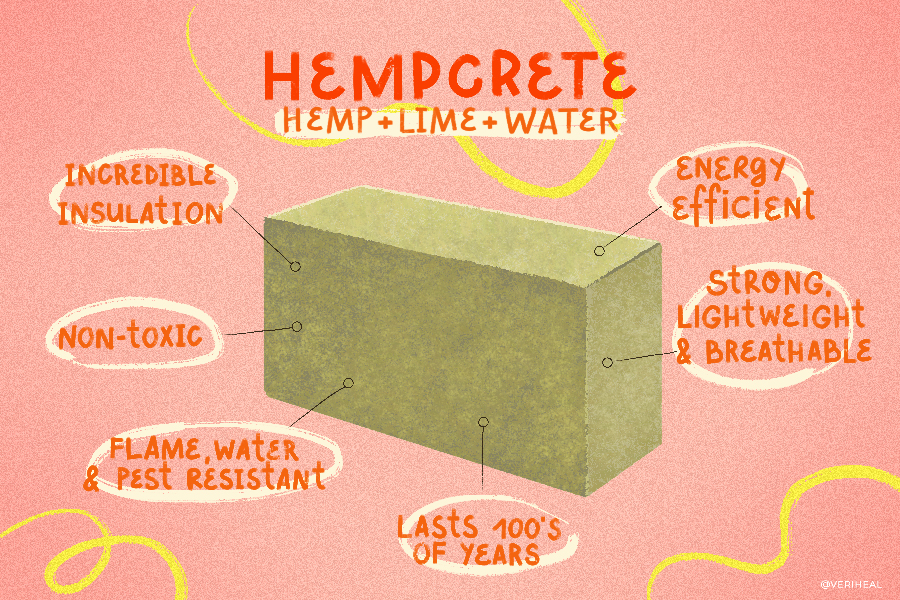
Hempcrete is Fire Resistant and Can Be Used As a “Non-Structural Wall Infill System”
The ICC explains that hempcrete can only be used as “a non-structural wall infill system…” and that the approval “will make it easier for building departments to review plans for permitting [it],” which “provides prescriptive guidance for a sustainable option for wall infill.” The appendix also includes some conditions regarding whether engineered designs are necessary for using hempcrete; regions of high seismic risk will require an engineered design to use hempcrete.
Adding to the many benefits of using hempcrete, the Hempbuild Magazine explains that European tests found hempcrete to be significantly fire-resistant. However, they note it needs further testing to “assign it a fire-resistance rating in the IRC [the governing building codes, specifically under testing standards ASTM E 119 or UL 263.” They explain that Hempitecture, Inc. tested hempcrete under standard ASTM E 84 and found that it “recorded the lowest (best) possible values.”
See If You Qualify For Medical Marijuana -Select Your State!
Select Your State
Alabama
Alaska
Arizona
Arkansas
California
Colorado
Connecticut
Delaware
Florida
Georgia
Hawaii
Idaho
Illinois
Indiana
Iowa
Kansas
Kentucky
Louisiana
Maine
Maryland
Massachusetts
Michigan
Minnesota
Mississippi
Missouri
Montana
Nebraska
Nevada
New Hampshire
New Jersey
New Mexico
New York
North Carolina
North Dakota
Ohio
Oklahoma
Oregon
Pennsylvania
Rhode Island
South Carolina
South Dakota
Tennessee
Texas
Utah
Vermont
Virginia
Washington
West Virginia
Wisconsin
Wyoming
Never miss a post
Get updates on cannabis culture, new research, and expert insights
Hempcrete was only just approved in America for the 2024 IRC, mainly due to the previously illegal status of industrial hemp. However, hempcrete has been used in Europe for around 30 years, with some reporting on the “explosive” demand for hempcrete and even hurd (the wooden core of stalks removed while processing hemp). The land dedicated to the cultivation of hemp increased from 2015 to 2019 by 75%.
Support for Hempcrete in America
Henry Gage, the president of the U.S. Hemp Building Association, expressed his excitement over the approval of hempcrete by stating that “hemp-lime (hempcrete) construction has moved to the mainstream, creating a new era of investment, research, architecture, and construction.” Supporters of hempcrete shared their thoughts on the impact of including hempcrete by stating that it will cut the red tape and streamline hempcrete projects, which benefits construction businesses, homeowners, and the environment.
Martin Hammar, the co-author architect on the submission of the hempcrete appendix, explained that the appendices in the IRC are voluntary unless a state or local jurisdiction has decided to adopt them. This means that hempcrete will be an option for 49 states but that the states or local jurisdiction still needs to choose to adopt Appendix BA. Additionally, if a state decides they want to adopt Appendix BA, the local building departments may be required to approve hempcrete as an “alternative material and method.”
Structural engineer, Anthony Dente of Berkeley, explains that “code induction of a natural building material of any type is huge news,” mainly because “there are not many of these types of codes globally compared to other conventional materials.” Dente adds, “The IRC hemp-lime Appendix is an excellent foundational document with a lot of really exciting areas of potential growth in the future.”
HempBlockUSA, a supplier of hempcrete walling systems, describes these hemp-lime blocks as revolutionary because it is the only carbon-negative option in America. Using hempcrete in residential construction means that individuals looking to build their homes now have the opportunity to use more environmentally friendly material, which then “guarantees a perfect environmental balance.”
Sustainable Construction: Hemp/Kenaf Blend
While hempcrete is a mix of hemp, lime, and water, some companies, such as Hemp, Inc., use Kenaf to blend with cannabis — intended to create a base for hempcrete blocks.
GlobeNewswire explains that Kenaf looks like hemp but is a hibiscus genus and makes a good option for a hemp blend base for hempcrete because Kenaf contains similar properties to hemp. Hemp and construction organizations are not only prepared for hempcrete but are also getting innovative with the construction and variations of the hempcrete blocks.
The approval of hempcrete for residential buildings is a significant win for the environment, constructors, and architects. However, the cost may stand in the way of being preferred to the more conventional building materials.
Realtor.com explains that hempcrete may add a “minimum of $60” to the square foot cost. They compare a traditional build costing $120 per square foot to the potential $180 per square foot just for the use of hempcrete. Once again, hemp provides a more environmentally friendly option, as it does for plastic, but the cost may be a significant barrier to overcome.
Chane Leigh, aka The Bud Fairy, is a South African cannabis advocate and enthusiast with a firey personality and a thirst for travel. She loves to educate people and to question the norms.
Oklahoma’s medical-only dispensary market gives licensed patients access to a wide range of cannabis products, but every purchase must follow OMMA rules. This guide explains how to find licensed dispensaries, what identification to bring, purchase and possession limits, product testing, pricing, and what to expect during a visit.
Oklahoma’s advertised $25 medical marijuana card renewal covers the physician evaluation, but patients must also pay a separate OMMA license fee. This guide explains the full renewal cost, reduced-fee eligibility, required documents, online renewal steps, processing times, and the new physician recommendation requirement.
An Oklahoma medical marijuana card provides legal protection under state law, but it can still affect employment, commercial driving, firearms, privacy, and federally regulated situations. This guide explains the main consequences to consider before applying, including workplace drug testing, CDL rules, insurance, housing, and registry privacy.
Getting a medical marijuana card in Oklahoma can be completed online, with no specific qualifying condition required for adult applicants. This guide covers eligibility, telehealth evaluations, required documents, OMMA application steps, fees, processing times, and what patients can do once approved.
A same-day telehealth appointment in Oklahoma can get you a physician recommendation quickly, but OMMA still needs to process your medical marijuana license application. This guide explains the timeline, required documents, costs, and when you can legally visit a dispensary while waiting for the physical card.
The statements made regarding cannabis products on this website have not been evaluated by the Food and Drug Administration (FDA). Cannabis is not an FDA-approved substance and is still illegal under federal law. The information provided on this website is intended for educational purposes only and is not intended to diagnose, treat, cure, or prevent any disease. It is not intended as medical advice and should not be considered as a substitute for advice from a healthcare professional. We strongly recommend that you consult with a physician or other qualified healthcare provider before using any cannabis products. The use of any information provided on this website is solely at your own risk.