1-855-452-6224 (Customer Support Available 24/7)


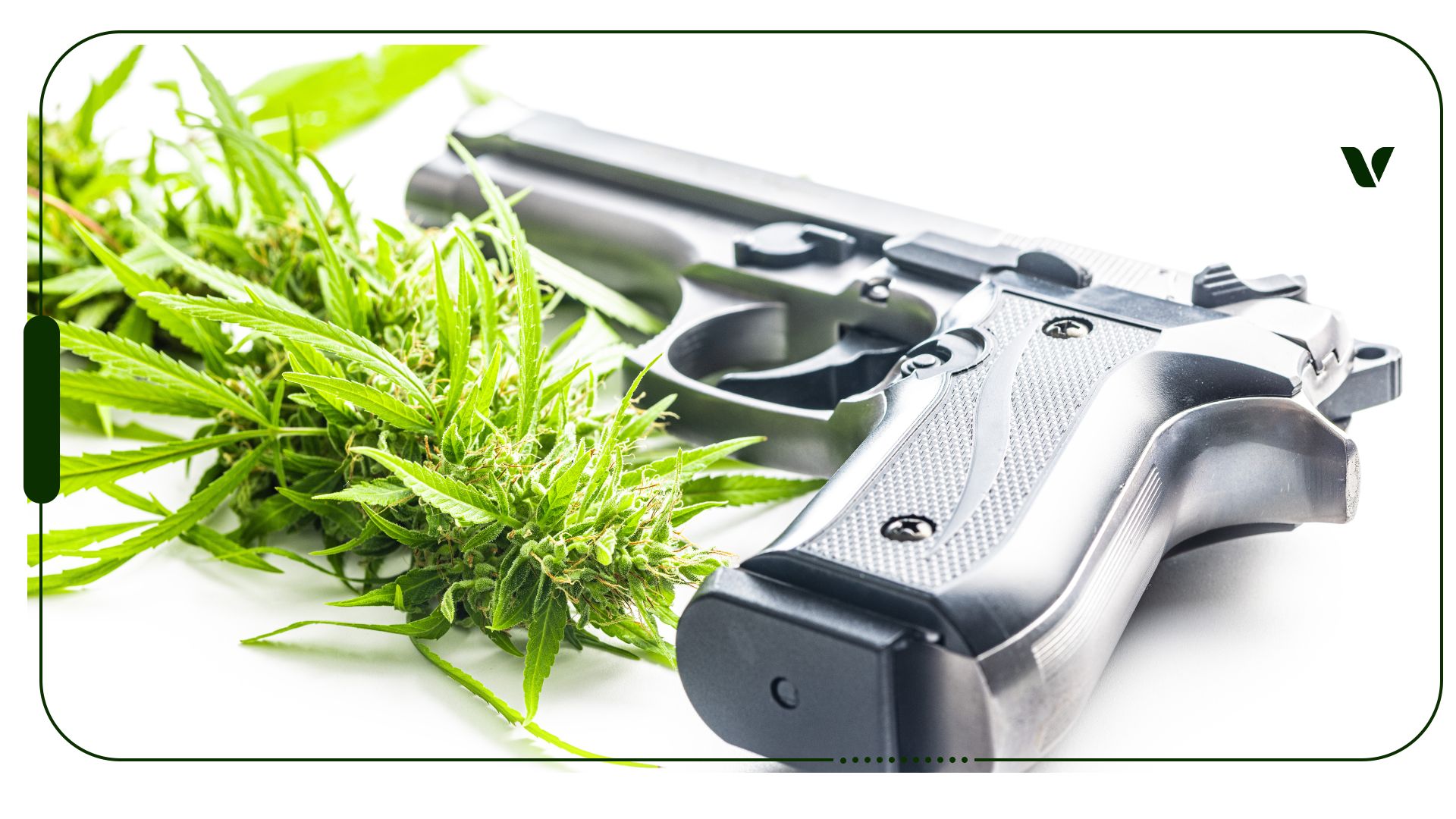
Federal law says no. Regardless of whether your state has legalized medical marijuana, holding a medical marijuana card and possessing a firearm at the same time puts you at risk of federal criminal charges. That conflict sits at the center of one of the most urgent legal questions facing cannabis patients today.
The prohibition comes from 18 U.S.C. § 922(g)(3) and federal firearm restrictions, which makes it a federal crime for any “unlawful user of or addicted to any controlled substance” to possess firearms. Because federal law still classifies marijuana as a Schedule I controlled substance under the Controlled Substances Act, that prohibition applies to medical marijuana users even in states where cannabis is fully legal.
Holding a MMJ card and gun rights does not create an exception. Federal law prohibits possession of any firearm, not just the purchase of one, which means the risk extends to guns you already own.
When you attempt to purchase a firearm from a licensed dealer, you must complete ATF Form 4473. Question 21e asks whether you are an unlawful user of, or addicted to, marijuana or any other controlled substance. The Bureau of Alcohol, Tobacco, Firearms and Explosives issued an open letter in September 2011 directing all federal firearms licensees to deny transfers to medical marijuana cardholders, because a registry card is reasonable cause to believe the applicant uses marijuana. Answering “no” to Question 21e while holding a medical card and actively using marijuana is a federal felony under 18 U.S.C. § 1001, which prohibits false statements to a federal agency.
The phrase “unlawful user of a controlled substance” is not limited to the moment of purchase. Federal prosecutors can rely on a medical marijuana card as evidence of current, ongoing use, which means possessing firearms you already own while actively using medical marijuana carries the same federal exposure as attempting to purchase a firearm.
The Ninth Circuit’s ruling in Wilson v. Lynch, 835 F.3d 1083 (2016), is the only federal appellate decision directly on this question. It upheld the denial of a firearm sale to a medical marijuana registry cardholder, holding that doing so does not violate second amendment rights. That precedent binds only the nine states within the Ninth Circuit’s jurisdiction, so readers in other states cannot rely on it as settled law in their region.
Several states have passed legislation intended to protect medical marijuana patients from losing their gun rights at the state level. Understanding what those protections actually cover, and what they do not, matters before you make any decisions about your card or your firearms.
| State | State-Level Protection | Changes Federal Exposure? | Practical Implication for Cardholders |
| Colorado | SB19-093 prohibits state authorities from denying firearms rights based solely on cannabis use | No | State cannot deny your state permit, but federal possession risk under § 922(g)(3) remains |
| Oklahoma | State law prohibits denial of firearms rights based on medical marijuana status | No | Same as Colorado: state protection does not override federal law |
| Florida | No state-level firearm protection for MMJ cardholders | No | Full federal and state exposure; no partial shield available |
| Pennsylvania | No state-level firearm protection for MMJ cardholders | No | State police have issued guidance that cardholders cannot purchase firearms under federal law |
| Louisiana | No state-level firearm protection for MMJ cardholders | No | Federal prohibition applies without any state-law offset |
The Supremacy Clause of the U.S. Constitution means that federal law governs regardless of what any state statute says. A cardholder in Colorado who is shielded from state-level denial still commits a federal offense under § 922(g)(3) by possessing a firearm while actively using marijuana.
Always verify current regulations in your state, because state-by-state medical marijuana card laws continue to evolve and individual circumstances vary.
Hemp-derived cannabidiol (CBD) containing less than 0.3% tetrahydrocannabinol (THC) is federally legal under the 2018 Farm Bill and is not classified as a Schedule I controlled substance. Purchasing and possessing hemp-derived CBD does not, by itself, disqualify you from owning a gun under § 922(g)(3).
Two caveats apply.
First, marijuana-derived CBD remains a Schedule I substance federally, so a medical marijuana card that covers CBD products triggers the same disqualification as any other cannabis use.
Second, Form 4473 asks about marijuana use specifically, not CBD, but a cardholder who uses marijuana-derived products cannot truthfully answer “no” to Question 21e.
The distinction between hemp-derived and marijuana-derived CBD matters legally, but it does not eliminate the risk if you hold an active medical card. Consult a licensed attorney before drawing conclusions about your specific situation.
In most states, medical marijuana registries are confidential and are not directly accessible through the National Instant Criminal Background Check System (NICS). That confidentiality, however, does not eliminate your legal exposure at the point of purchase.
The medical marijuana card background check question is separate from the Form 4473 self-disclosure question. If you hold an active medical card and actively use marijuana, you cannot truthfully answer “no” to Question 21e, regardless of whether your registry data appears in a background check. A false answer is a federal felony under 18 U.S.C. § 1001. In states with universal background check requirements, this exposure applies to private firearm transfers as well as dealer sales.
Efforts toward protecting your privacy as a cannabis patient matter, but privacy protections at the state registry level do not change your obligations under federal law.
If you use medical marijuana and want to possess firearms legally, you currently face a genuine conflict under federal law with no clean resolution. Understanding your realistic options is the first step.
Some cardholders choose not to possess firearms while their card is active, then allow the card to expire before purchasing a firearm. The FAQ below addresses that scenario in more detail. Others consult a firearms attorney in their jurisdiction to assess their specific exposure before making any decisions about their card, their medications, or their gun ownership. You should also consider whether you tell your employer about your medical card, since employment consequences and legal exposure can intersect in ways that affect how you manage your cannabis status overall.
Advocacy is also a real pathway. Organizations focused on cannabis law reform and Second Amendment rights have pushed for legislative changes at both the state and federal levels. Supporting that work is one way to address the underlying policy conflict rather than simply navigate around it.
The federal prohibition on medical marijuana users owning guns flows directly from marijuana’s Schedule I status under the Controlled Substances Act. Any meaningful change to gun ownership rights for cannabis patients depends on federal rescheduling or Congressional action, neither of which has yet occurred.
The Drug Enforcement Administration has initiated a rescheduling review that could move marijuana to Schedule III. A Schedule III classification would not automatically eliminate the § 922(g)(3) prohibition, because that statute covers any controlled substance, but it could alter the legal landscape in ways that courts and regulators would need to address. State legislative trends, including measures like research on cannabis rescheduling and federal drug policy, reflect growing pressure on Congress to reconcile the federal-state conflict. Until federal law changes, the prohibition remains in force for every medical marijuana user in every state.
If you are navigating the conflict between your cannabis use and your gun rights, speaking with a qualified physician about your medical marijuana options is a useful first step. Should you tell your employer about your medical card is one related question worth exploring as you assess how your card affects your broader legal and professional life. Find a licensed cannabis physician through Veriheal and get information specific to your state.
Note: The content on this page is for informational purposes only and is not intended to be professional medical advice. Do not attempt to self-diagnose or prescribe treatment based on the information provided. Always consult a physician before making any decision on the treatment of a medical condition.
Note: Veriheal does not support illegally consuming therapeutic substances such as cannabis but acknowledges that it transpires because of the current illicit status, which we strive to change by advocating for research, legal access, and responsible consumption. Always consult a physician before attempting alternative therapies.
Note: This article is for informational purposes only and does not constitute legal advice. Readers should consult a licensed attorney in their jurisdiction for guidance specific to their situation.
Under federal law, holding an active medical marijuana card and possessing a firearm at the same time is prohibited for an unlawful user of a controlled substance under 18 U.S.C. § 922(g)(3). Because marijuana remains federally illegal regardless of state law, your medical card does not create a legal exception. This applies to firearms you already own, not just to new purchases.
Federal law prohibits medical marijuana users from possessing firearms, which effectively suspends your ability to legally own or purchase a firearm while your card is active and you are using marijuana. No state-level protection fully overrides that federal prohibition due to the Supremacy Clause.
Once your medical marijuana card has expired and you have stopped using marijuana, you are no longer an active unlawful user of a controlled substance under federal law, which means the § 922(g)(3) prohibition no longer applies to you. The key is that both conditions must be true: the card must be expired and use must have ceased. There is no defined federal waiting period, but a gap in documented use strengthens your legal position.
Your wife holding a medical marijuana card does not affect your own firearm rights under federal law. The § 922(g)(3) prohibition applies to the individual who is an unlawful marijuana user, not to members of their household. You may legally own and possess firearms as long as you yourself are not an unlawful user of a controlled substance.
Concealed carry permits are governed by state law, but the underlying federal prohibition still applies. Some states have denied concealed carry permits to medical marijuana cardholders, while others have not built in an automatic disqualification at the state level. Carrying a concealed firearm while actively using marijuana, however, carries federal risk regardless of whether your state issued the permit.
Sign up for our newsletter

Learn the process in your state
All Rights Reserved Veriheal Inc. ©
Terms Privacy Policy Advertising Agreement Content Disclamer


Get your medical marijuana card today
Sign up in under 5 minutes
Start By Selecting Your State
 Alabama
Alaska
Arizona
Arkansas
California
Colorado
Connecticut
Delaware
Florida
Georgia
Hawaii
Idaho
Illinois
Indiana
Iowa
Kansas
Kentucky
Louisiana
Maine
Maryland
Massachusetts
Michigan
Minnesota
Mississippi
Missouri
Montana
Nebraska
Nevada
New Hampshire
New Jersey
New Mexico
New York
North Carolina
North Dakota
Ohio
Oklahoma
Oregon
Pennsylvania
Rhode Island
South Carolina
South Dakota
Tennessee
Texas
Utah
Vermont
Virginia
Washington
West Virginia
Wisconsin
Wyoming
Puerto Rico
Alabama
Alaska
Arizona
Arkansas
California
Colorado
Connecticut
Delaware
Florida
Georgia
Hawaii
Idaho
Illinois
Indiana
Iowa
Kansas
Kentucky
Louisiana
Maine
Maryland
Massachusetts
Michigan
Minnesota
Mississippi
Missouri
Montana
Nebraska
Nevada
New Hampshire
New Jersey
New Mexico
New York
North Carolina
North Dakota
Ohio
Oklahoma
Oregon
Pennsylvania
Rhode Island
South Carolina
South Dakota
Tennessee
Texas
Utah
Vermont
Virginia
Washington
West Virginia
Wisconsin
Wyoming
Puerto Rico
