A West Virginia medical marijuana card gives you legal protection to buy and possess cannabis under state law. It also carries federal and practical consequences that are easy to miss. Before you apply, understand what the card protects, what it costs you, and where state law ends and federal law begins.
West Virginia’s program runs under the West Virginia Medical Cannabis Act, codified at WV Code §16A. The Act gives qualifying patients real legal protections. But those protections clash with federal law in four areas that matter to West Virginia residents: firearm ownership, commercial driving, federal employment, and family court. This article walks through each one, citing the specific laws involved, so you can make an informed decision.
What Does a West Virginia Medical Marijuana Card Actually Protect You From?
A West Virginia medical marijuana card protects you from state arrest and prosecution for lawfully buying and possessing medical cannabis from a licensed dispensary. It does not protect you if you grow your own, because home cultivation remains illegal under WV Code §60A-4-401.
You must carry your identification card whenever you possess medical cannabis, and a dispensary can sell to you only after you show a valid card. Without one, cannabis possession in West Virginia is a misdemeanor under the same law. It is punishable by 90 days to six months in jail, a fine of up to $1,000, or both. For compliant patients, the card removes that state-level risk.
If you are under 18, you must have a caregiver. Under WV Code §16A-5-6, that caregiver can be:
- A parent or legal guardian: The default choice for most minor patients.
- Someone a parent or guardian designates: A trusted adult chosen by the family.
- A state-approved individual: An option when no parent or guardian is appropriate or available.
Caregivers generally must be at least 21, apply separately to the Office of Medical Cannabis (OMC), and pass a fingerprint-based criminal history check.
Your card’s protections also stop at the state line. West Virginia does not honor out-of-state medical cannabis cards, and other states may not honor yours. If you travel, check whether your destination accepts WV cards. Reciprocity rules change often, so review which states allow out-of-state patients to purchase medical marijuana before you go.
How a Medical Marijuana Card Affects Your Right to Own a Firearm
Under federal law, 18 U.S.C. §922(g)(3) makes it unlawful for anyone who uses or is addicted to a controlled substance to possess, buy, or receive a firearm or ammunition. The federal picture shifted in 2026, though.
In April 2026, state-licensed medical marijuana moved from Schedule I to Schedule III, while recreational cannabis remains Schedule I. Then, on June 18, 2026, the Supreme Court ruled unanimously in United States v. Hemani. The Court held that prosecuting someone under §922(g)(3) for marijuana use alone, without evidence of impairment or dangerousness, violates the Second Amendment.
These changes narrow your federal risk, but they do not remove it. Section 922(g)(3) is still on the books. West Virginia’s Medical Cannabis Act says nothing about firearm ownership, so state law offers you no protection here. Do not assume a WV medical cannabis card is now firearms-neutral.
What the ATF Says About Medical Marijuana Cardholders
The Bureau of Alcohol, Tobacco, Firearms and Explosives (ATF) has rescinded its 2011 open letter. That letter had told licensed dealers to treat a medical marijuana card as automatic grounds to refuse a sale.
ATF Form 4473 has not changed, though. Every licensed dealer still uses it, including the question asking whether you are an unlawful user of a controlled substance. The ATF has not issued replacement guidance, so dealer practices may vary. A false answer on Form 4473 still carries real federal risk.
Because §922(g)(3) focuses on use, the key question is whether you use cannabis, not just whether you hold a card. If you have specific concerns, talk to a firearms attorney before you apply. To go deeper, Veriheal has guides on:
CDL Holders and Commercial Drivers: Why a Medical Card Does Not Protect You
If you hold a commercial driver’s license (CDL) or do other safety-sensitive transportation work, a West Virginia medical cannabis card gives you no protection under federal drug testing rules. Federal Department of Transportation (DOT) rules make cannabis use incompatible with a commercial driving career, whatever your state card says. Here’s why:
- Marijuana is still on the test: DOT’s drug testing procedures under 49 CFR Part 40 still include marijuana, and the April 2026 rescheduling did not change that.
- A state card won’t clear a positive result: In May 2026 guidance, DOT confirmed that a Medical Review Officer (MRO) cannot verify a lab-confirmed marijuana positive as negative just because you used a state-licensed product.
- It doesn’t count as a prescription: State-dispensed cannabis is not an FDA-approved drug and cannot be prescribed. That means it doesn’t qualify as the kind of legitimate medical explanation an MRO can accept.
For a detailed breakdown of how this affects professional drivers, see Veriheal’s article on truck drivers and medical cannabis.
What a Positive Test Means for Commercial Drivers
A verified positive marijuana test removes you from safety-sensitive duties until you complete DOT’s return-to-duty process, which includes a negative return-to-duty test. If you are regulated by the Federal Motor Carrier Safety Administration (FMCSA), the violation is also reported to the FMCSA Drug and Alcohol Clearinghouse, where prospective employers can see it.
Safety-Sensitive Roles Beyond CDL Drivers
West Virginia’s own law adds workplace limits that apply to every patient, not just commercial drivers. Under WV Code §16A-5-10, you may not:
- Operate vehicles or heavy equipment over the THC limit: This covers vehicles, aircraft, trains, boats, heavy machinery, and public utility equipment when you have more than three nanograms of active THC per milliliter of blood.
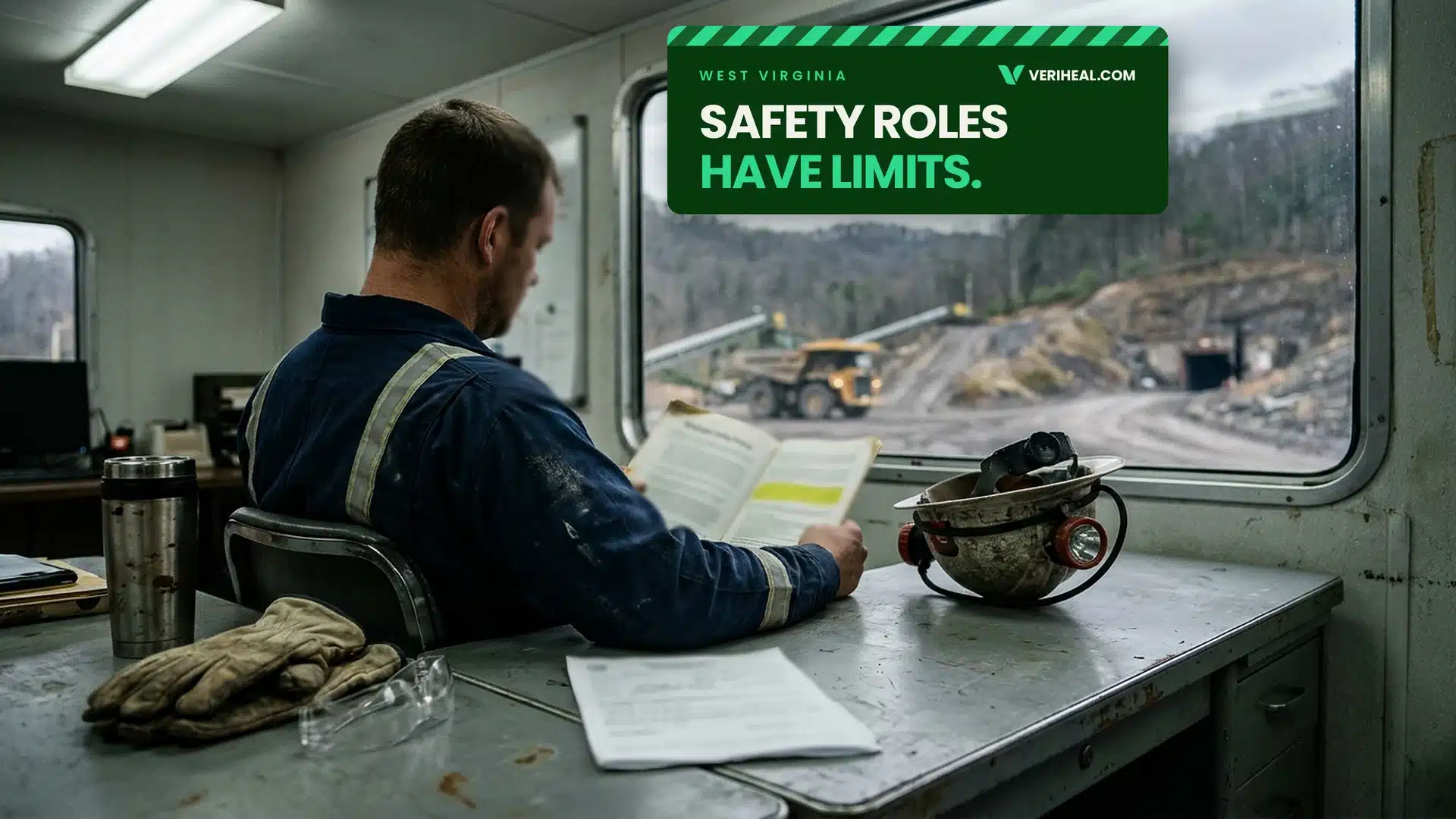
- Work at heights or in confined spaces while under the influence: This includes jobs such as mining.
- Perform high-risk duties your employer restricts: Your employer may bar you from life-threatening tasks, or duties that create a public health or safety risk, while you are under the influence.
The statute also says that this restriction is not an adverse employment decision, even if it costs you income.
Employment Consequences: What West Virginia Law Does and Does Not Protect
West Virginia’s Medical Cannabis Act (WV Code §16A-15-4(b)) prohibits employers from firing, threatening, refusing to hire, or otherwise discriminating or retaliating against you solely because you are certified to use medical cannabis. That protection has three built-in limits:
- Employers do not have to accommodate use on work premises.
- They can discipline you for working under the influence when your conduct falls below the standard of care for your position.
- They are not required to do anything that would violate federal law.
The federal-law limit matters most. State-licensed medical marijuana moved to Schedule III in April 2026. But DOT testing rules have not changed, and federal drug-free workplace requirements remain in place. Federally regulated employers and federal contractors can still discipline or fire employees who test positive, regardless of cardholder status. Knowing whether to tell your employer about your medical card is a separate question, and the answer depends on your industry and your employer’s policies.
What WV Law Actually Protects
The anti-discrimination provision in WV Code §16A-15-4(b)(1) means an employer cannot refuse to hire you or fire you solely because you are certified. The exceptions are workplace impairment or a specific federal-law override. This protection matters most in private workplaces with no federal drug-free workplace obligation.
West Virginia does not yet have much case law interpreting §16A-15-4(b), so the practical scope of this protection is largely untested in court. That uncertainty cuts both ways. The protection exists on paper, but WV judges have not yet defined its limits.
Where the Protection Has Limits
A WV medical cannabis card does not shield you from a positive drug test. These employers keep the right to test you and act on the results:
- Employers in safety-sensitive industries
- Federal contractors
- Any employer covered by federal drug-free workplace laws
Some states go further than West Virginia. Oklahoma generally bars employers from penalizing a medical license holder based solely on a positive marijuana test. Minnesota lets registered patients present their registry verification to help explain a positive result. West Virginia’s statute has no comparable drug-test provision.
If you work in healthcare, transportation, or a federally regulated field, the WV anti-discrimination provision offers you limited practical protection. Talk to an employment attorney before you apply for a card.
Federal Employment and Security Clearances: What Clearance Holders Should Know
Government is one of West Virginia’s largest employment sectors, according to Bureau of Labor Statistics data for West Virginia, and that sector includes federal agency and contractor jobs. If you work in that space, this consequence is not theoretical.
If you are a federal employee, service member, or contractor who holds or seeks a security clearance, you must answer questions about illegal drug use on the SF-86, the Questionnaire for National Security Positions. State-licensed medical marijuana moved to Schedule III in April 2026, but it is still not an FDA-approved, prescribable drug. Federal clearance rules also have no exception for state medical cardholders. As a result, cannabis use consistent with holding a WV card can raise a disqualifying concern when you apply for or try to keep a clearance.
Clearance decisions are made by agency adjudicators, such as the Defense Counterintelligence and Security Agency (DCSA), under Security Executive Agent Directive 4 (SEAD 4) and its drug involvement guideline. December 2021 guidance from the Director of National Intelligence shapes how adjudicators treat marijuana:
- Relevant, not automatic: Marijuana use is relevant to your clearance but not determinative on its own.
- Mitigating factors count: Adjudicators weigh factors such as how often and how recently you used.
- No cardholder exemption: There is still no automatic exception for state medical cardholders.
- Stop once you apply: The guidance encourages agencies to advise applicants to stop all marijuana use once they sign the SF-86.
Before you apply for a WV medical cannabis card, consult both an attorney and your agency’s or employer’s security officer.
Medical Marijuana Cards and Child Custody in West Virginia
Holding a West Virginia medical cannabis card does not automatically affect your parental rights or custody arrangements, but WV family court judges have broad discretion. Under WV Code §48-9-209, a court can limit a parent’s custodial time, including requiring the parent to abstain from nonprescribed drugs during custodial time and the 24 hours beforehand.
Medical cannabis in West Virginia is certified rather than prescribed, so how a court treats it under that language is unsettled. No West Virginia statute explicitly protects cardholders from adverse custody findings based on their cardholder status.
That absence matters. Minnesota, for example, bars courts from denying custody, visitation, or parenting time based solely on a person’s status as an enrolled medical cannabis patient. West Virginia has not enacted equivalent language, which leaves the question to judicial discretion.
What Family Courts Can Consider
WV judges assess the totality of circumstances in custody disputes. Documented impairment around children, use in the presence of children, or failure to follow physician guidance are all factors that can arise in contested proceedings. The fact that your use is state-authorized does not prevent opposing counsel from raising it as a concern, and no WV statute removes it from consideration.
Outcomes vary significantly by circuit and by judge. This section reflects the general legal landscape, not legal advice.
What Cardholders Can Do to Protect Themselves
If custody is actively contested, you can take three steps to protect yourself:
- Document your certification: Keep records of your physician certification and qualifying condition.
- Use only as directed: Follow your physician’s guidance on how and when to use medical cannabis.
- Keep use away from your children: Avoid any use in their presence.
These steps do not guarantee a favorable outcome. They do create a record of responsible, medically supervised use that a family law attorney can work with. If custody is a live issue in your life, talk to a family law attorney before you apply for a card.
Professional Licenses, Housing Assistance, and Other Overlooked Consequences
Two consequence areas get little attention in most discussions of West Virginia’s program. Both carry real risk for specific groups of residents.
Licensed Professionals in Regulated Fields
West Virginia law gives licensed professionals more protection than many readers expect. Under WV Code §16A-15-4(a), you may not be denied any right or privilege solely for lawful use of medical cannabis. That includes disciplinary action by a state licensing board or commission.
That protection has two limits:
- Lawful use only: The protection covers lawful use and nothing more.
- No cover for impaired work: Under WV Code §16A-12-9, the Act does not shield you if you perform a task under the influence and that amounts to negligence, professional malpractice, or professional misconduct.
If you are a nurse, pharmacist, teacher, or social worker, also review your employer’s policies. The licensing protection does not override the employment limits described earlier. The Veriheal article on nurses and medical marijuana cards shows how this plays out in one regulated profession.
If you are a health care professional with a Drug Enforcement Administration (DEA) registration, check with your compliance office or counsel before applying. State-licensed medical marijuana is now Schedule III, but it is still not an FDA-approved drug. West Virginia’s licensing protection cannot resolve federal registration questions.
HUD and Federal Housing Assistance
If you live in federally subsidized housing under HUD programs, including Section 8 and public housing, the card carries a concrete risk. Federal law treats applicants and existing tenants differently:
- Applicants: Housing agencies and owners must deny admission to applicants who currently use medical marijuana. HUD’s published guidance says it has no discretion to admit medical marijuana users without a change in federal law.
- Existing tenants: Housing agencies have discretion to end assistance for illegal drug use.
HUD’s guidance predates the April 2026 move of state-licensed medical marijuana to Schedule III. Confirm your housing authority’s current policy before you apply.
For lower-income patients who rely on federal housing assistance, the same card that opens dispensary access can put their housing at risk. Weigh that trade-off carefully before applying.
What Happens to Your Information: OMC Registry Privacy and Law Enforcement Access
The Office of Medical Cannabis maintains a confidential list of patients and caregivers. Under WV Code §16A-3-4, the following are confidential and exempt from West Virginia’s Freedom of Information Act:
- Your identifying information
- Your physician’s certification
- The information on your identification card
- Information about your serious medical condition
Your card also cannot be required to display your condition.
That confidentiality does not mean the registry is hidden from law enforcement. Under WV Code §16A-10-3, the state must confirm to law enforcement, in appropriate cases, whether your card is valid, including releasing your name. Law enforcement can also access the dispensary tracking system under conditions the state sets. The Act’s disclosure limits also do not apply where disclosure is permitted or required by law or court order. If you have federal employment or security obligations, factor that into your decision.
Who Can Access the Registry
OMC staff and licensed dispensaries are the ones who routinely see your registry information. Dispensaries must check the state’s electronic tracking system before dispensing to you. Beyond that, access is limited to the law enforcement and legal exceptions described above.
What stays protected is public access, because your registry information is not a public record. For more on how retailers handle your data, see Veriheal’s guide to what dispensaries do with your personal information.
What HIPAA Covers and What It Does Not
Your medical privacy is protected by two separate frameworks:
- Your physician’s records: Patient records held by your certifying physician are protected under the Health Insurance Portability and Accountability Act (HIPAA).
- Your registry data: OMC registry data is protected separately under WV Code §16A-3-4.
These frameworks are related but legally distinct, and they do not provide identical coverage. Many patients assume one protection automatically extends to the other, and that mistake can be costly. For a full breakdown of how the two interact in practice, see Veriheal’s guide to HIPAA and medical cannabis privacy.
None of these consequences make a card the wrong choice, but they should shape how you apply. Before you do, review West Virginia’s medical cannabis program to see the qualifying conditions and application requirements alongside these trade-offs. Once you’re ready to apply, connect with a Veriheal-certified physician to start the application process.
Note: The content on this page is for informational purposes only and is not intended to be professional medical advice. Do not attempt to self-diagnose or prescribe treatment based on the information provided. Always consult a physician before making any decision on the treatment of a medical condition.
Note: Veriheal does not support illegally consuming therapeutic substances such as cannabis but acknowledges that it transpires because of the current illicit status, which we strive to change by advocating for research, legal access, and responsible consumption. Always consult a physician before attempting alternative therapies.
Frequently Asked Questions
How hard is it to get a medical marijuana card in WV?
The process is straightforward if you are a West Virginia resident with a qualifying serious medical condition. First, a registered physician certifies you. Then you apply and pay the $50 fee through the Office of Medical Cannabis’s online portal.
What are the negatives of getting a medical marijuana card?
The main negatives are federal. Cannabis use can still create risk under federal firearms law, even after the Supreme Court’s 2026 Hemani ruling. It is also incompatible with commercial driving under DOT testing rules, and it can complicate a federal security clearance. State law gives you some employment and licensing board protection. It does not shield you from federal drug testing, HUD housing rules, or custody disputes. Each of these is covered in the sections above.
What rights do you lose with a medical card?
A WV card does not strip your rights automatically, but it can limit several federal ones. Your firearm eligibility under 18 U.S.C. §922(g)(3) remains uncertain, even after the Hemani ruling. DOT rules bar cannabis use in commercial driving and other safety-sensitive transportation jobs. Your federal clearance eligibility can also be affected. WV Code §16A-15-4(b) protects you from employment discrimination based solely on your certification. It does not, however, require employers to violate federal law.
What happens if you get caught with marijuana in West Virginia?
Without a valid card, possession is a misdemeanor under WV Code §60A-4-401. It is punishable by 90 days to six months in jail, a fine of up to $1,000, or both. A first offense involving less than 15 grams is handled through conditional discharge. With a valid card and use that follows the West Virginia Medical Cannabis Act, you are protected from state prosecution. Federal law still applies in federal jurisdictions, though.
Author, Share & Comments