Renewing your Pennsylvania medical marijuana card comes down to two things: a new patient certification and an annual state fee. Practitioners can recertify you by phone or video. The fee is $50, or $0 if you qualify through the state’s assistance program.
This guide walks you through each step, from your renewal email to your new card in the mail. You’ll also learn how to bring the fee down to $0 and what to do if your card has already expired, so you can keep your access without a gap.
How Does Pennsylvania Medical Marijuana Card Renewal Work?
The Pennsylvania Department of Health (DOH) emails you 60 days before your patient certification and ID card expire, according to its renewal page. That email is your signal to start. Renewal then follows three steps:
- Get recertified: See any DOH-approved practitioner for a new patient certification.
- Keep your annual fee current: Pay the state fee when it’s due.
- Receive your new card: The DOH prints your card and mails it to the address in your patient portal.
The fee runs on its own yearly schedule, separate from your card, and you’ll get a second email 30 days before it’s due. Your new card starts after your current one expires, so the DOH says to keep using your current card until the new card’s issue date.
Step 1: Get Recertified by a Registered Practitioner
You need a new patient certification to renew. Any DOH-approved practitioner can issue it, and you don’t have to return to the doctor who certified you the first time. Your practitioner sets how long the certification lasts, up to one year, according to the DOH’s patients and caregivers page.
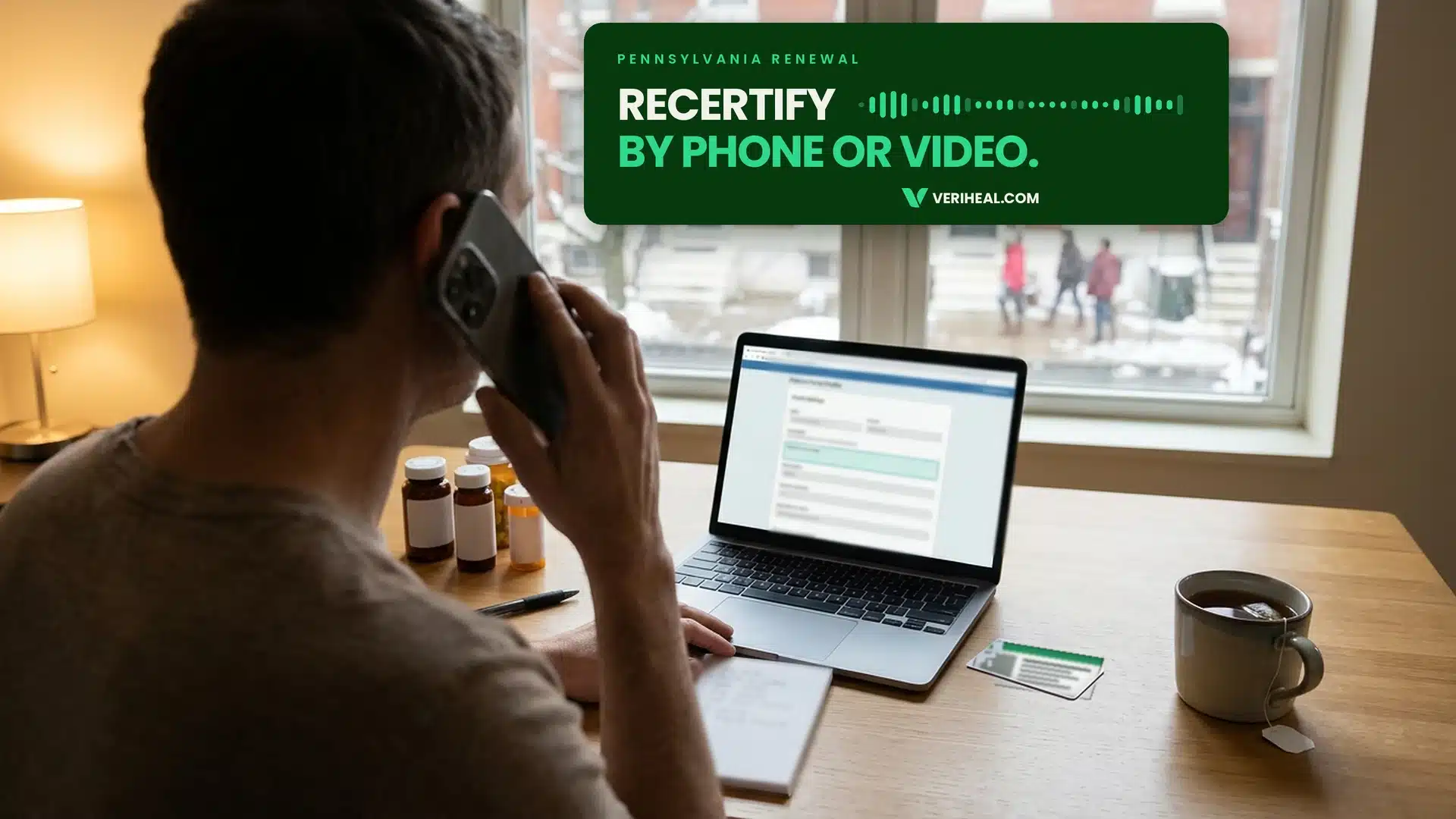
Your appointment doesn’t have to happen in an office. The DOH says Act 44 of 2021 lets practitioners issue certifications by phone or video conference. To find a practitioner, check the DOH’s list of approved practitioners. To learn how online visits work, read Veriheal’s guide on telemedicine for medical cannabis.
What to Have Ready for Your Renewal Appointment
The DOH asks patients to have their patient ID number handy for the consultation. You’ll find it under Profile Settings in your patient portal. It also helps to come ready to talk about:
- Changes in your health: Any new symptoms or diagnoses since your last certification.
- Your current treatment: The cannabis products you use now and how well they’re working.
- Other medications: Anything else you take, so your practitioner can review it.
Can You Add a New Condition at Renewal?
If you’ve been diagnosed with a new condition, bring it up at your renewal appointment. Your certification confirms that you have at least one of Pennsylvania’s approved serious medical conditions. Your practitioner makes that determination before issuing it.
Step 2: Pay the $50 State Fee or Apply for a Fee Reduction
The annual fee is $50, paid to the DOH, not to your practitioner or to Veriheal. It’s due once every 12 months, no matter how many cards or certifications you’re issued. Watch for the DOH’s email 30 days before the due date, and pay by that date to avoid a lapse in your card’s activation.
To pay, log in to the patient portal as a returning user, select the Make Payment tab, and follow the prompts. If your certification email asks you to pay, do it within 60 days of the certification date. Otherwise, the DOH says your certification expires, and you’d need a new one.
You may qualify to pay $0 through the Medical Marijuana Assistance Program (MMAP). It covers patients enrolled in any of these Pennsylvania programs:
- CHIP: Children’s Health Insurance Program.
- Medicaid: Pennsylvania Medical Assistance.
- PACE or PACENET: Pharmaceutical Assistance Contract for the Elderly, or its Needs Enhancement Tier.
- SNAP: Supplemental Nutrition Assistance Program.
- WIC: Women, Infants and Children.
Claiming the reduction is simple. When you go to pay, a screen asks you to confirm your participation by typing your name as a digital signature, according to the DOH’s MMAP Phase 1 FAQs. Your fee then drops to $0, and you confirm again each year. The MMAP page says patients must be able to verify their participation, so keep your enrollment records handy.
Step 3: Receive Your Renewed Card
Once you’re recertified and your annual fee is up to date, the DOH prints your new card and mails it to the address in your patient portal. Check the address under Profile Settings before your appointment, since that’s where your card will go. For ID cards, the DOH says to allow 7 days for printing from the date you paid and 14 days for delivery.
If three weeks pass after you’ve met the requirements and your card hasn’t arrived, you can request a new one under Profile Settings. For a broader look at timelines, read Veriheal’s guide on how long it takes to get a medical card. To see what you keep by renewing, read Veriheal’s guide on the benefits of a medical marijuana card.
What Happens If Your Pennsylvania Card Has Already Expired?
The DOH’s renewal page doesn’t describe a separate process for expired cards. It does say a new card is issued once you’re certified and your annual payment is up to date. Paying the fee on time avoids a lapse in your card’s activation.
Call the Medical Marijuana Program at 888-733-5595 to confirm your next steps. The call center is open 7 a.m. to 9 p.m. Eastern, seven days a week, except state holidays. If you also hold a card in another state, read Veriheal’s guide to medical marijuana card state-by-state laws.
Should You Talk to a Lawyer First If You Own Firearms?
If you own firearms, check with a lawyer before you renew your Pennsylvania medical marijuana card. Federal rules moved in 2026, and some of those changes work in patients’ favor:
- Federal scheduling: In April 2026, state-licensed medical marijuana was reclassified to Schedule III, according to the U.S. Department of Justice. Recreational cannabis remains in Schedule I.
- Hemani decision: On June 18, 2026, the Supreme Court ruled unanimously in United States v. Hemani. Prosecuting someone under 18 U.S.C. § 922(g)(3) based only on marijuana use violates the Second Amendment.
- Dealer guidance: The Bureau of Alcohol, Tobacco, Firearms and Explosives (ATF) withdrew its 2011 open letter, which had told dealers to treat a medical marijuana card as a reason to refuse a sale.
Other parts of federal law haven’t moved, and these still matter if you own or buy a gun:
- The statute: Section 922(g)(3) remains on the books.
- The purchase form: ATF Form 4473 hasn’t changed, and the ATF hasn’t replaced its old guidance. You still need to answer the form’s drug-use question honestly.
Federal risk hasn’t gone away, so a lawyer can explain how these rules apply to you. For a deeper look, read Veriheal’s guide on medical cannabis patients and gun rights.
How Can Veriheal Help You Renew in Pennsylvania?
Veriheal connects you with a Pennsylvania health care provider for an online video evaluation, so you can get recertified from home. Every evaluation comes with a “get approved or your money back” policy, and you can split the fee into interest-free installments. The $50 state fee is separate and paid to the DOH.
Book your Pennsylvania renewal evaluation with Veriheal as soon as your 60-day renewal email arrives.
Note: The content on this page is for informational purposes only and is not intended to be professional medical advice. Do not attempt to self-diagnose or prescribe treatment based on the information provided. Always consult a physician before making any decision on the treatment of a medical condition.
Note: Veriheal does not support illegally consuming therapeutic substances such as cannabis but acknowledges that it transpires because of the current illicit status, which we strive to change by advocating for research, legal access, and responsible consumption. Always consult a physician before attempting alternative therapies.
Frequently Asked Questions
Do I need to see a doctor again to renew my Pennsylvania medical marijuana card?
Yes, you need a new patient certification from a DOH-approved practitioner to renew a Pennsylvania medical marijuana card. You can see any approved practitioner, not only the one who first certified you. Practitioners can issue certifications by phone or video.
How much does it cost to renew a Pennsylvania medical marijuana card?
Renewing a Pennsylvania medical marijuana card costs $50 a year in state fees, or $0 if you qualify through the state’s Medical Marijuana Assistance Program. You pay the fee to the DOH once every 12 months. Your practitioner’s recertification visit is a separate cost, and the DOH notes it may not be covered by insurance.
How often do I renew my Pennsylvania medical marijuana card?
You renew your Pennsylvania medical marijuana card at least once a year. Your practitioner sets the certification length, up to one year, and the state fee is due every 12 months.
How long does it take to get a renewed Pennsylvania card?
For Pennsylvania medical marijuana ID cards, the DOH says to allow 7 days for printing from the date you paid and 14 days for mailing. Keep using your current card until your new card’s issue date. If three weeks pass with no card, request a new one under Profile Settings in your patient portal.
Can I add a new qualifying condition when I renew?
Yes, you can raise a new diagnosis with your practitioner at your Pennsylvania renewal appointment. Your practitioner decides whether it’s one of the state’s approved serious medical conditions before issuing your certification.
What happens if my Pennsylvania medical marijuana card expires?
If your Pennsylvania medical marijuana card expires, you’ll need a current certification and an up-to-date annual fee before the DOH issues a new card. The DOH doesn’t publish a separate process for expired cards. Call the Medical Marijuana Program at 888-733-5595 to confirm your next steps.
Author, Share & Comments