Getting a Minnesota medical cannabis card costs less than most patients expect. The state no longer charges an enrollment fee, enrollment lasts three years, and registered patients skip Minnesota’s cannabis tax. This guide breaks down every cost layer in the process so you can calculate your true out-of-pocket spend before you book a single appointment.
What Does a Minnesota Medical Cannabis Card Actually Cost?
The cost of a Minnesota medical cannabis card comes in three layers, and it helps to understand all of them.
Certification Fee
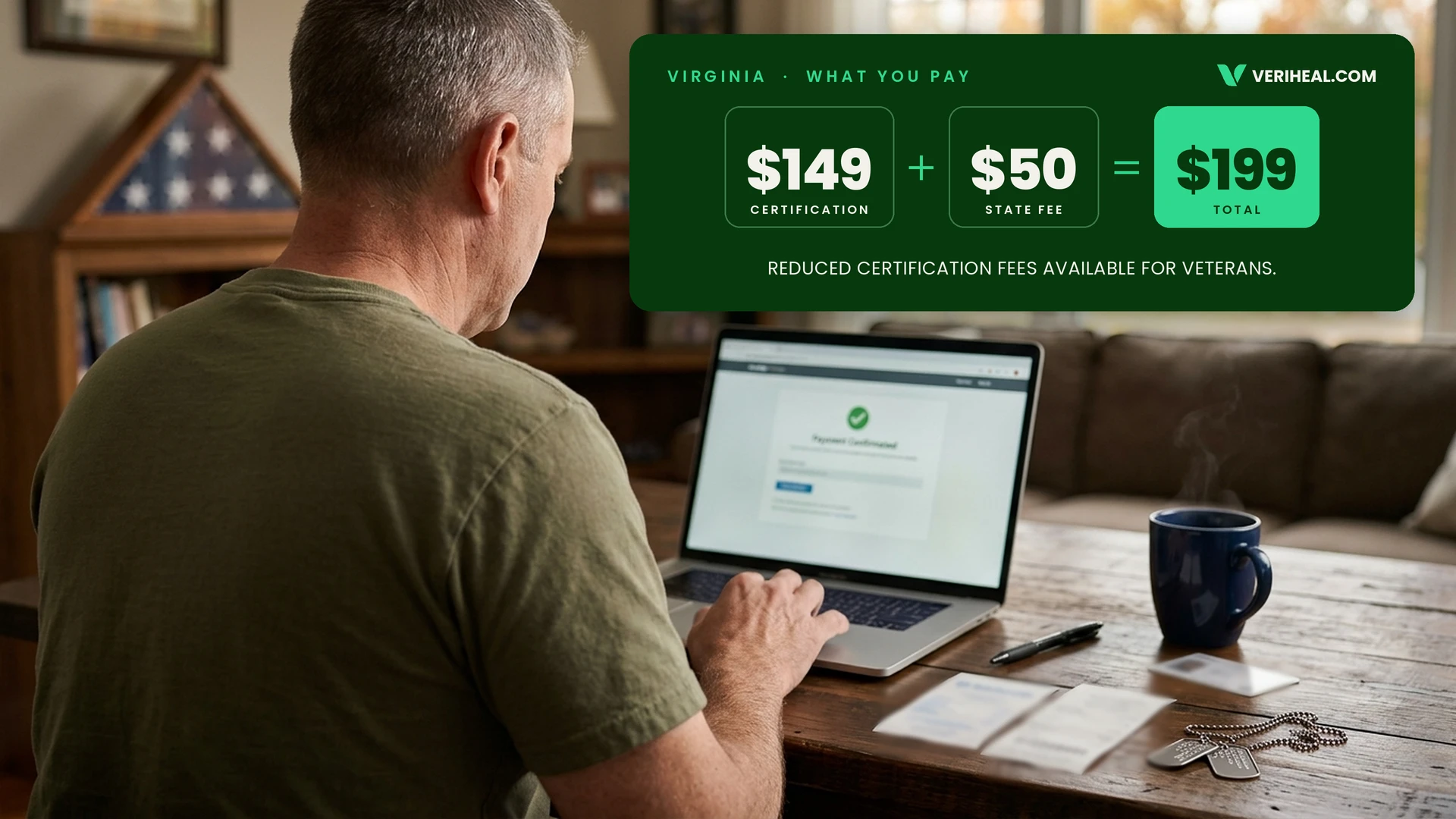
A certifying health care practitioner must confirm that you have a qualifying medical condition before the state will enroll you in the medical cannabis program. This is the only real cost in the process, and what you pay depends on where you go. Through Veriheal, you can book a Minnesota consultation for as low as $49.74 in interest-free installments ($199 total). Primary care providers and specialists may charge more, because the visit is priced like a standard appointment rather than a stripped-down certification service.
State Enrollment Fee
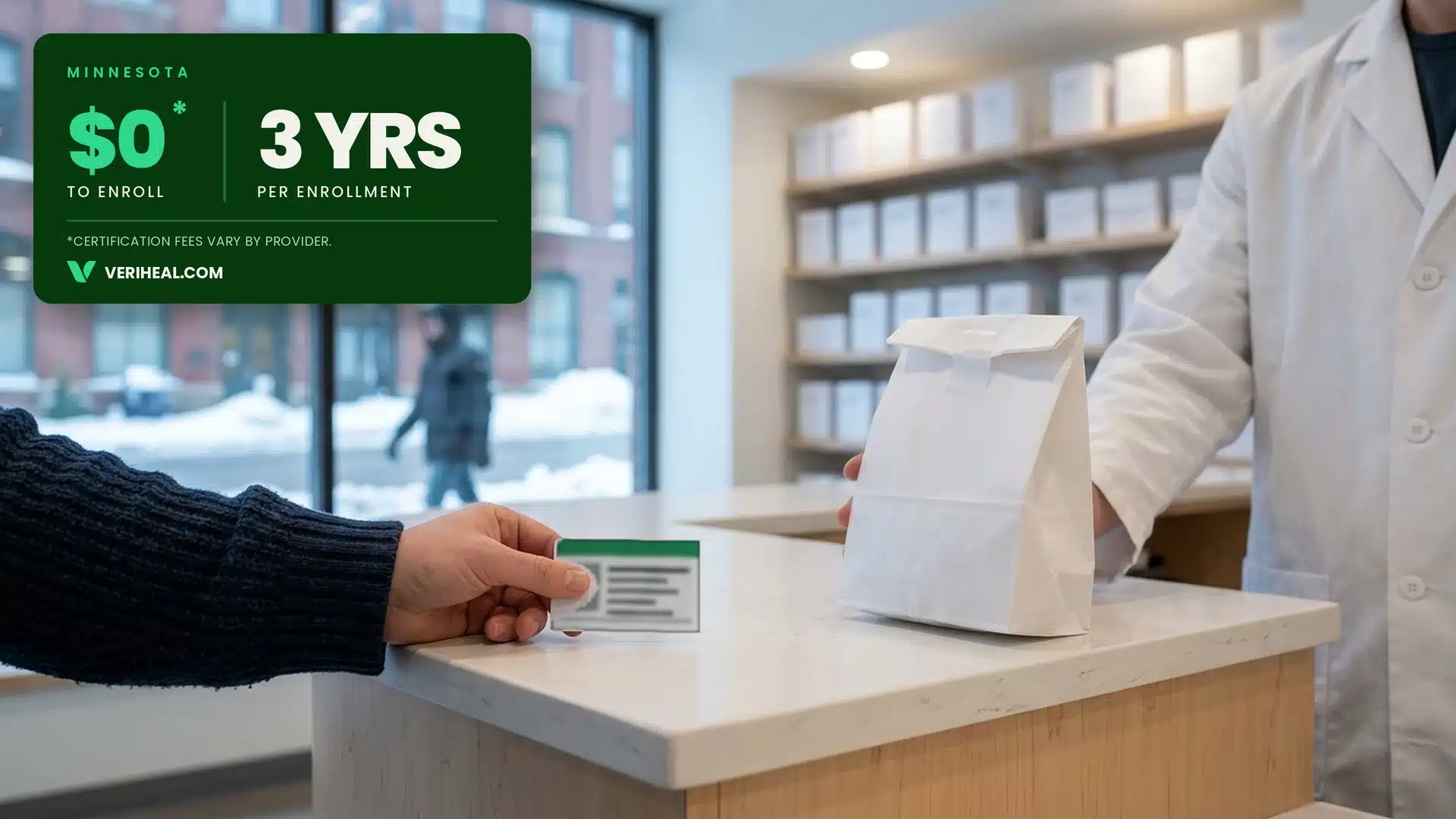
There is no state enrollment fee. Minnesota eliminated its patient enrollment fee in July 2023. Current law, Minn. Stat. §342.52, sets no charge to enroll. After your practitioner certifies you, you complete the enrollment application with the Office of Cannabis Management’s Division of Medical Cannabis at no cost. The office must then approve or deny it within 30 days.
Re-Enrollment Costs
Your enrollment is valid for three years, not one. To re-enroll, you submit a new application with a practitioner certification dated within 90 days, so the only recurring cost is a certification visit every three years. Some telehealth platforms offer lower rates for returning patients, so ask before you commit to a provider.
| Cost Item |
Typical Cost |
| Certification fee |
Varies by provider; Veriheal is $199, as low as $49.75 in interest-free installments |
| State enrollment fee |
$0 |
| Re-enrollment (every three years) |
A new certification fee; no state fee |
Because the state side is free, the certification fee is the only cost you need to shop around on. And for some patients, even that fee can be lowered or avoided entirely. Veterans and patients whose regular doctor will certify them have options worth checking first, as the next section explains.
What’s Free in Minnesota, and Who Can Pay Even Less
Minnesota used to charge a $200 annual enrollment fee, with a reduced $50 rate for patients receiving certain government assistance. Both were eliminated in July 2023, so there is no longer a fee to reduce and no assistance form to file. Every patient enrolls for free.
Veterans may be able to skip the certification cost: Under Minn. Stat. §342.52, subdivision 3, the Office of Cannabis Management must offer veterans an alternative enrollment procedure. Instead of a practitioner certification, it can accept a copy of a veteran ID card and an attestation of a qualifying diagnosis. For eligible veterans, that can make the entire process free. Before you apply, check the Division of Medical Cannabis site to see how the office currently handles veteran enrollment.
Your existing doctor may be the cheapest certifier: Minnesota’s qualifying conditions now include any condition your practitioner recommends cannabis for, alongside 19 listed conditions (Minn. Stat. §342.01, subdivision 63). If your primary care provider already treats your condition and is willing to certify you, your cost may be lower than a cash-pay telehealth visit. That’s especially true if your insurance covers the office visit.
How to keep your costs as low as possible:
- Check whether you qualify for the veteran enrollment path before booking any appointment.
- Ask your current practitioner whether they will certify you during a regular visit.
- If not, compare telehealth certification prices, including any returning-patient rates and money-back guarantees.
- Once certified, complete your free enrollment application promptly, since your certification must be dated within 90 days of the application.
- Plan to re-enroll every three years rather than budgeting for an annual renewal.
Cheapest Certification Options in Minnesota: Telehealth vs. In-Person
The certification fee is the one cost you control, and the choice between telehealth and in-person care makes the biggest difference. Under Minnesota law, your certifying practitioner must be a Minnesota-licensed doctor of medicine, physician assistant, or advanced practice registered nurse. They must also have primary responsibility for treating your qualifying condition. That gives you a range of provider types to choose from.
Telehealth cannabis clinics usually charge less than traditional clinical settings because their entire operation is built around the certification visit. There is no overhead from a full-service practice and no billing through insurance, which typically means a shorter, lower-cost video appointment.
Veriheal offers telemedicine certification for Minnesota patients, connecting you with a Minnesota-licensed practitioner by video. Every Veriheal evaluation comes with a “get approved or your money back” policy, and you can split the fee into interest-free installments. To learn more, see Veriheal’s step-by-step guide on how to get your medical marijuana card online.
| Provider Type |
Typical Cost |
Appointment Format |
Turnaround |
| Telehealth cannabis clinic |
Commonly $75 to $150, cash pay |
Video call |
Often same day to a few days |
| Primary care practitioner |
Office visit rate; may be billed to insurance |
Office or telehealth visit |
Depends on appointment availability |
| Specialist |
Specialist visit rate; may be billed to insurance |
Office visit |
Often weeks |
What to Look for When Comparing Providers
Price is not the only thing that separates a good provider from a frustrating one. Before booking, check these three things:
- A money-back guarantee: See whether the platform refunds your fee if you are not certified. Many telehealth clinics do, and it removes the financial risk.
- What happens after your visit: Ask how the provider enters your certification and what you need to do next, since you complete the state enrollment application yourself.
- Turnaround time: This matters most if your condition needs ongoing treatment.
A provider who is clear about pricing, timelines, and what happens if you are not approved is worth more than one that is simply the cheapest option on the page.
Telemedicine for medical cannabis has expanded access for patients who live far from major metro areas or have mobility limitations. Before booking, confirm how telehealth works in your state.
Medical Card vs. Recreational: Does the Card Pay for Itself?
Minnesota legalized recreational cannabis in 2023, so the question is no longer whether you can access cannabis. It is whether the savings from enrolling as a patient outweigh the certification cost. For most regular buyers, the answer is clearly yes.
Adult-use cannabis purchases in Minnesota carry a 15% cannabis gross receipts tax, plus the 6.875% state sales tax and any local sales taxes. According to the Minnesota Department of Revenue, medical cannabis purchased by or for a patient enrolled in the registry program is exempt from the cannabis tax. With no state enrollment fee and a three-year enrollment, the math shifts heavily in the card’s favor.
The table below assumes Veriheal’s $199 certification every three years, or about $66 per year, and counts only the 15% cannabis tax savings.
| Monthly Spend |
Annual Cannabis Tax Avoided (15%) |
Annual Card Cost (est.) |
Net Annual Savings With Card |
| $50/month |
$90 |
$66 |
+$24 |
| $100/month |
$180 |
$66 |
+$114 |
| $150/month |
$270 |
$66 |
+$204 |
| $200/month |
$360 |
$66 |
+$294 |
| $300/month |
$540 |
$66 |
+$474 |
At these assumptions, the card breaks even at roughly $37 per month in purchases. These figures are illustrative. Your actual savings depend on your certification cost and the products you buy. Any sales tax exemption on your medical purchases would add to them. Understanding the full picture of medical vs. recreational cannabis taxes is worth reviewing before you decide.
Do You Still Need a Medical Card in Minnesota?
Minnesota adults 21 and older can now purchase cannabis without a medical card. That change has prompted many patients to ask whether enrolling in the medical program is still worth it. For some patients, the answer is clearly yes. For others, recreational access may be enough.
Patients who benefit most from enrolling tend to fall into a few categories. Anyone who buys regularly will recover the certification cost through the cannabis tax exemption, as the previous section shows. Patients under 21 can only access cannabis through the medical program, which makes enrollment necessary rather than optional. Understanding the full benefits of a medical marijuana card can help you weigh the other advantages of the medical program beyond taxes.
Minnesota’s 19 listed qualifying conditions are:
- Alzheimer’s disease
- Autism spectrum disorder (meeting DSM-5 criteria)
- Cancer, if the condition or its treatment causes severe or chronic pain, nausea or severe vomiting, or cachexia or severe wasting
- Chronic motor or vocal tic disorder
- Chronic pain
- Glaucoma
- HIV/AIDS
- Intractable pain
- Obstructive sleep apnea
- Post-traumatic stress disorder (PTSD)
- Tourette syndrome
- Amyotrophic lateral sclerosis (ALS)
- Seizures, including those characteristic of epilepsy
- Severe and persistent muscle spasms, including those characteristic of multiple sclerosis
- Inflammatory bowel disease, including Crohn’s disease
- Irritable bowel syndrome
- Obsessive-compulsive disorder
- Sickle cell disease
- Terminal illness with a probable life expectancy of under one year, if the illness or its treatment causes severe or chronic pain, nausea or severe vomiting, or cachexia or severe wasting
Beyond this list, Minnesota law also counts any condition for which your health care practitioner has recommended or authorized cannabis, so talk with your practitioner even if your condition is not listed. The full statutory definition is in Minn. Stat. §342.01, subdivision 63.
Before you decide, a couple of practical questions are worth answering. Check how long it takes to get a medical card so the approval timeline fits your plans. It also helps to know whether medical cannabis is covered by insurance. In most cases it isn’t, and cash-pay telehealth certifications generally aren’t either.
Once the numbers make sense for you, see Veriheal’s Minnesota pricing and book your certification.
Note: The content on this page is for informational purposes only and is not intended to be professional medical advice. Do not attempt to self-diagnose or prescribe treatment based on the information provided. Always consult a physician before making any decision on the treatment of a medical condition.
Note: Veriheal does not support illegally consuming therapeutic substances such as cannabis but acknowledges that it transpires because of the current illicit status, which we strive to change by advocating for research, legal access, and responsible consumption. Always consult a physician before attempting alternative therapies.
Frequently Asked Questions
How much does it cost to get a medical cannabis card in Minnesota?
The only cost is the certification visit with a health care practitioner, since Minnesota charges no state enrollment fee. Through Veriheal, you can book a consultation for as low as $49.75 in interest-free installments ($199 total). Enrollment lasts three years, so you only pay for a certification about once every three years.
Can I get a Minnesota medical cannabis card online?
In many cases, yes. Many Minnesota-licensed practitioners offer certification by video visit. After you are certified, you complete the enrollment application online with the Office of Cannabis Management’s Division of Medical Cannabis, at no cost.
What conditions qualify for medical cannabis in Minnesota?
Minnesota lists 19 qualifying conditions, including chronic pain, PTSD, cancer, epilepsy, ALS, inflammatory bowel disease, obsessive-compulsive disorder, and autism spectrum disorder. The law also covers any condition for which your health care practitioner has recommended or authorized cannabis, so a practitioner can advise you even if your condition is not on the list.
Does Minnesota offer a fee waiver or discount for low-income medical cannabis patients?
There is no fee to waive. Minnesota eliminated its patient enrollment fee, including the reduced fee for patients on government assistance, in July 2023. Veterans may also be able to use an alternative enrollment path that does not require a paid practitioner certification.
How long does it take to get approved for a Minnesota medical cannabis card?
After your practitioner certifies you, you submit your enrollment application, and the office must approve or deny it within 30 days. Submit your application soon after your visit, since the certification must be dated within 90 days of your application.
Author, Share & Comments