Anti-marijuana propaganda has shaped US cannabis policy for over a century, and understanding where it came from helps explain why so many misconceptions about cannabis persist today. The campaign was not accidental. It was built deliberately, by identifiable people, using identifiable tools, and it worked.
If you want to understand cannabis culture in colonial America, where cannabis was a commonplace agricultural and medicinal crop, the contrast with what happened in the 20th century becomes even sharper. The plant did not change. The politics around it did.
1910s: The “Marijuana Menace” and the Language of Propaganda
The story of anti-cannabis propaganda begins not with a film or a law, but with a word. Before the 1930s, “cannabis” was the standard term in American medical and legal contexts. The American Medical Association used it in official communications, pharmacists stocked it under that name, and physicians prescribed it without controversy.
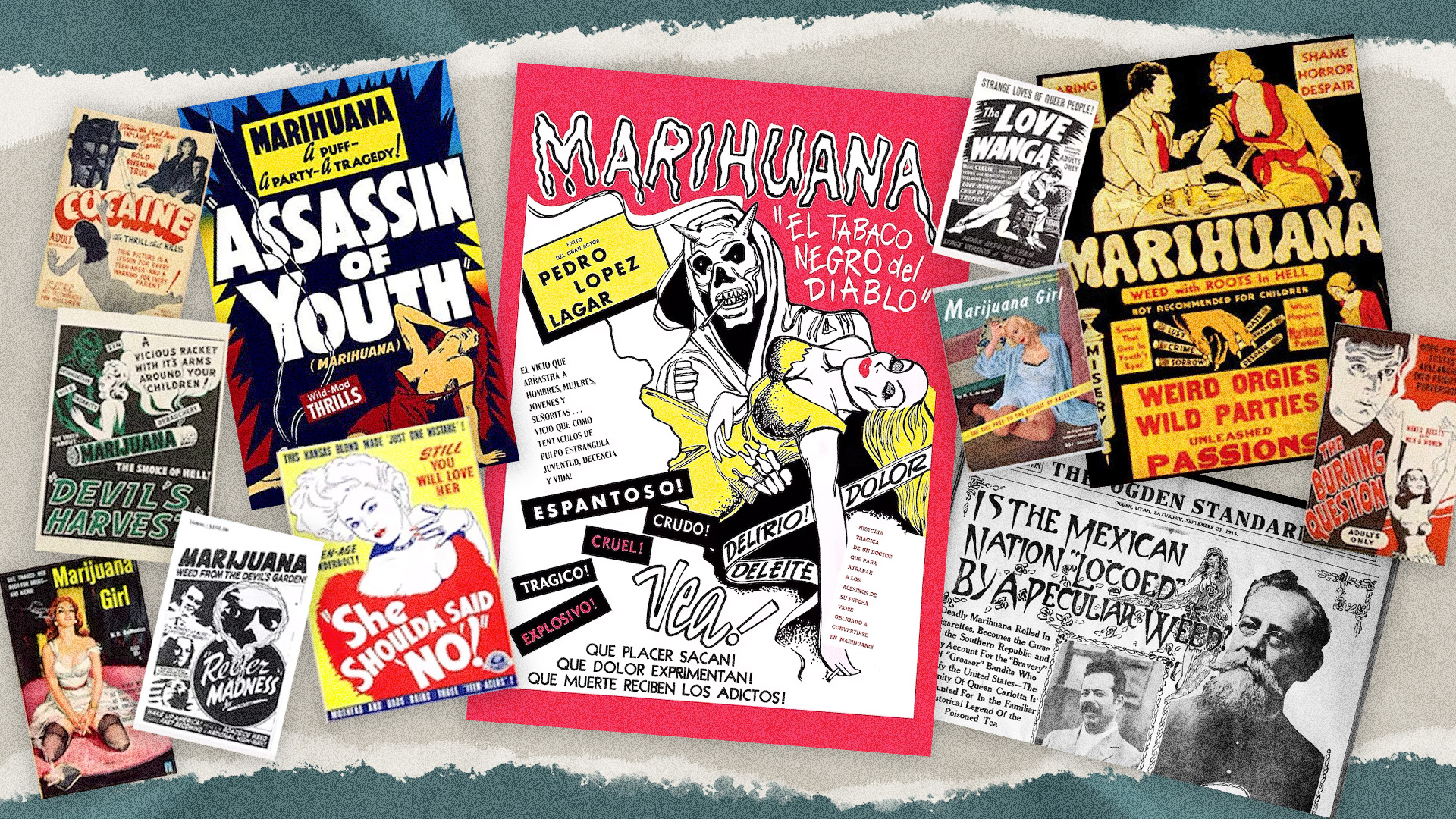
The substitution of “cannabis” with “marijuana” or “marihuana” was not a neutral linguistic drift. Yellow press outlets, particularly those connected to William Randolph Hearst’s newspaper empire, began using “marihuana” in coverage that explicitly linked the substance to Mexican immigrants arriving in the Southwest after 1910. The word sounded foreign because it was chosen to sound foreign.
By making “marihuana” the dominant term in public discourse and law enforcement communications, journalists and officials effectively rebranded a familiar medical substance as a dangerous foreign import. This was not incidental. It was the propaganda’s foundation.
The downstream effects were concrete. When legislators debated the substance in congressional hearings, they used “marihuana,” not “cannabis.” Many lawmakers did not recognize that the substance being described was the same plant their constituents had used medicinally for decades. Contemporary advocates and researchers have since argued for returning to “cannabis” as the preferred term precisely because “marijuana” retains this stigmatized history, and our own editorial preference reflects that reasoning.
The racial caricature ran alongside the linguistic shift. Newspaper coverage depicted cannabis use as a Mexican and Black cultural practice that threatened white society, associating it with crime, sexual violence, and moral collapse. The fear being sold was not primarily about the plant. It was about the people being associated with it.
This framing, established in the 1910s and 1920s, provided the cultural raw material that federal officials would later weaponize into law. The roaring twenties cannabis culture of jazz clubs and tea pads existed in parallel with this mounting hysteria, largely ignored by mainstream coverage that preferred the menace narrative.
1930s: Reefer Madness, Harry Anslinger, and the FBN
Reefer Madness and the Propaganda Film Era
The 1936 film Reefer Madness has become the most recognizable artifact of this era, depicting cannabis users descending into murder, madness, and sexual depravity after a single use. It was not a fringe production. Films like it were distributed through schools, churches, and civic organizations as educational material. The anti-marijuana propaganda embedded in these films was designed to terrify parents and community leaders, and for a generation it succeeded.
Harry Anslinger and the Federal Bureau of Narcotics
The man most responsible for institutionalizing anti-cannabis messaging was Harry Anslinger, commissioner of the Federal Bureau of Narcotics, who served in that role from 1930. Anslinger was a skilled political operator who recognized that cannabis prohibition offered the FBN a new mandate at a moment when alcohol prohibition had just ended, leaving his agency without a primary target.
He testified before Congress using race-inflected rhetoric that linked cannabis use to Black and Hispanic communities, and he distributed sensationalized case files to press outlets to generate coverage that would support his legislative agenda.
The FBN under Anslinger was not just a law enforcement agency. It was an institutional propaganda engine that produced and distributed anti-cannabis materials to schools, local law enforcement, and press organizations across the country. Anslinger cultivated relationships with journalists who would run his claims without scrutiny, effectively using the press as a distribution network for federal messaging.
The CIA, LSD, and MK-Ultra era of federal drug experimentation would later reveal how deeply government agencies were willing to intertwine with public perception management, but Anslinger built the template decades earlier.
How Anti-Cannabis Propaganda Became Federal Law
The propaganda campaign of the 1930s had a legislative endpoint. The timeline below shows how public fear was converted into federal law.
| Year |
Event |
Significance |
| 1930 |
FBN established under Anslinger |
Created the institutional infrastructure for federal anti-cannabis messaging |
| 1937 |
Marihuana Tax Act |
Imposed a prohibitive federal tax, effectively criminalizing cannabis without outright banning it |
| 1970 |
Controlled Substances Act |
Placed cannabis on Schedule I alongside heroin |
| 1972 |
Shafer Commission report |
Nixon-appointed commission recommended decriminalization; Nixon ignored it |
The 1937 Marihuana Tax Act: Propaganda’s Legislative Endpoint
The 1937 Marihuana Tax Act did not technically criminalize cannabis outright. It imposed a prohibitive federal transfer tax that made legal commerce practically impossible, which achieved the same result through a legal backdoor. The congressional hearings that produced the Act were notable for how thin the evidentiary case was.
The American Medical Association sent a representative to object, arguing that cannabis had legitimate medical uses and that the proposed legislation was based on exaggerated claims. He was largely dismissed. The congressional record of the 1937 Marihuana Tax Act hearings runs to only a few minutes of substantive testimony before the bill was advanced.
Schedule I: Nixon, the Shafer Commission, and a Contested Ruling
The Controlled Substances Act of 1970 placed cannabis on Schedule I, the most restrictive federal drug classification, alongside heroin. This decision classified cannabis as having no accepted medical use and a high potential for abuse. It was contested from the start. President Nixon appointed the National Commission on Marihuana and Drug Abuse, known as the Shafer Commission, to evaluate the scheduling decision.
In 1972, the Commission recommended decriminalization. Nixon ignored the recommendation entirely, and Schedule I status has persisted, affecting how many people are still in prison for cannabis to this day. If you want to understand what Schedule I drugs are and why that classification matters, the cannabis case is the clearest example of scheduling driven by politics rather than pharmacology.
1950s: The Gateway Drug Theory Takes Hold
The postwar period gave anti-cannabis propaganda a new scientific veneer. The gateway drug theory, which holds that cannabis use leads predictably to harder drug use, emerged as the dominant anti-cannabis claim of the 1950s. It provided a framework that sounded empirical without requiring rigorous evidence, and it proved durable far beyond the decade that produced it.
The theory’s appeal was partly structural. It allowed prohibitionists to argue against cannabis not on its own effects, but on where it supposedly led, which made the claim much harder to disprove.
Research questioning the causal basis of the gateway drug hypothesis has since challenged whether cannabis use itself drives subsequent drug use, or whether both behaviors share common social and environmental causes. By the time that research accumulated, the gateway framing had already shaped decades of public policy and public perception.
1970s, 1990s: The War on Drugs and “Just Say No”
The War on Drugs was not just a law enforcement campaign. It was a federally backed public messaging strategy, and anti-cannabis propaganda was central to it. The National Institute on Drug Abuse (NIDA), established in 1974, became the primary federal funder of anti-drug public communications, shaping how cannabis was discussed in schools, media, and public health contexts throughout the Reagan era.
“Just Say No,” launched by Nancy Reagan in 1982, was not a spontaneous cultural moment. It was a coordinated federal messaging campaign backed by NIDA research budgets and distributed through school programs, PSAs, and celebrity endorsements.
Key institutional milestones in this period:
- 1974: NIDA founded, centralizing federal control over anti-drug public messaging
- 1982: “Just Say No” campaign launched under Nancy Reagan
- 1988: Office of National Drug Control Policy (ONDCP) established, coordinating federal anti-drug strategy across agencies
The gateway drug claims from the 1950s were deployed most aggressively in this era, often without distinguishing between correlation and causation in public-facing materials.
1980s, 90s: Cartoon Characters and the Kids’ Campaign
The most memorable artifacts of this era were aimed directly at children. *Cartoon All-Stars to the Rescue* (1990) featured virtually every major animated character of the period, from Bugs Bunny to Alvin and the Chipmunks, converging on a single anti-drug message. It aired simultaneously on every major broadcast network, an unprecedented coordinated distribution that reflected the scale of federal investment in youth-targeted messaging.
Talking Dog
The 1980s also produced the “Talking Dog” PSA, in which a dog warns its owner about the dangers of drug use. The ad became unintentionally iconic because its earnestness read as absurd to the very audience it was targeting. It remains one of the more widely remembered examples of how the era’s anti-drug messaging could undermine its own credibility through overreach.
Flat Friend
The “Flat Friend” campaign depicted a teenager rendered literally flat, a visual metaphor for what drug use supposedly did to a person’s potential. Like many PSAs of the period, it prioritized shocking imagery over persuasive logic, and the gap between the visual claim and lived experience gave young viewers little reason to trust the message.
2000s: ONDCP Ads and the Peak of Anti-Drug Absurdity
By the 2000s, the ONDCP’s Above the Influence campaign had taken over as the primary vehicle for federal anti-cannabis messaging. Some of the resulting PSAs became cultural landmarks for the wrong reasons. The “This is your brain on drugs” frying pan metaphor was extended and remixed until it had lost any connection to its intended message. Ads depicting teenagers being flattened by sofas or slowly melting into couches circulated widely, achieving viral notoriety as objects of parody rather than persuasion.
The ONDCP spent hundreds of millions of dollars on this messaging over the decade, with federal anti-drug advertising expenditure data from the ONDCP showing the scale of the investment. Independent evaluations of the campaign found limited evidence that the ads reduced cannabis use among teenagers, and some analyses suggested they may have increased curiosity about the substances being depicted.
The propaganda had become so disconnected from the experiences of its target audience that it functioned primarily as content for ridicule. It is worth asking, given what we now know about why the US government holds a patent on cannabis, how seriously federal agencies ever took their own anti-cannabis claims.
Just Say No…to Propaganda
Anti-marijuana propaganda worked for as long as it did because it operated across multiple systems simultaneously: language, law, media, education, and federal funding. Each system reinforced the others. The word “marijuana” primed public fear; the films and newspaper coverage amplified it; the FBN and later NIDA institutionalized it; the Controlled Substances Act embedded it in law. By the time independent research began challenging the gateway drug theory, Schedule I cannabis prohibition had been law for decades, and the burden of proof had been effectively reversed.
Understanding this history matters not just as a curiosity about the past. It matters because the stigma anti-cannabis propaganda constructed has had lasting consequences for real people, including the communities it was originally designed to target. The cannabis in ancient rituals that predate any of this history by thousands of years offer a useful corrective: the narrative that cannabis is inherently dangerous is not ancient wisdom. It was invented, strategically, within living memory.
The propaganda campaign was not inevitable. It was a choice made by specific people with specific interests. Knowing that is the first step toward evaluating current cannabis messaging with the critical eye it deserves.
If you are ready to explore medical cannabis legally and with confidence, find a medical marijuana doctor near you.
Note: The content on this page is for informational purposes only and is not intended to be professional medical advice. Do not attempt to self-diagnose or prescribe treatment based on the information provided. Always consult a physician before making any decision on the treatment of a medical condition.
Note: Veriheal does not support illegally consuming therapeutic substances such as cannabis but acknowledges that it transpires because of the current illicit status, which we strive to change by advocating for research, legal access, and responsible consumption. Always consult a physician before attempting alternative therapies.
Frequently Asked Questions
Why is cannabis so demonized in the United States?
Cannabis was demonized through a deliberate propaganda campaign that began in the 1910s and 1930s, led by Federal Bureau of Narcotics Commissioner Harry Anslinger and amplified by sensationalist press coverage. The substitution of the word “cannabis” with “marijuana” was itself a rhetorical strategy designed to make the plant sound foreign and dangerous. The resulting stigma was then codified in federal law through the 1937 Marihuana Tax Act and the 1970 Controlled Substances Act.
Why are people still against cannabis today?
Much of the ongoing opposition to cannabis traces back to institutional messaging established by NIDA and the ONDCP during the War on Drugs era. Federal agencies spent decades funding anti-cannabis education campaigns in schools and media, and those messages shaped the beliefs of multiple generations before independent research began challenging their claims.
What was Harry Anslinger’s role in cannabis prohibition?
Harry Anslinger served as FBN commissioner from 1930 and used his position to campaign aggressively for federal cannabis prohibition. He testified before Congress using race-inflected rhetoric, cultivated press relationships to distribute sensationalized anti-cannabis claims, and was a primary architect of the 1937 Marihuana Tax Act.
What did the Shafer Commission recommend?
The Shafer Commission, officially the National Commission on Marihuana and Drug Abuse, was appointed by President Nixon to evaluate cannabis scheduling. In 1972, it recommended decriminalization of cannabis for personal use. Nixon rejected the recommendation, and cannabis has remained a Schedule I substance ever since.
What is the gateway drug theory and is it accurate?
The gateway drug theory holds that cannabis use leads to harder drug use. It became the dominant anti-cannabis argument in the 1950s and was heavily deployed during the Reagan-era War on Drugs. Research has since questioned whether cannabis causes subsequent drug use, or whether both reflect shared social and environmental risk factors rather than a causal chain.
Author, Share & Comments