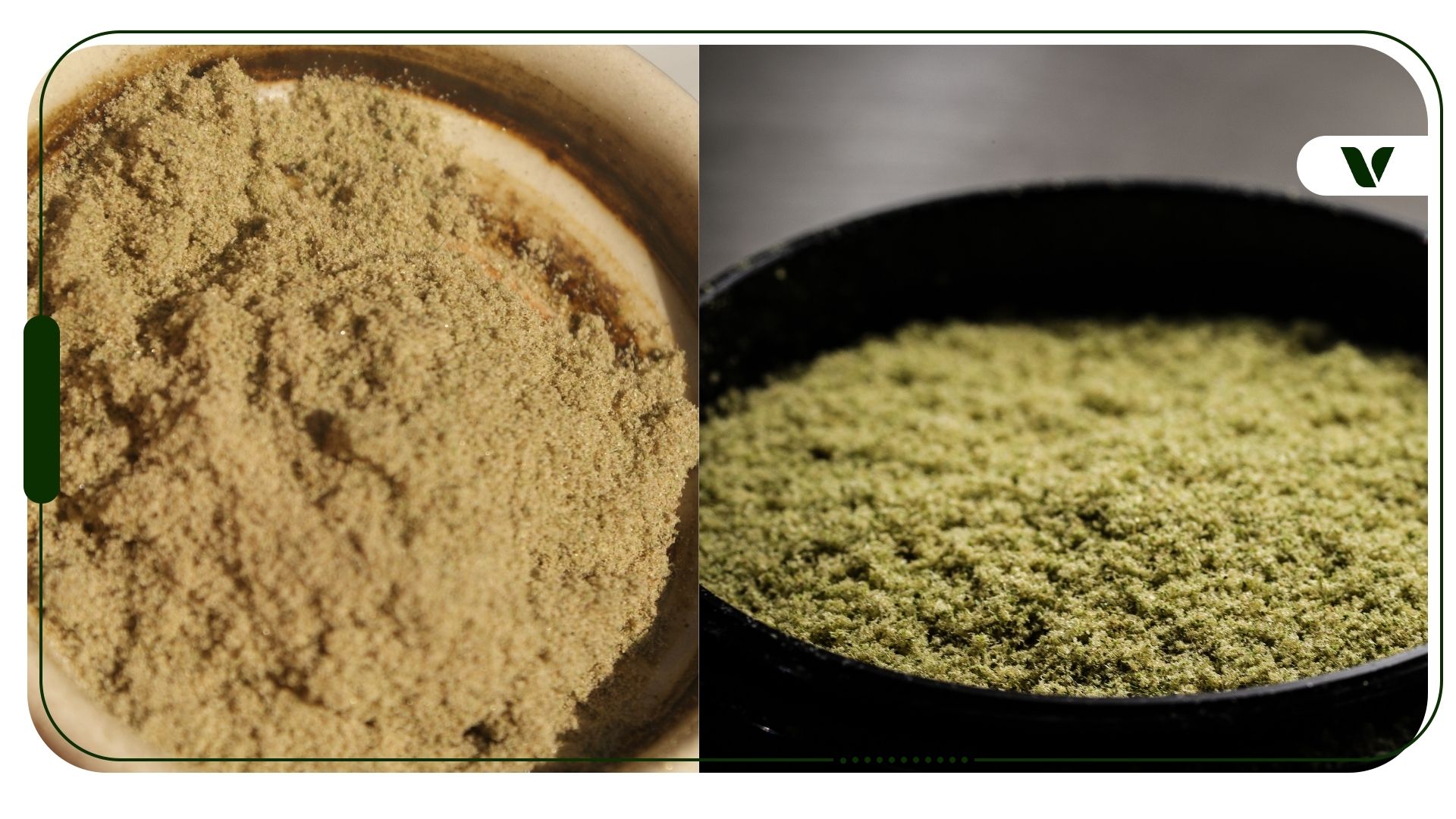
Kief and hash both come from the same part of the cannabis plant, but they are not the same thing. Kief is the loose, powdery collection of cannabis trichomes that falls off flower during grinding or handling. Hash is what you get when those same trichomes are processed further, compressed with heat and pressure or washed with ice water, into a denser, more stable concentrate.
Understanding the difference between the two helps you get more from your material, whether you are sprinkling kief on a bowl, pressing it into a puck, or decarbing either one for edibles.
What Is Kief and How Is It Collected?
Kief is the powdery, golden-green dust that collects at the bottom of your grinder after you break down cannabis flower. It consists almost entirely of trichome heads, the resin-filled glands that contain the plant’s cannabinoids and terpenes. Because plant material and stems are filtered out, kief is considerably more potent than the flower it came from, typically testing between 50% and 80% tetrahydrocannabinol (THC) depending on the source material and how cleanly it was collected.
The reason kief separates so easily is mechanical. As cannabis flower tumbles against the grinder’s teeth, the fragile trichome heads snap off and fall through a mesh screen into a dedicated chamber below. The finer that mesh screen, the purer the kief, since coarser screens allow more plant matter to pass through alongside the resin heads. Understanding the cannabis plant anatomy behind trichome structure helps explain why collection efficiency varies so much between strains and grinder types.
Common Kief Collection Methods (at a Glance)
| Method |
How It Works |
Purity Level |
| Three-chamber grinder |
Flower grinds above a mesh screen; kief drops into a bottom chamber |
Medium |
| Dry sift / silk screen |
Flower is worked over stacked micron screens by hand or machine |
High |
| Freezing method |
Frozen flower is shaken over a screen, making trichomes brittle and easier to collect |
High |
| Coin-press collection |
A coin placed in the kief chamber agitates and compacts loose kief as you grind |
Low to medium |
Most home users collect kief passively using a three-chamber grinder. Dry sift setups using tiered micron screens produce cleaner material with less plant matter, but they require more equipment and effort. Either way, patience is the strategy: meaningful quantities accumulate gradually over weeks of regular use.
What Is Hash and How Is It Made?
Hash, or hashish, is a cannabis concentrate made by collecting trichome resin from the plant and processing it into a compressed, cohesive form. The result is denser and more shelf-stable than loose kief, and it typically delivers a richer aroma because the compression process preserves terpene content more effectively. Hash has been produced for centuries across Central Asia and the Middle East, making it one of the oldest cannabis concentrates in recorded history.
Modern production methods range from simple hand-rolling to sophisticated ice-water extraction. The method used affects both the final texture and the potency of the hash. You can also make hash at home from collected kief using nothing more than parchment paper and moderate heat, which is covered in the pressing section below. For a deeper look at solventless extraction and how hash rosin fits into that picture, see rosin and live rosin explained.
Hash Making Methods (Quick Comparison)
| Method |
Process |
Texture |
Potency |
| Hand-rolled / finger hash |
Resin collected by rubbing fresh flower between palms |
Dark, sticky, soft |
Moderate |
| Dry sift hash |
Kief is sifted through fine micron screens, then pressed |
Blonde to light brown, firm |
High |
| Pressed kief |
Collected kief compressed with heat and pressure |
Dense puck or block |
High |
| Bubble hash / ice water hash |
Flower agitated in ice water, trichomes collected through mesh bags and dried |
Light to dark patty |
Very high (full-melt grades) |
Bubble hash deserves a specific note because it produces some of the cleanest solventless material available. The ice water process separates trichome heads from plant matter more completely than dry sift, and high-grade bubble hash can approach the purity of rosin. The tradeoff is that the process requires a bucket, ice, bubble hash bags in multiple micron sizes, and a way to dry the wet material thoroughly before storage.
What’s the Main Difference Between Kief and Hash?
Kief is stronger on paper, but hash often delivers a more consistent experience. Kief typically contains 50-80% THC, while most hash methods produce material in the 40-60% range, though full-melt bubble hash and rosin-pressed hash can reach higher. The practical difference is that kief is loose and difficult to control in terms of dose and combustion, while hash burns more evenly and predictably. Research examining cannabinoid concentration in solventless cannabis extracts has found that the extraction and compression method significantly influences the final cannabinoid and terpene profile of hash products.
Kief vs. Hash (Side-by-Side)
| Feature |
Kief |
Hash |
| Form / texture |
Loose, powdery, fine |
Dense, solid block or puck |
| Production method |
Mechanical separation (sifting) |
Compression, heat and pressure, or ice-water washing |
| THC range |
Typically 50-80% |
Typically 40-60% (higher for bubble/rosin) |
| Best consumption methods |
Bowl topper, joint filler, edibles (after decarb) |
Smoking, vaping, dabbing, edibles (after decarb) |
| Shelf life |
Shorter; degrades faster if exposed to air |
Longer; density slows oxidation |
| Ease of use |
Easy to collect, harder to handle |
Easier to handle and dose |
| Flavor / aroma |
Fresh, bright terpene profile |
Richer, more complex aroma post-compression |
The potency comparison is worth pausing on. In raw THC percentage, kief from high-quality flower often tests higher than the hash made from the same starting material, because the compression and heating involved in making hash can cause some THC to convert to cannabinol (CBN) or other degradation products. That said, the gap is typically small, and both are dramatically more potent than the cannabis flower they came from.
Is Kief a Type of Hash?
Kief is not a type of hash. Kief is the raw, unprocessed starting material that hash is made from. Hash requires an additional transformation step, whether that is compression with heat and pressure, washing with ice water, or hand-rolling, that kief has not undergone. Calling kief a type of hash is a bit like calling flour a type of bread.
Both come from the same place: the trichome resin heads of the cannabis plant. Both are more potent than cannabis flower, and both are solventless concentrates. The confusion is understandable because they look similar at a glance, especially compressed kief pucks and light-colored hash blocks. The meaningful distinction is processing. Kief is collected and used as-is. Hash is collected and then transformed.
How Do You Use Kief and Hash?
Both kief and hash are versatile, but they each have methods where they perform better. The format of the material, loose powder versus compressed block, shapes how practical each option is for a given consumption method.
Using Kief
The most accessible way to use kief is to sprinkle it over a packed bowl or mix it into a joint. Because it is so fine, a light layer on top of flower is enough to noticeably increase potency. You can also roll a joint, wet the outside slightly, and roll it in kief for a “moon rock” style effect. For edibles, kief needs to be decarbed first, which is covered in the section below. A small amount of kief, roughly 0.1-0.3 grams, is enough to meaningfully boost a single serving if you are working in small batches.
Using Hash
Hash can be crumbled or sliced and added to a bowl or joint much like kief, but its dense texture makes it easier to handle in controlled amounts. Firmer varieties can be dabbed at low temperatures using a dab rig, though soft or oily hash types work better than dry-pressed blocks for this method. Hash can also be gently vaporized, and it pairs well with dry herb vaporizers that have a concentrate insert. Like kief, hash used for edibles needs to go through a decarb process first. If you are new to concentrates and want a broader introduction, the cannabis concentrate guide covers the full landscape.
Which Is Better: Kief or Hash?
Neither is objectively better. The right choice depends on what you are trying to do. Kief is the lower-effort option because it accumulates passively in your grinder and requires no additional processing to use. If your goal is simply to enhance the potency of a bowl or joint without spending extra money or time, kief is the practical answer.
Hash makes more sense when you want something portable, shelf-stable, and easier to dose consistently. A pressed hash puck stores cleanly, travels well, and does not scatter across your tray the way kief does. Hash also tends to have a more developed aroma because the compression concentrates terpenes that might otherwise dissipate from loose kief. The effect duration for both concentrates tends to be longer than flower, which is worth factoring into your session planning. For more on how different consumption methods and potency levels affect duration, see how long a cannabis high lasts.
If you have enough kief and want to extend its shelf life while improving its usability, pressing it into hash is a straightforward solution, which leads directly to the next section.
How to Press Kief Into Hash (Simple Home Method)
Pressing kief into hash at home requires minimal equipment. The basic method uses parchment paper, moderate heat, and firm pressure to compress loose kief into a dense, workable puck. The result is not full-melt quality hash, but it is a stable, longer-lasting concentrate that handles better than raw powder.
What you need: kief, parchment paper, a hair straightener or heated press set to a low temperature (around 150-175 degrees F), and optionally a small metal pollen press or a coin press for a cleaner result.
Steps:
- Wrap a small amount of kief (0.5-1g minimum works well for a coin press) tightly in parchment paper, folding it into a flat packet.
- Apply gentle, even heat and pressure using your hair straightener or press. Hold for 3-5 seconds, release, and repeat 2-3 times.
- Allow the parchment packet to cool completely before opening, roughly 5-10 minutes.
- The kief should have compressed into a firm, golden-brown puck. If it is still crumbly, repeat the heat-and-pressure step once more.
Avoid temperatures above 200 degrees F during this step. Excess heat causes THC to degrade before you have even used the material. For a detailed look at the temperature ranges where THC breakdown occurs, see at what temperature THC degrades.
How Much Kief Do You Need? (Quantities and What to Expect)
Knowing roughly how much kief you are working with helps you plan how to use it. Yield varies by strain, grinder type, and how finely the flower is ground, but here are practical reference points for the most common use scenarios:
- Grinder yield: A typical three-chamber grinder produces roughly 0.3-0.5g of kief per 3.5g of flower ground, though this varies considerably by strain and screen quality. Strains with heavy trichome coverage produce noticeably more.
- Pressing minimum: You need at least 0.5g to press a usable coin-press puck. A rosin press works better with 1g or more, since smaller amounts are harder to keep contained in the micron bag and tend to produce less even compression.
- Edibles dose: For a single serving, 0.1-0.3g of decarbed kief mixed into a fat-based recipe (butter, coconut oil) is a reasonable starting point. Potency varies, so start conservatively.
If you are buying kief from a dispensary rather than collecting it from your own grinder, expect to pay a premium per gram compared to cannabis flower, since the trichome separation and handling involved in producing clean kief adds to the cost. Purchased kief is typically sold in half-gram or full-gram quantities.
How to Decarb Kief and Hash for Edibles
Neither kief nor hash will produce meaningful psychoactive effects in edibles without decarboxylation first. In their raw form, both contain tetrahydrocannabinolic acid (THCA) rather than THC. Heat converts THCA to THC, which is the form your body processes. Skip this step, and your edibles will be significantly weaker than expected. For the full explanation of why decarboxylation matters, see decarboxylation explained.
How to Decarb Kief
Kief decarbs faster than whole flower because it has no dense bud structure to conduct heat through. Spread it in a thin, even layer, and use the lower end of the standard temperature range to avoid degrading THC into cannabinol (CBN) before the decarb is complete.
- Preheat your oven to 220-230 degrees F.
- Spread kief in a thin, even layer on a parchment paper-lined baking sheet. Avoid piling it up, since uneven layers decarb unevenly.
- Bake for 20-25 minutes. The kief will darken slightly and may clump a little. That is normal.
- Remove and let cool completely before using. Studies on THCA-to-THC conversion efficiency at varying decarb temperatures indicate that staying within this temperature range maximizes THC yield while minimizing degradation.
Once decarbed, kief infuses well into fat-based carriers. The cannabis-infused coconut oil creation method works directly with decarbed kief in place of flower, using the same ratio and process. Kief edibles made this way are potent, so dosing conservatively on the first batch is worth it.
How to Decarb Hash
Hash decarbs similarly to kief, but its compressed density means heat penetrates more slowly. Breaking the hash into small crumbles before spreading it on parchment paper helps ensure even decarboxylation throughout.
- Preheat your oven to 230-240 degrees F.
- Crumble hash into small pieces and spread on parchment paper.
- Bake for 25-30 minutes, checking at the 20-minute mark.
- Cool completely before incorporating into your recipe.
The slightly higher temperature and longer time compared to kief accounts for the density difference. The same temperature ceiling applies: keeping the oven below 250 degrees F protects the cannabinoid and terpene content you want to preserve in the final edible.
Storage and Freshness Tips
Kief degrades faster than hash when stored poorly because its loose, exposed surface area makes it more vulnerable to air, light, and heat. The trichome heads that make kief potent are the same structures most susceptible to oxidation and THC degradation. Store kief in a small, airtight glass container in a cool, dark location. Avoid leaving it in the bottom of your grinder for weeks at a time if you are not using it regularly.
Hash stores better by nature. Its compressed form reduces the surface area exposed to oxygen, which slows the degradation process. A well-pressed, properly dried hash block kept in an airtight container, away from light and heat, can typically maintain quality for several months. Avoid storing either kief or hash in plastic bags, which allow air exchange and can cause static buildup that pulls fine material to the sides.
Both benefit from the same general principle that applies to all cannabis storage: cool temperature, darkness, and minimal air exposure slow the breakdown of THC and terpenes. If you are storing a larger quantity for extended periods, a small UV-protective glass jar with a tight lid is the most practical solution for either material.
Note: The content on this page is for informational purposes only and is not intended to be professional medical advice. Do not attempt to self-diagnose or prescribe treatment based on the information provided. Always consult a physician before making any decision on the treatment of a medical condition.
Note: Veriheal does not support illegally consuming therapeutic substances such as cannabis but acknowledges that it transpires because of the current illicit status, which we strive to change by advocating for research, legal access, and responsible consumption. Always consult a physician before attempting alternative therapies.
If you are navigating medical cannabis options and want guidance on what concentrates might fit your situation, speak with a Veriheal cannabis doctor who can help you understand your state’s qualifying conditions and legal access options.
Frequently Asked Questions
Is kief stronger than hash?
Kief typically tests higher in raw THC percentage, often in the 50-80% range, compared to most hash methods which produce material in the 40-60% range. The compression and mild heating involved in making hash can cause some THC to convert to other compounds, which narrows the potency gap slightly. Both are significantly more potent than cannabis flower.
Can you press kief into hash at home?
Yes, kief presses into hash using parchment paper and a hair straightener set to a low temperature, around 150-175 degrees F. Apply gentle heat and pressure in short intervals, let the packet cool, and the kief will have compressed into a firm puck. A minimum of 0.5g gives you enough material to work with.
What is the best way to use kief?
The simplest way to use kief is to sprinkle it over a packed bowl or mix it into a joint to boost potency. For edibles, kief needs to be decarbed first at around 220-230 degrees F for 20-25 minutes, then infused into butter or oil.
Can you eat kief or hash without decarbing it?
Eating raw kief or hash without decarbing will produce significantly weaker effects than expected because the dominant compound in both is THCA, not THC. THCA does not interact with the body the same way THC does, so skipping decarboxylation means most of the potency is wasted.
Does hash get you higher than regular weed?
Hash is substantially more potent than cannabis flower because it is a concentrate of trichome resin rather than whole plant material. Even modest hash types test at 40% THC or above, compared to typical flower in the 15-25% range, so the effects are more intense and the appropriate dose is much smaller.
What’s the difference between hash and rosin?
Hash is made by compressing collected trichomes using heat and pressure or ice-water extraction, while rosin is made by pressing flower, hash, or kief under high heat and pressure to squeeze out a solventless oil. Rosin is generally considered a more refined and purer extract, and hash can actually serve as the starting material for a product called hash rosin.
Can you make hash from kief?
Yes. Kief is the most common starting material for home hash production. Wrapping kief in parchment paper and applying gentle heat and pressure is all that is needed to press it into a functional hash puck. The result is denser, easier to store, and more shelf-stable than loose kief.
Author, Share & Comments