Your medical cannabis journey simplified: find partnered dispensaries, explore pricing options, earn rewards, and get answers to FAQs, all in one spot.
Art isn’t always so easily explainable, often due to its sometimes subjective nature. Pop culture — specifically, movies and music — has transformed into the primary artistic showcase for the masses over the last half century. A considerable shift in tone and expression in pop culture took a sharp turn in the 1960s, largely due to the countercultural influence on society at the time.
The results of this countercultural and drug-fueled revolution are some of the most enduring and endearing music and films ever created. Much of that media contains overt as well as vague references to drugs that might fly well over the heads of the inexperienced among conventional society. Meanwhile, the rest of us can easily decipher and pick up what those folks were throwing down. The cultural impact that many of these artists and filmmakers have had on society since then is substantial enough to warrant a review of some of their messages and influence.
The 1960s Ushered in Psychedelia
The backdrop of an unpopular war, coupled with civil rights protests, created the right winds for upheaval in American society during the 1960s. Significant changes in how typical American society operated and perceived its place in time shifted dramatically from the conventionality of post-World War II. Rock and roll, literature, and films had all already had a significant effect on society at that time; however, once psychedelic drugs and mainstream cannabis usage entered the void, things were never the same again.
Mind-expansion and new ways of thinking burst from the seams of American society in the mid-to-late 1960s on through the early 1970s, no doubt fueled by the lysergic acid diethylamide (LSD) experience. Hairstyles and clothing made a dramatic shift, but more importantly, so too did art, Filmmaking, and popular music become the defining pop culture canvases of the era in contrast to abstract painting and literature, which had dominated for so many decades and centuries before.
Popular music and movies represented a new world order in which the youth generation and drug cultures would have a lasting impact. Cannabis and psychedelics came to represent freedom, independence, and rebellion from the conventionality of society, and music and movies of the time mirrored those notions.
The Roots of the Psychedelic 60s
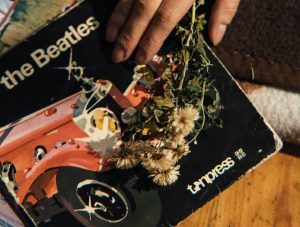
The Beat Generation was a group of American artists, poets, and writers like Jack Kerouac, William S. Burroughs, and Allen Ginsberg whose muses were the spirit of independence, defined no doubt by Kerouac’s seminal book On the Road. These luminaries loomed large to anyone who wished to defy and go further than what American society deemed acceptable and conventional. Beat Literature influenced artists like The Beatles, whose name even refers to the Beats–Bob Dylan, The Grateful Dead, and many more.
Fans of Beat Literature also included Ken Kesey, a luminary of the counterculture that developed in American society as a result of LSD’s popularity. Kesey got a job as a test subject for what was eventually discovered as the MK Ultra experiments by the Central Intelligence Agency (CIA).
Kesey was paid to ingest large doses of LSD, peyote, and mescaline while undergoing supervised trips that, unbeknownst to him, the CIA was testing in an attempt to create a sort of “mind-control” influence for the military. Ken Kesey secretly took a personal stash of LSD from the veteran’s hospital—where researchers were testing the drug on him—and used it recreationally with his friends. His LSD experiences, along with the time he spent working in the hospital’s mental health ward, directly shaped his 1962 novel One Flew Over the Cuckoo’s Nest. He wrote the first few pages of the book while under the influence of LSD. Much of the symbolism in the book is a result of new ways of thinking that Kesey had following his initial LSD trips, including the experiences of the book’s narrator, Chief Bromden.
Once word got around to people like the chemist Stanley Owsley, another friend of Kesey and the Grateful Dead, he began to synthesize his own, purer LSD recipe and produce millions upon millions of tablets of it. This led to widespread LSD usage in the Bay Area during the mid to late 1960s, with “Acid Test” events by Kesey and friends starting much of the psychedelic influence that spread worldwide and eventually made it illegal soon after.
Popular Music Became Turned-On By Cannabis and LSD
Before LSD became mainstream in the 1960s, there was a good chance your little sister would be bopping along to some pretty harmless kid stuff like Connie Francis or Pat Boone on the jukebox while enjoying a soda pop at the local pharmacy. However, once LSD came on the scene, she was probably more likely to jam out to a Santana record and smoke a joint with her friends before her parents got home from work.
I Asked Bobby Dylan, I Asked the Beatles
Popular music became inundated with psychedelic and cannabis-friendly lyrics and imagery by musical artists during this time. The Beatles evolved from writing simple R&B tunes to crafting introspective and imaginative songs that profoundly influenced society. Songs like “Got To Get You Into My Life” and “Tomorrow Never Knows” from the album “Revolver” were odes to John Lennon and Paul McCartney’s recent experiences with LSD. Fantastical songs like “Yellow Submarine” would demonstrate the Fab Four’s trademark psychedelic whimsy.
None of these songs ever directly mentions LSD, but their messages and lyrics allude to the mystery, introspection, and joy that many users of LSD have experienced. This phenomenal new dynamic ultimately culminated in their psychedelic masterpiece, “Sgt. Pepper’s Lonely Hearts Club Band,” featuring songs with vague and not-so-vague references to drugs like “Lucy In The Sky With Diamonds”.
See If You Qualify For Medical Marijuana -Select Your State!
Select Your State
Alabama
Alaska
Arizona
Arkansas
California
Colorado
Connecticut
Delaware
Florida
Georgia
Hawaii
Idaho
Illinois
Indiana
Iowa
Kansas
Kentucky
Louisiana
Maine
Maryland
Massachusetts
Michigan
Minnesota
Mississippi
Missouri
Montana
Nebraska
Nevada
New Hampshire
New Jersey
New Mexico
New York
North Carolina
North Dakota
Ohio
Oklahoma
Oregon
Pennsylvania
Rhode Island
South Carolina
South Dakota
Tennessee
Texas
Utah
Vermont
Virginia
Washington
West Virginia
Wisconsin
Wyoming
Never miss a post
Get updates on cannabis culture, new research, and expert insights
The Beatles were inspired by The Beats, as was Bob Dylan. Dylan, a folk singer by trade, eventually rejected the labels the media and mainstream culture put on him and evolved into the artist he wanted to be, not the one they expected. His attitude was and still is ultimately a testament to the “choose your own path” mentality that constituted much of the counterculture.
Dylan’s use of LSD and cannabis would influence many of his vaguely stream-of-consciousness lyrical songs, such as “Mr Tambourine Man”, “Stuck Inside of Mobile with the Memphis Blues Again”, and “Visions of Johanna”. However, Dylan could also be right on the nose lyrically when he wanted to be regarding drugs–case in point, his song “Rainy Day Women #12 & 35” and its chorus “Everybody Must Get Stoned!”.
Pop Music Followed Suit Once the Psychedelic Cat Was Out of the Bag
The counterculture and drug culture of the mid-to-late 60s and early 70s heavily influenced a sizable portion of pop music. Even clean-cut bands like the Beach Boys embraced the era’s swirling psychedelia.. Clean-cut kids like the Beach Boys even got turned on by the psychedelia swirling around everywhere at the time. Beach Boys songs like “Good Vibrations” and “I Know There’s An Answer (Hang On to Your Ego)” introduced a newfound mindset affected by LSD. Psychedelics inspired Miles Davis to shift from his usual jazz styles into the more free-flowing and loose fusion music featured on classic albums like “Bitches Brew” and “In A Silent Way”.
Many people interpret David Bowie’s song “Space Oddity” as a reflection of an LSD experience. Artists in that era often blurred the lines between drug references and abstract expression, making it hard to tell where one ended and the other began. Even The Fifth Dimension’s “Up, Up, and Away” sounds like a celebration of being incredibly high—or simply an ode to personal freedom. Both interpretations capture the essence of the counterculture movement, which embraced altered states and liberation as central values.
New Hollywood Infused Countercultural Ideals Into Filmmaking
The ripples of LSD, cannabis, and the counterculture spread to Hollywood in the mid-to-late 60s and early-70s as well. Writers and directors presented new perspectives to movie audiences that were free of the trappings of the studio system that had previously dominated storytelling. Directors utilized experimental and visionary approaches to reshape cinema, offer fresh perspectives, and empower independent voices to contribute meaningfully to the broader cultural conversation.
New Hollywood filmmakers like Mike Nichols, Bob Rafelson, and Hal Ashby embraced techniques drawn from experimental European cinema from previous decades, similar to how some musical artists were influenced by the Beats. The rise of the anti-hero in films at that time made for a morally ambiguous central character that could sometimes lack the morals and values that were previously seen as essential in a protagonist. A great example of this is the main characters–drug-dealing bikers–of the 1969 film, Easy Rider, because audiences rooted for these unconventional main characters.
Filmmakers of the New Hollywood style often portrayed drug use and the psychedelic experience in new and interesting ways, often blurring the lines of what could be thought of as representing the drug experience or just what is plain weird and unconventional looking. The Beatles’ animated film, “Yellow Submarine,” was based on the song of the same name. This oddly vibrant and euphoric film doesn’t overtly state that it’s about drug use, but it’s certainly implied.
New Era, Same Ambiguity
The legacy of the spirit of the ’60s continued, with characters like the old hippie Jeffrey Lebowski in 1998’s cult classic, The Big Lebowski. “The Dude,” as he’s known to all, regularly has sudden and trippy experiences that seem eerily similar to what many describe as acid flashbacks.
Homer Simpson even gets in on some of the drug experience ambiguity in 2007’s “The Simpsons Movie” when he undergoes what could easily be seen as an ayahuasca ceremony in a tipi during one very funny scene. However, the countercultural impact that pop culture from previous decades had by this time either dwindled considerably or became permanently incorporated into the fabric of mainstream culture.
Psychedelic and Cannabis-Centric Ideas Are No Longer a Secret
Society has since learned to grapple with the impact of psychedelics and cannabis on ideas and messages found in popular music and films. It’s certainly not as risque to mention, promote, glorify, or even imply drug use by any artist or filmmaker in this day in age.
The true impact of the counterculture is currently most relevant in how an artist wishes to portray their point of view experimentally or unconventionally. A lot of current pop culture doesn’t leave much to the imagination. However, sometimes it is not as obvious that modern-day pop artists or filmmakers are speaking about the drug experience, continuing on a tradition in which those types of ambiguous expressions have always been a fun point of discussion.
Anthony DiMeo is a Southern New Jersey-based journalist and cannabis advocate whose work and advocacy have been featured in Leafly, DOPE Magazine, and the Philadelphia Inquirer. Hobbies include navigating interdimensional psychedelic energy vortexes and tennis.
In the confusing landscape of state-by-state medical marijuana legalization and federal prohibition lies a patient’s pursuit of a better quality of life, balanced with an unrestricted financial livelihood. In workplaces across many different medical marijuana legal states, no law guarantees that a valid, card-carrying MMJ patient status exempts an employee from termination or discrimination stemming…
It feels like every other day, a fresh slang term pops up in the cannabis lexicon, and today, we’re looking at an entry that’s all over TikTok and Reddit – Yart! Spoiler alert: it has everything to do with the humble vape cart (and how challenging it is to talk about cannabis on social media). …
The final stage of life often brings profound challenges for both patients and their families. For patients in hospice and palliative care, common symptoms not only affect the physical body but also their mental well-being. While traditional medications may dull pain, they often come with heavy sedation, confusion, and loss of clarity. Fortunately, medical cannabis…
The old “lazy stoner” stereotype is quickly fading. We now see bodybuilder moms using cannabis for better sleep, runners getting in the zone with the help of weed, and many other examples of cannabis being used in ways that counter the unmotivated stereotypes of the past. As legal access to the plant increases, more people…
If you’re planning to get a medical marijuana card in 2026, you might be wondering whether you need to meet with a certified cannabis doctor—either online or in person. Still, finding a qualified medical marijuana doctor near you can feel overwhelming and confusing if you’re not sure where to start. This guide shows you exactly…
The statements made regarding cannabis products on this website have not been evaluated by the Food and Drug Administration (FDA). Cannabis is not an FDA-approved substance and is still illegal under federal law. The information provided on this website is intended for educational purposes only and is not intended to diagnose, treat, cure, or prevent any disease. It is not intended as medical advice and should not be considered as a substitute for advice from a healthcare professional. We strongly recommend that you consult with a physician or other qualified healthcare provider before using any cannabis products. The use of any information provided on this website is solely at your own risk.