1-855-452-6224 (Customer Support Available 24/7)


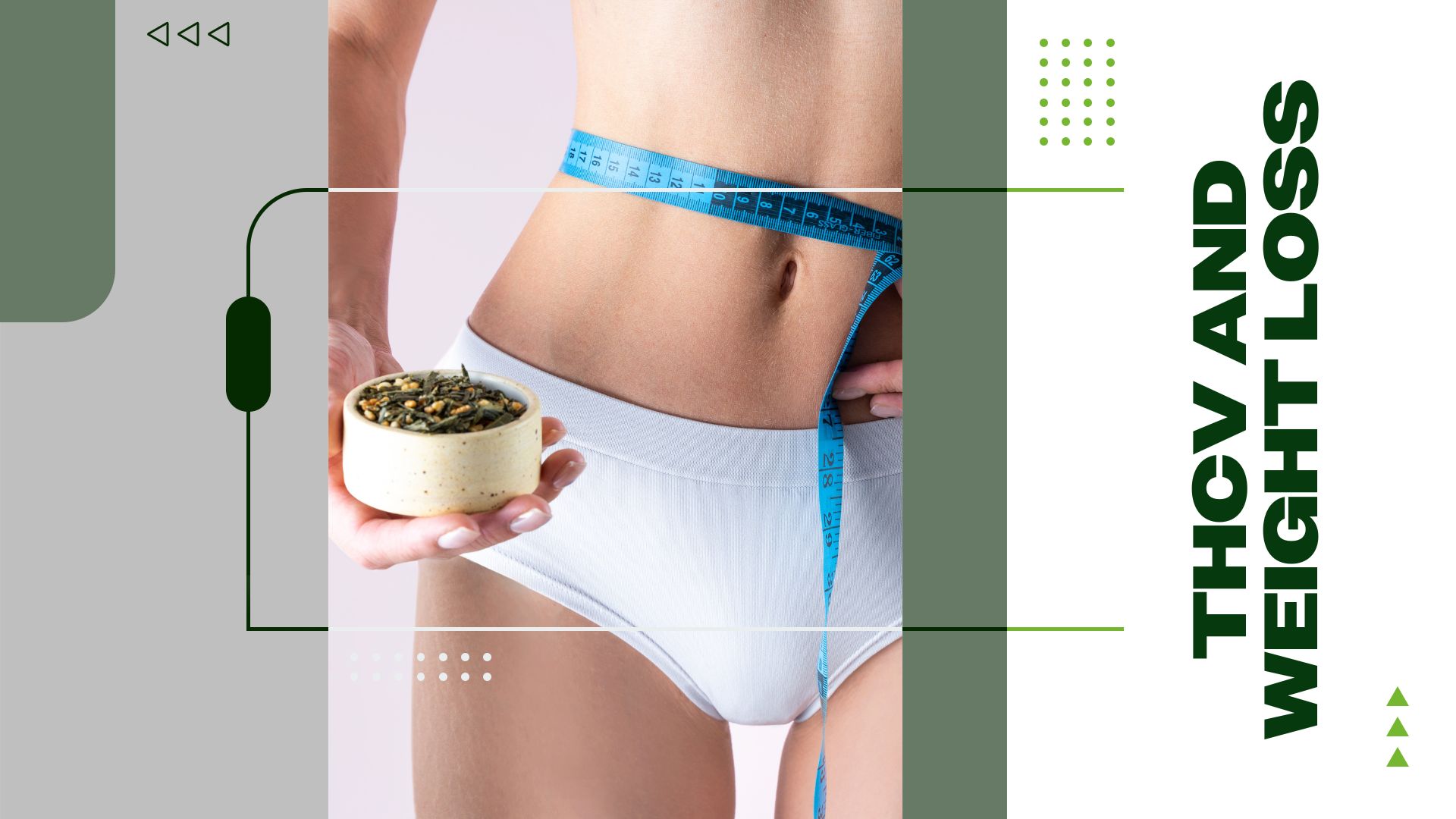
Tetrahydrocannabivarin (THCV) is a non-psychoactive cannabinoid compound with a unique variety of appetite effects and possible medical benefits (1). As research on it progresses, its full potential becomes more fascinating. This cannabinoid has been known to counteract the psychoactive effects of Δ9-tetrahydrocannabinol (THC), and leave its consumers feeling more motivated, alert, energized, and euphoric.
Along with those effects, THCV may provide better sugar and insulin control benefits in Type 2 diabetes and potential motor relief from medical conditions such as Parkinson’s disease and seizures as well as taking on a neuroprotective and anti-inflammatory role (6). THCV stands out from THC and cannabidiol (CBD) due to its distinct combined provision of potential medical benefits and effects.
THCV has a similar molecular structure to THC without sharing the same psychoactive properties. Psychoactive properties refer to compounds that have an effect on the mind. The only difference between THCV and THC is that molecularly there is a 3-carbon group instead of a 5-carbon group. The number tells you the elongation of the hydrocarbon which consists of hydrogens bound to carbon. This small change makes THCV an inverse agonist and antagonist at CB1 and CB2 receptors, rather than THC which activates CB1. It also gives THCV an advantage in the medical space for being non-psychoactive in humans (1).
The discovery of this cannabinoid containing a sort of ‘combination’ between the effects of CBD and THC, shows just how much we have yet to find out about the cannabis plant. Similar to CBD, THCV can make some of the effects of THC less severe, leaving you with a clearer mind. A 2015 study put THCV to the test against the psychological and physical effects of THC and found that it is able to counteract the intensity of the psychoactive effect as well as inhibit THC-induced increases in heart rate (3).
Researchers have found that cannabis contains over five hundred different organic compounds, each with its own potential benefits and effects. However, THCV can be found more commonly in certain strains of cannabis and in minute amounts in others. For the moment, THCV’s overall psychological effects are still undergoing research, as are many other aspects of this cannabinoid. The more that is learned, the more amazing this cannabinoid becomes. Let’s look at some of the possible benefits of consuming THCV.
THCV has a variety of health benefits and researchers hope to keep discovering its potential uses in the future. Some of these benefits include:
THCV can be found at trace levels in most strains, however, if you want to benefit from the cannabinoid, you will have to consume strains that have a higher quantity, such as the recommended strains below:
It is important to note that you may be able to purchase THCV distillate and shatter as well in some dispensaries. Many of the strains above are genetically linked to landrace strains. These strains began in parts of Asia and Africa and are known for invigorating highs.
Though there is still a lot to learn about THCV and many of its sister cannabinoids found in cannabis, the results from several studies show some promising uses for the future. Although research is continuing, there is no doubt we will continue to learn and one day confirm the medical benefits, including weight loss, that THCV can deliver.
Note: The content on this page is for informational purposes only and is not intended to be professional medical advice. Do not attempt to self-diagnose or prescribe treatment based on the information provided. Always consult a physician before making any decision on the treatment of a medical condition.
1. Abioye, A., Ayodele, O., Marinkovic, A. et al. Δ9-Tetrahydrocannabivarin (THCV): a commentary on potential therapeutic benefit for the management of obesity and diabetes. J Cannabis Res 2, 6 (2020).https://jcannabisresearch.biomedcentral.com/articles/10.1186/s42238-020-0016-7
2. Cascio, M. G., Zamberletti, E., Marini, P., Parolaro, D., & Pertwee, R. G. (2015). The phytocannabinoid, Δ⁹-tetrahydrocannabivarin, can act through 5-HT₁A receptors to produce antipsychotic effects. British journal of pharmacology, 172(5), 1305–1318. https://www.ncbi.nlm.nih.gov/pmc/articles/PMC4337703/
3. Englund, A., Atakan, Z., Kralj, A., Tunstall, N., Murray, R., & Morrison, P. (2015). The effect of five day dosing with THCV on THC-induced cognitive, psychological and physiological effects in healthy male human volunteers: A placebo-controlled, double-blind, crossover pilot trial. Journal of Psychopharmacology, 30(2), 140–151. https://journals.sagepub.com/doi/abs/10.1177/0269881115615104
4. Idris, A. I., & Ralston, S. H. (2012). Role of cannabinoids in the regulation of bone remodeling. Frontiers in endocrinology, 3, 136. https://www.ncbi.nlm.nih.gov/pmc/articles/PMC3499879/
5. Jadoon, K. A., Ratcliffe, S. H., Barrett, D. A., Thomas, E. L., Stott, C., Bell, J. D., O’Sullivan, S. E., & Tan, G. D. (2016). Efficacy and safety of Cannabidiol and Tetrahydrocannabivarin on glycemic and lipid parameters in patients with type 2 diabetes: A randomized, double-blind, placebo-controlled, Parallel Group Pilot Study. Diabetes Care, 39(10), 1777–1786. https://care.diabetesjournals.org/content/39/10/1777.long
6. Salami, S. A., Martinelli, F., Giovino, A., Bachari, A., Arad, N., & Mantri, N. (2020). It Is Our Turn to Get Cannabis High: Put Cannabinoids in Food and Health Baskets. Molecules (Basel, Switzerland), 25(18), 4036. https://www.ncbi.nlm.nih.gov/pmc/articles/PMC7571138/
Are these just smokable or is their any edibles in the Strans ?
You would need to get flower from one of the mentioned strains or another with a high THCV content and make a base infusion such as cannabutter or infused coconut oil that you can use to make edibles.
Your awesome Chane and I love this article and will be researching more on (THCV) thank you for sharing:)
Is it available for purchase at Veriheal?
We don’t sell cannabis products at this time.
Very interesting.
Thank you.
I enjoyed the article that you wrote and I would love to find out how can I receive THCV thank you Bill
I just ordered THCv isolate. What is a good starter dose and how should I consume it? Just let it dissolve under my tongue? I’m guessing??? Or ingest it?
Kinda confused. Thanks for any help.
Hi, Jason! If it’s in the form of a tincture, you will want to let it dissolve under your tongue. If it’s in a crystalline form, you can dab it or put it into a vaporizer that takes concentrates. If it’s a powder, you can mix it in food, etc. As far as dosing, that is a journey that is a ‘to each their own’ situation. Start with 5mg, see how you feel, and then build up from there. Hope that helps!
I find this very interesting. I visited my local dispensary and my dedicated associate was not familiar with the ‘V’ part. Should I have asked for the strains suggested? Was unsure if ‘Girl Scout Cookie’ just to name a strain was produced and offered as the same in any dispensary.
Okay… Where do I buy this product here in Las Vegas?
The Girl Scout Cookies seeds that I have found to buy refer to the extreme munchie effect to be prepared for.. Would you recheck the thvc in this strain please ?
Hi,
Thank you for sharing your experience. Unfortunately, the contents of cannabis strains under the same name to vary quite a bit- which is part of the difficulty in regulating cannabis. However, I will take this under advisement and do some more research. Have a great day!
Where can we get THCV from !
Howdy it seems when I find strains that work well with my diabetes type 2 and chronic osteoporosis pain inflammatory spinal pain I usually hit commerce city kush for pain it’s great I was using critical sensi star it disappeared can’t find it then crescendo #11 was also another one but something happened to it the potency completely changed for the worse in AR buying weed is like Forest Gumps famous words AR weeds like a box of chocolate you never know what your going to get and worse part is I’m struggling on disability I can’t afford to purchase just to see what works at 45 an eighth .Any ideas ??? I just had my 5th Stent placement I had a bypass surgery in 2016 been told by pain management I need surgery on back but I’m trying my best to get by on opiates and weed to keep that on back burner no surgery unless I can’t walk .
Sign up for our newsletter
Learn the process in your state
All Rights Reserved Veriheal Inc. ©
Terms Privacy Policy Advertising Agreement Content Disclamer

Get your medical marijuana card today
Sign up in under 5 minutes
Start By Selecting Your State
 Alabama
Alaska
Arizona
Arkansas
California
Colorado
Connecticut
Delaware
Florida
Georgia
Hawaii
Idaho
Illinois
Indiana
Iowa
Kansas
Kentucky
Louisiana
Maine
Maryland
Massachusetts
Michigan
Minnesota
Mississippi
Missouri
Montana
Nebraska
Nevada
New Hampshire
New Jersey
New Mexico
New York
North Carolina
North Dakota
Ohio
Oklahoma
Oregon
Pennsylvania
Rhode Island
South Carolina
South Dakota
Tennessee
Texas
Utah
Vermont
Virginia
Washington
West Virginia
Wisconsin
Wyoming
Puerto Rico
Alabama
Alaska
Arizona
Arkansas
California
Colorado
Connecticut
Delaware
Florida
Georgia
Hawaii
Idaho
Illinois
Indiana
Iowa
Kansas
Kentucky
Louisiana
Maine
Maryland
Massachusetts
Michigan
Minnesota
Mississippi
Missouri
Montana
Nebraska
Nevada
New Hampshire
New Jersey
New Mexico
New York
North Carolina
North Dakota
Ohio
Oklahoma
Oregon
Pennsylvania
Rhode Island
South Carolina
South Dakota
Tennessee
Texas
Utah
Vermont
Virginia
Washington
West Virginia
Wisconsin
Wyoming
Puerto Rico