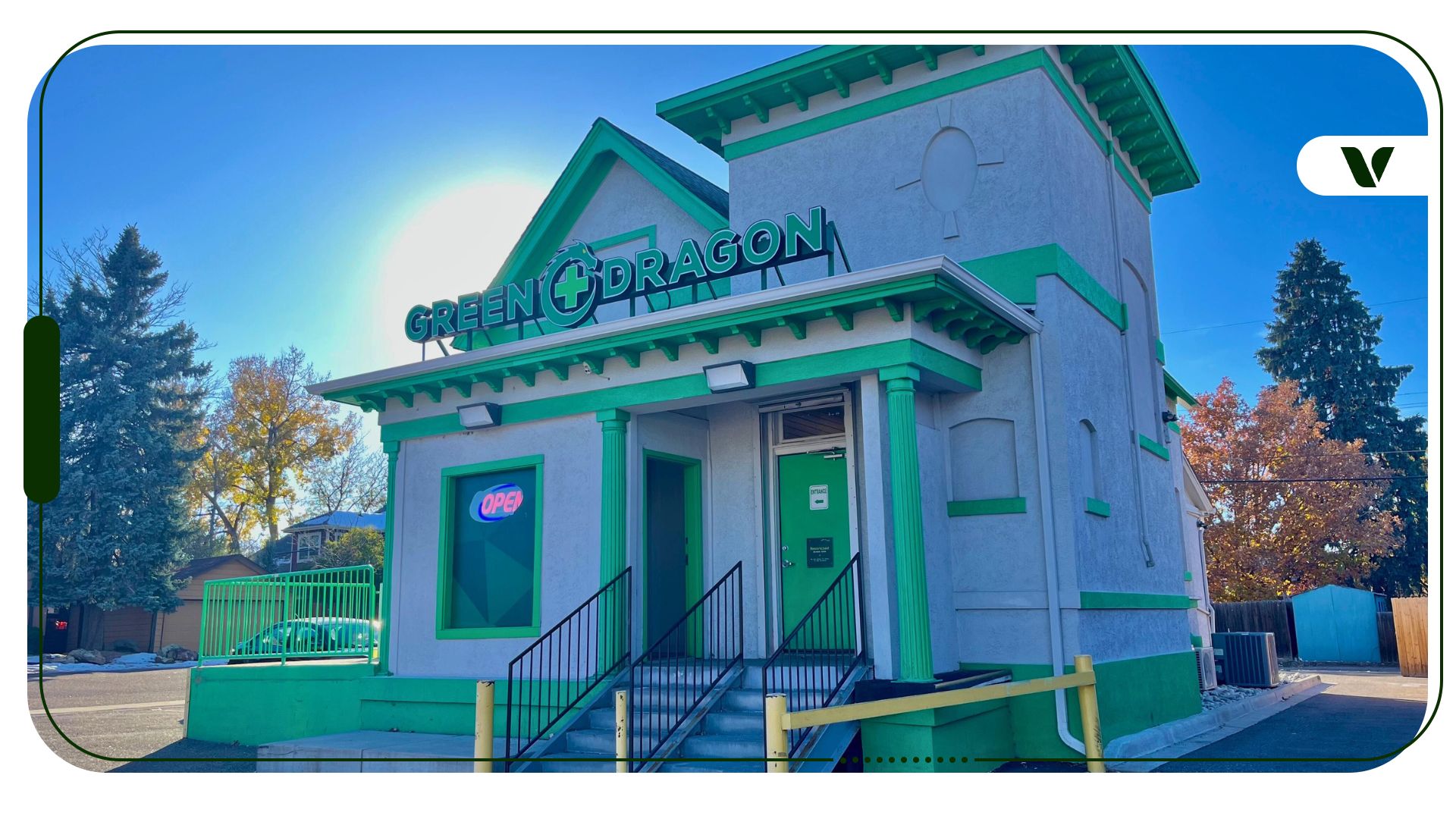
Green Dragon, one of the most established multi-state cannabis operators in the country, is closing dispensaries and cultivation facilities across Colorado and Florida after 15 years in business. The name carries some recognition beyond the dispensary chain itself, in part because the green dragon tincture recipe is a well-known homemade cannabis preparation that predates the company and happens to share its name.
But the shutdowns underway now are not just a story about one company’s troubles. They reflect market forces that are reshaping cannabis retail across two of the most significant legal cannabis states in the US.
If you’ve followed Green Dragon as a customer, employee, or industry watcher, the scale of what’s happening is significant. Colorado is losing 17 dispensaries and a major Denver grow facility. Florida is losing 39 dispensaries and a 400,000-square-foot cultivation operation. Understanding why each state’s situation unfolded differently matters as much as knowing the numbers.
Did Green Dragon Get Bought Out? The Eaze Connection
Yes. Green Dragon was acquired by Eaze, a California-based cannabis technology and delivery company. The parent entity that filed the Colorado closure notice in October 2024 was DP Holdings Colorado LLC, operating under Eaze’s ownership structure. Eaze CEO Cory Azzalino has been the named decision-maker in public statements about the closures, particularly around the cultivation facility shutdowns.
Understanding this ownership structure matters because it reframes the story. Green Dragon’s collapse is not the failure of an independent Colorado operator. It is the unwinding of a multi-state retail footprint that a California-based parent company can no longer sustain at current market economics.
Azzalino’s public comments have focused on the cultivation economics rather than any broader strategic exit from Colorado or Florida retail. What remains unclear is whether Eaze intends to retain any licensed retail presence in either state under the Green Dragon brand or through a successor entity.
The most reliable way to check which Green Dragon locations remain operational is the Colorado Marijuana Enforcement Division (MED) licensed facilities database for Colorado locations, since operational status changes faster than any editorial update can track.
What Is Driving Colorado’s Dispensary Closures?
The economics of growing cannabis in Colorado have fundamentally changed, and Green Dragon’s cultivation footprint made the company especially vulnerable to that shift.
The Numbers Behind the Colorado Closures
The operational scope of the Colorado closures is substantial:
- 17 dispensaries closed across the state
- 92,000-square-foot grow facility at 830 Wyandot St. in Denver shuttered
- 59 layoffs tied to dispensary operations
- 45 additional employees at the 830 Wyandot St. facility affected by the June 2025 cultivation shutdown
- Closure notice filed by DP Holdings Colorado LLC in October 2024
Those numbers represent one of the largest single-operator contractions Colorado’s cannabis market has seen. The cultivation facility closure, announced separately from the dispensary closures, came as the direct result of an economic calculation that Azzalino made public.
Why In-House Cultivation Stopped Making Sense
Azzalino’s explanation for shutting down the 830 Wyandot St. facility was direct: buying cannabis wholesale is now cheaper than growing it in-house. The average wholesale price for a pound of flower in Colorado fell from approximately $1,300 in October 2021 to around $655 by mid-2025, according to Colorado Department of Revenue data. When the market price of a product drops below the cost of producing it, no amount of operational efficiency closes that gap.
This is what price compression looks like at scale. Colorado legalized recreational cannabis in 2012 and now has one of the most saturated cannabis markets in the country. Years of new license issuance and expanded cultivation capacity drove supply well ahead of demand, pushing wholesale prices down steadily. For operators who built large vertical integration models, those fixed costs of cultivation, staffing, and facility maintenance became liabilities rather than advantages.
The Green Dragon situation illustrates a structural problem facing any multi-state operator that scaled cultivation capacity during the high-price years. Vertical integration was a competitive advantage when wholesale prices were high. At $655 per pound, it is a cost center.
For information on how medical vs. recreational cannabis taxes compound the financial pressure on operators in both market types, Colorado’s dual-market structure adds another layer of cost complexity.
Colorado’s Cannabis Sales Are Falling: By the Numbers
The wholesale price collapse does not exist in isolation. Colorado’s total cannabis sales have declined year over year, reflecting a market that has matured past its growth phase.
| Period |
Monthly Sales |
| August 2023 |
$132.45 million |
| August 2024 |
$109 million |
That $23 million year-over-year decline in a single month captures the direction of travel. Colorado’s cannabis market sales data from the Colorado Department of Revenue shows a multi-year pattern of contraction, not a single-year anomaly.
For operators running large fixed-cost cultivation facilities, declining retail sales volumes compound the pressure from falling wholesale prices. The Green Dragon closures are the most visible consequence of that combination so far, but they are not likely to be the last.
What Happens to the Workers at 830 Wyandot St.
The 45 employees at the 830 Wyandot St. cultivation facility faced a distinct timeline from the earlier dispensary closures, with the facility shutdown occurring by the end of June 2025. Workers affected by a closure of this scale should be aware of how federal and state notification requirements apply.
The federal Worker Adjustment and Retraining Notification Act (29 U.S.C. § 2101), commonly called the WARN Act, requires 60 days’ advance notice for layoffs affecting 100 or more employees at a single site. For smaller layoffs, Colorado’s own labor provisions and the Colorado Department of Labor and Employment (CDLE) Rapid Response Unit are the relevant resources for displaced worker support, including job placement assistance and benefits guidance.
Affected employees should contact CDLE directly to understand what support is available based on the specific size and timing of the layoff. This article is not legal or employment advice. Anyone navigating a layoff from a cannabis facility should seek guidance from CDLE or a qualified employment attorney.
Why Green Dragon’s Florida Exit Looks Different From Colorado
Florida’s Green Dragon closures involve larger numbers than Colorado’s, but the underlying cause is different. In Colorado, the driver is wholesale price compression in a recreational market with too much supply. In Florida, the driver is a regulatory future that did not materialize.
The Florida Numbers
The Florida operational closure is the larger of the two by every measure:
- 39 dispensaries closed across the state
- 400,000-square-foot cultivation facility shuttered
- 113 layoffs tied to the Florida operations
- DP Holdings filing covered both the Colorado and Florida operations
A 400,000-square-foot cultivation facility is not built to serve a medical-only market. It is built in anticipation of a recreational market that requires significantly higher volume. Understanding why Green Dragon built to that scale, and why it became untenable, requires understanding what happened in November 2024.
How Amendment 3’s Failure Changed the Calculus
Florida voters rejected Amendment 3 in November 2024, keeping the state in a medical-only cannabis framework. That outcome closed off the recreational expansion that cannabis operators, including Green Dragon, had reportedly been factoring into their capacity planning. A 400,000-square-foot cultivation facility sized for recreational volume does not pencil out in a medical-only market, particularly when patient count growth has come in below projections.
Data from New Cannabis Ventures on Florida’s patient count trends supports this picture: the medical patient base has not grown at the rate operators projected when making infrastructure decisions during the pre-Amendment 3 period. The gap between projected patient volume and actual patient volume is the gap between a facility that makes economic sense and one that does not. Florida’s situation is not about price compression in the way Colorado’s is. It is about a regulatory outcome foreclosing a market expansion that had already been built for.
This distinction matters for anyone watching what happens next in Florida. The state’s medical-only framework remains in place, and the operators best positioned in that environment are those who scaled to medical demand rather than anticipated recreational demand. Green Dragon’s 400,000-square-foot facility represents the cost of building for a future that voters chose not to create. The broader question of what areSchedule 1 drugs and federal cannabis scheduling continues to shape which financial tools and restructuring options are available to cannabis operators in states like Florida when closures occur.
What This Means for Cannabis Operators and Patients
The Green Dragon closures raise structural questions that extend well beyond one company. The two audiences most directly affected are operators watching this unfold and patients who relied on Green Dragon locations.
For Operators: What the Vertical Integration Collapse Signals
Azzalino’s explanation for the grow facility shutdown frames the question every multi-state operator with in-house cultivation now has to answer: at what wholesale price does growing your own product stop making sense? In Colorado, the market answered that question at roughly $655 per pound. Operators running cultivation facilities with similar cost structures should be stress-testing their economics against that figure now rather than after a filing.
The regulatory wind-down for a licensed cultivation facility is not instantaneous. Closing a licensed grow in Colorado requires license surrender, a premises deactivation inspection, and inventory liquidation or transfer procedures under Colorado Marijuana Rules (1 CCR 212-3), administered by the state’s Marijuana Enforcement Division (MED).
The process takes time, and operators watching the Green Dragon situation should understand that exiting a cultivation license is a structured regulatory process, not a simple shutdown. The conversation around how many people are still in prison for cannabis is a reminder that cannabis’s continued federal Schedule I status shapes every aspect of how operators must navigate financial distress, including the unavailability of standard bankruptcy protections.
For Patients: Finding Alternative Dispensaries
Patients who relied on Green Dragon locations in Colorado or Florida need to confirm which dispensaries near them are currently licensed and operational. Operational status changes faster than any published article can track, so the most reliable sources are official state databases.
In Colorado, the MED’s public licensee database shows currently licensed retail dispensaries by location. In Florida, the Office of Medical Marijuana Use (OMMU) maintains a dispensary locator for licensed medical cannabis treatment centers. Checking those databases directly gives you current information rather than a snapshot from the time this article was written. If you are a patient whose nearest dispensary has closed and you need to find a licensed provider, those state databases are the right starting point.
If you are looking for a medical cannabis doctor in your state, find a licensed medical marijuana doctor near you through Veriheal’s network.
Note: The content on this page is for informational purposes only and is not intended to be professional medical advice. Do not attempt to self-diagnose or prescribe treatment based on the information provided. Always consult a physician before making any decision on the treatment of a medical condition.
Note: Veriheal does not support illegally consuming therapeutic substances such as cannabis but acknowledges that it transpires because of the current illicit status, which we strive to change by advocating for research, legal access, and responsible consumption. Always consult a physician before attempting alternative therapies.
FAQ
Did Green Dragon get bought out?
Yes. Green Dragon was acquired by Eaze, a California-based cannabis company. The parent entity that filed the Colorado closure notice in October 2024 was DP Holdings Colorado LLC, operating under Eaze’s ownership. Eaze CEO Cory Azzalino has publicly cited the economics of in-house cultivation as the primary driver of the grow facility shutdowns.
Is Green Dragon closing in Colorado?
Green Dragon has closed 17 dispensaries and is shuttering its 92,000-square-foot Denver cultivation facility at 830 Wyandot St. Whether any Colorado retail locations remain operational under the Green Dragon brand or new ownership is best confirmed through the Colorado Marijuana Enforcement Division’s public licensee database, since operational status changes frequently.
Why are dispensaries closing in Colorado?
Colorado’s cannabis market has faced sustained wholesale price compression over several years. The average price for a pound of flower fell from approximately $1,300 in October 2021 to around $655 by mid-2025, according to Colorado Department of Revenue data, making in-house cultivation and high-overhead retail increasingly difficult to sustain. Colorado has one of the most mature and saturated cannabis markets in the country, which makes this pressure more severe than in newer recreational states.
How much do dispensary owners make in Colorado?
Dispensary profitability in Colorado varies widely based on location, license type, and operational scale. The broader market downturn, reflected in the state’s declining annual sales figures, has compressed margins across the sector. The Green Dragon closures illustrate that even large, established operators with significant cultivation infrastructure are not insulated from market-wide price pressure.
Author, Share & Comments