1-855-452-6224 (Customer Support Available 24/7)

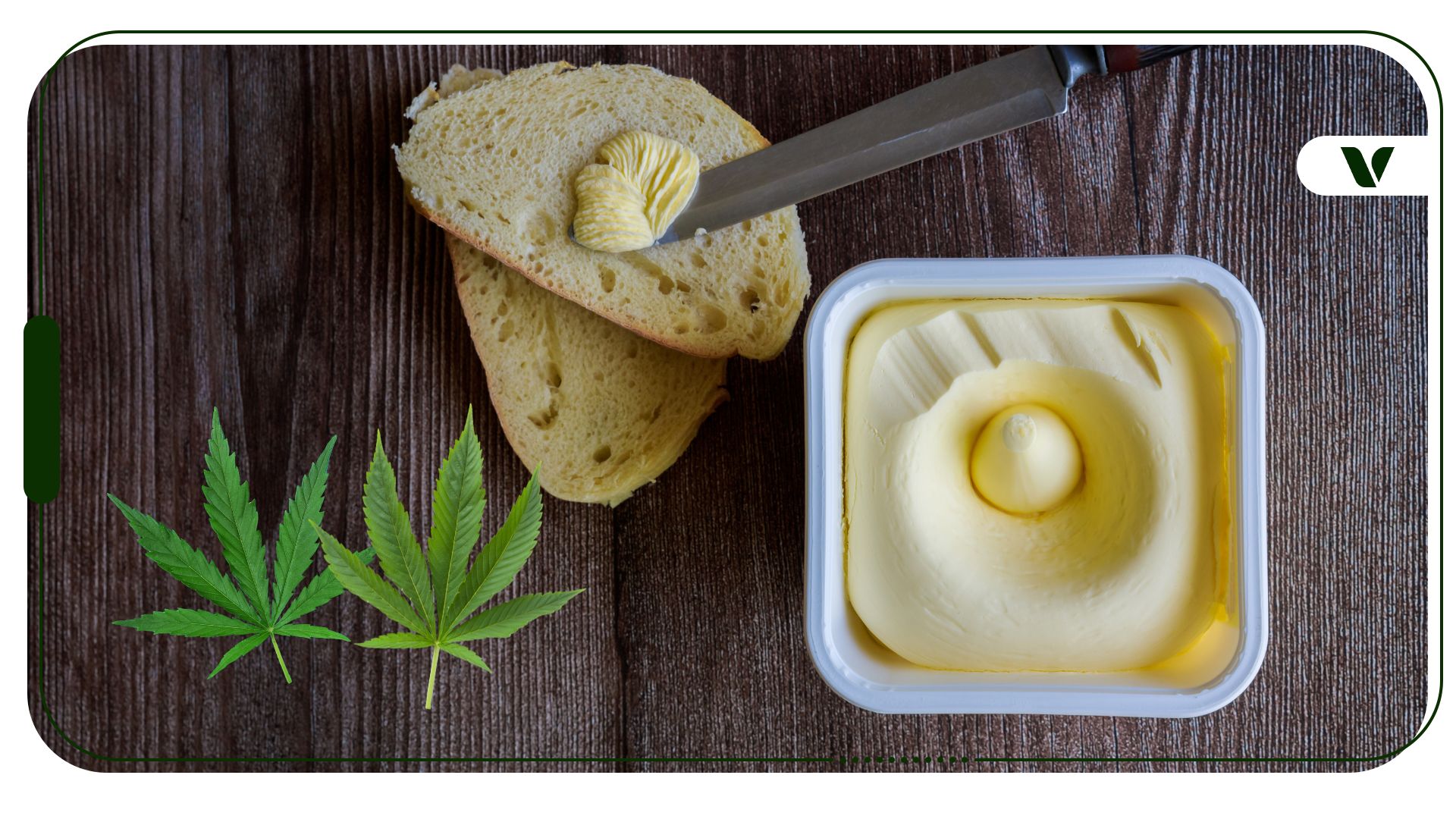
Have you ever wondered what it would take to make your own edibles at home? Have you ever been wowed by a friend’s or professional baker’s creations in a 420-friendly kitchen? If so, we can help you achieve those skills on your own. With this guide, you’ll learn the best practices for making cannabutter and turning any recipe into an infused, medicated delight.
Cannabis-infused butter, or cannabutter, is a staple ingredient for any edible chef, whether home-based or professional. Learning how to make this simple infusion will allow you to medicate with your favorite recipes the way you want or need.
You’ve surely heard, and likely seen, that oil and water don’t mix. The same is true of THC and other cannabinoids present in marijuana. This cannabinoid is lipophilic — or more plainly — fat-soluble. That means THC molecules want to bind themselves to fat. This is also why it can take weeks to leave your body; it naturally wants to stay stored in your fat cells and is best extracted into a high-fat substance.
Butter is an excellent choice for infusion because it is high in saturated fat (about 63%). Many edible chefs have noted anecdotally that saturated fat attracts THC the best, which is why coconut oil is a commonly used infusion base. Olive oil is another popular choice, but it makes other vegetable and seed oils less ideal as infusion mediums.
Making weed butter at home is a wonderful skill to add to your repertoire. The possibilities are endless when it comes to homemade edibles. Whether you spread a little cannabutter on your morning toast, melt a pad on top of a steak, or use infused butter as the star of buttercream frosting on a cupcake, you can make any recipe a medicated, delicious edible. Brownies are great, but wait until you try some infused better on a couple of over-easy eggs — now that’s a Sunday brunch dish!
A good rule of thumb for infusing cannabis oil is to use about 1 gram of flower per 1 ounce of infusion base (whether that is butter, coconut oil, or grain alcohol). Therefore, for 1 cup of butter, you’ll want to use 7 grams (or 1/4 ounce) of cannabis. It is possible to use more, but more than a 2:1 ratio (flower:infusion base) runs the risk of wasting flower.
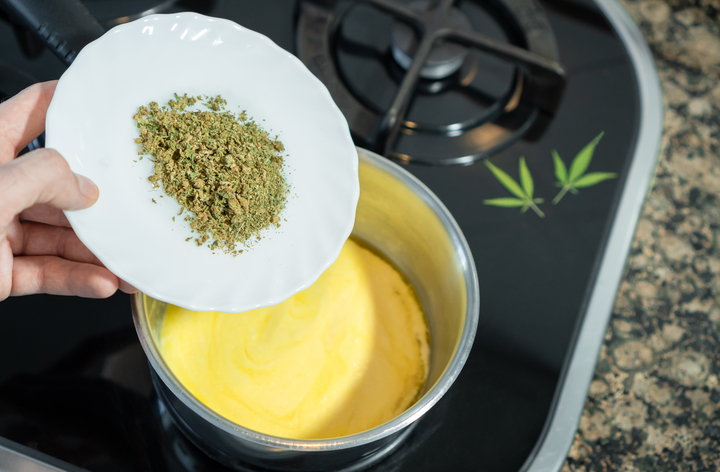
A quick way to make weed butter is to make it on the stovetop, in a saucepot, directly over the heat. Let’s break it down step-by-step.
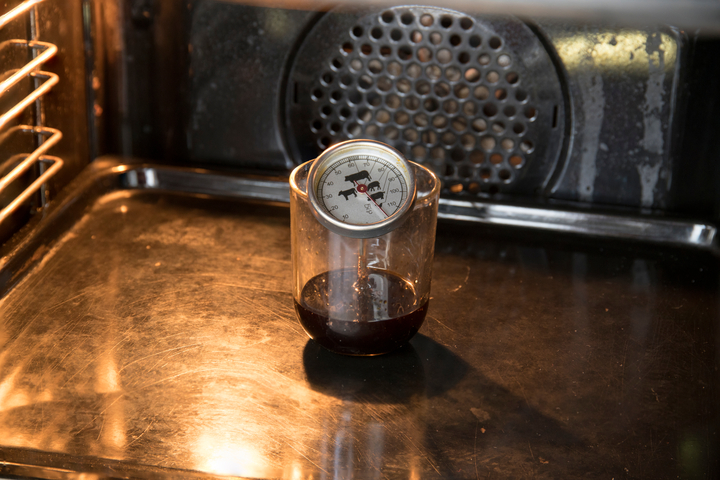
Using your slow cooker and a mason jar will give you both a reduced smell and a more hands-off method of cooking. As a bonus, the cannabis edible scent is contained by the tight lid of the cooker and the lid of a mason jar.
It’s not completely scent-free, but it is considerably more palatable than the open-air stovetop method, and it’s far less likely to encroach into a neighbor’s space if that is a concern. Since the crock pot method relies so heavily on water — and water can only get so hot before it evaporates — whether you use the “low” or “high” temperature setting, the infusion will never reach over 212 degrees Fahrenheit (less the further away from sea level you are), preserving the terpenes with a lower temperature.
Alternative: if you don’t have a slow cooker, you can implement this same method on a stovetop with a pot of water and a mason jar. However, you should add a tea towel to rest the mason jar on in the pot, start with cold water, and make sure to keep an eye on the pot in case you need to refill the evaporated water with more HOT water. Remember, start with cold water, and only add HOT as it evaporates.
Note: You might be curious about whether you should infuse for more time or less, and frankly, you may get a slightly more potent result at 8 hours vs. 2 hours, but there won’t be a significant difference. What will be noticeable is the greenness in both color and flavor. So, if you’re not into the “green” flavor, especially in baked goods and pastries, aim for a shorter infusion time. You can always compensate for the slight decrease in potency by adding a little extra flower (an extra gram per stick of butter).
Learning how to make cannabis-infused butter is an easy process. It is an incredibly versatile ingredient that is sure to become a staple in your kitchen. Other than the introduction of cannabinoids, cannabutter is just like regular butter and can be incorporated into any butter-based recipe.
The key thing to keep in mind, especially if you’re new to eating medicated dishes, is to take it easy with your taste tests. Start with a low dose, and give it some time when you’re testing the results of your newly learned butter-infusing skills. And if you do overdo it, go ahead and indulge in a little nap, water, and your favorite snacks.
Cannabutter should be stored in an airtight container, and it is best kept in the refrigerator. Uninfused butter is generally safe on the countertop, but once you introduce marijuana flower, heat, and potentially water, you are at risk of mold. Unless you know you’ll use it within 48 hours, it’s ideal in the safe and cool temperatures of your fridge. For longer-term storage, it’s recommended to wrap the butter in parchment paper before storing it in a separate airtight container, especially if it’s heading into your freezer.
If stored incorrectly, or if it is exposed to any kind of light, you run the risk of degrading the potency of your infused butter or recipe that uses the infused butter. That’s why it’s important to make only what you will use within a couple of weeks. Freezer storage can help prolong the shelf life of the infusions, but it’s always recommended to work with fresh ingredients in the kitchen, infused or not. For the most part, if stored correctly, your infused recipes or cannabutter will not lose potency before the base ingredients start to turn.
Without a lab or home testing device, it may seem impossible to figure out just how potent your freshly made marijuana butter is. Thankfully, there’s a pretty simple way to calculate the dose if you already know what percentage of THC is in your flower. If you purchased it from a dispensary, it is likely labeled on the container or the dispensary’s website. Most marijuana is in a range of 15-25% THC.
For this article, let’s assume that the flower used in the infusion was 20% THC. That means for each gram of marijuana flower, at maximum, there is 200 mg of THC.
Since this cannabutter recipe called for 3.5 grams of flower (more commonly known as an eighth), we can multiply 200 by 3.5 and get 700 mg of THC. That sounds pretty potent in 4 ounces of butter at about 87.5 mg per tablespoon; however, to play it safe, we can assume that only about 75% of that 700 ended up in the butter. That brings it down to about 66 mg per tablespoon.
To figure out the dose, you’ll need to know three basic equations:
Using the numbers from the example above, let’s say you want to make a half dozen chocolate chip cookies that are 10 mg each. Your recipe calls for ½ stick, or ¼ cup, of butter. You know that your butter contains approximately 66 mg of THC per tablespoon. And 66 mg of THC divided by 6 cookies is 11 mg each. This means you need just 1 tablespoon of the infused cannabis butter and can use regular butter to make up the rest (which would be just 3 more tablespoons to fill out the quarter cup).
With this recipe and the example butter, you could go all the way up to 44 mg of THC per cookie by using only the cannabis butter. If you’re unsure of what dose works for your body, you should start on the lower end and work your way up. The best way to find out is to safely test it out yourself.
For help figuring out dosing, use Veriheal’s Edible Dosage Calculator.
If you are using the slow-cooker method, you might be curious about whether you should infuse for more time or less. You may get a slightly more potent result at 8 hours vs. 2 hours, but it won’t make a significant difference. What will be noticeable is the greenness in both color and flavor. If you don’t want a strong cannabis flavor or color, aim for a shorter infusion time.
This recipe calls for 3.5 grams of cannabis flower for a stick of butter, so you would need 8 sticks of butter to prepare an ounce (28 grams) of cannabis flower. However, you could potentially infuse your butter with more or less THC by increasing or decreasing the amount of cannabis you use. A good rule of thumb is to aim for no more than 7 grams (1/4 ounce) of cannabis per 1 cup of butter.
Cannabutter typically takes 30 minutes to 2 hours to take effect. Factors like individual metabolism, tolerance, and how recently you’ve eaten can influence the onset time for your cannabutter or edibles. It is best to start with a small dose of about 5-10 mg and wait around 2 hours to feel the effects before consuming a second dose.
Overall recipe rating: 4.9 out of 5 based on 12 reviews
Hi Lauren! Your recipe instructions seem very easy thank you. I have a question. The other recipes that don’t use lecithin have a lot of liquid under the butter. Is the lecithin the reason why your recipe doesn’t?
Hello Cheryl,
Great question! Unfortunately, I’m not able to answer. I’ve only ever made cannabutter this particular way and never had any issues with extra liquid or separation. Water might actually be the culprit. I know many other cannabutter recipes out there often call for water to clarify the butter a bit and I don’t use water in mine. I hope that helps!
Lecithin is absolutely the reason why this recipe leaves less water as a byproduct; it’s an emulsifier, which means it creates a colloidal suspension for the water and liquefied butter (oil) to form a solution. It also facilitates the binding of THC molecules to fat cells, helping with the potency. It’s possible to make infused butter or oil without it, but generally it’s better with it.
Thank you for this wonderful explanation!
No, it is because you did not use clarified butter, the junk on the bottom is water and milk solids/whey, clarify your butter first so it’s only butter fat which is what is absorbing ur THC. You could also just buy Ghee instead of clarifying youself
Thx 4 that awesome tip
I’ve made canna butter with and without water. I’ve never made it with Lecithin before. The liquid you are speaking of is the water that was added during the cooking process. Oil rises to the top of water, since water and oil do not mix. After the cooking process the butter is cooled, I put it into the refrigerator until the butter hardens. Then I pull it out and make a large enough hole on the side to quickly drain the water and muck from the cannabis that got through the straining process. I like this method because my butter comes out cleaner. Just be careful, I’ve had my butter crack and splash the water out. It can make a mess. I then whip my butter and put into a sealable glass container (mason jar) and refrigerate it until I use it for baking.
The water helps control to temp and not burn the butter you never want it to reach boiling from everything I’ve read
Great article with simple instructions Lauren, but I do have a question. What is the best way to store the leftover plant matter for future use? What kind of a container is best? I’d like to keep adding leftover plant matter to this as I make more infusions, until I decide what I want to do with it all. Thank you!
Hi Bree! Thanks for reaching out. I would not recommend holding on to the leftover plant matter after it’s been run through the butter. It’ll basically be tapped dry of its cannabinoid/terpene profiles and will go rancid over time. Take care!
What about freezing the leftover vegetation like spinach and using in cooking elsewhere?
I freeze mine all the time. When I make a batch in my levo infuser, I usually do 14 grams so I’ll strain it out. I end up with 2 or 3 balls of flower wrapped in cheesecloth, then I make tea with the balls lol Eating it doesn’t taste very good. I’ve tried making sauces and cookies with the leftovers before and I wouldn’t suggest it… but tea is great!!
I find about a cup of spent green Makes for good flavoring in rustic bread loaf. Often even get mild effects.
Will this recipe work with vegan butter?
Yes, this recipe should work for vegan butter as well. Cheers!
You dont have to break open the lecithin gel caps do you?
I’ve never done it without breaking the gel caps, so I can’t say. However, if I were to, I’d probably be a little concerned with the additional outer capsule ingredients messing up the butter somehow. If it helps, lecithin does also come in a powder or liquid form that’s sold in the vitamin section at most grocery or health food stores.
What is the exact amount of lecithin that you’re using? Mine is powered form.
How do you calculate the mg of THC per unit of volume so you can calculate portions of 10 mg?
Hi! Please check out our dosing calculator https://www.veriheal.com/edible-dosage-calculator/
Thanks- just the info I needed
Just out of curiosity, as some places have different definitions of “stick of butter” how much is in your “stick of butter” lol sorry probs a weird question!!
I use unsalted land of lakes butter…1 stick is 8 tablespoons.
It takes 16 tablespoons for 2 stick of butter.
2 sticks= 1 cup.
Hope this helps
Great recipe thank you for sharing this. I came across this article and was surprised by how good it turned out. Highly recommended!
Thanks for this! I found it incredible hard to keep the temp between 190 and 200 but managed after it flared up to 220🥺 (yes i had a thermometer too) it looks very brown at the moment and has been simmering for 40 min, Does simmering it for the full 90 increase the intensity? Also forgot to let the weed cool before adding it to the butter , I did the recommended 240 for 40 min method, will that effect it much? I loved not having to use the water, but wondering if thats why it turned brown, coudl you up load some pics of your process? that would be most helpful!
We just made our butter out 28g of high quality roach weed-easily 20 different strains.Very potent! We’ve been asked how much to sell for & I’ve got no idea what it’s worth or honestly even how to weigh it out.. ?????
I tried my hand at this. I decarbed in the oven 240 degrees for 45 minutes. I used a makeshift double boiler and according the the candy thermometer it only reached 150 degrees for one hour. Do you have to heat the medium between 190 and 210 degrees if you have decarbed properly? If so I will get a real double boiler as i dont want to scorch the butter.
While everything is great, I just wanted a specific or recommended amount of water for the Slow Cooker method. I’m using my instapot and don’t want to either “flood” it or too little. Thank you
what can i do with the leftover weed
I am unable to have any results with edibles. Some people just can’t receive the love edibles??? I have been told that Any thoughts
In the HOW TO MAKE CANNABUTTER section above, it states, “Therefore, for 1 cup of butter, you’ll want to use 7 grams (or 1/4 pound) of cannabis. ”
You mean 1/4 ounce! Lord help anyone who uses a quarter pound.
Oh my goodness! Good catch, Yoni! We’ll be sure to update the recipe ASAP.
Sign up for our newsletter
Learn the process in your state
All Rights Reserved Veriheal Inc. ©
Terms Privacy Policy Advertising Agreement Content Disclamer

Get your medical marijuana card today
Sign up in under 5 minutes
Start By Selecting Your State
 Alabama
Alaska
Arizona
Arkansas
California
Colorado
Connecticut
Delaware
Florida
Georgia
Hawaii
Idaho
Illinois
Indiana
Iowa
Kansas
Kentucky
Louisiana
Maine
Maryland
Massachusetts
Michigan
Minnesota
Mississippi
Missouri
Montana
Nebraska
Nevada
New Hampshire
New Jersey
New Mexico
New York
North Carolina
North Dakota
Ohio
Oklahoma
Oregon
Pennsylvania
Rhode Island
South Carolina
South Dakota
Tennessee
Texas
Utah
Vermont
Virginia
Washington
West Virginia
Wisconsin
Wyoming
Puerto Rico
Alabama
Alaska
Arizona
Arkansas
California
Colorado
Connecticut
Delaware
Florida
Georgia
Hawaii
Idaho
Illinois
Indiana
Iowa
Kansas
Kentucky
Louisiana
Maine
Maryland
Massachusetts
Michigan
Minnesota
Mississippi
Missouri
Montana
Nebraska
Nevada
New Hampshire
New Jersey
New Mexico
New York
North Carolina
North Dakota
Ohio
Oklahoma
Oregon
Pennsylvania
Rhode Island
South Carolina
South Dakota
Tennessee
Texas
Utah
Vermont
Virginia
Washington
West Virginia
Wisconsin
Wyoming
Puerto Rico