Your medical cannabis journey simplified: find partnered dispensaries, explore pricing options, earn rewards, and get answers to FAQs, all in one spot.
July 24, 2020 02:10 pm ETEstimated Read Time: 4 Minutes
Researchers demand higher quality cannabis. The DEA promised a few years ago it would let more people grow cannabis for research purposes, but it wasn’t until late last month — as the country locked down under safer-at-home orders to combat the coronavirus pandemic — that the agency unveiled a plan for how it would do that. Under the DEA’s newly proposed rules, the agency would allow more scientists and companies to grow cannabis for research, but they would have to turn it over to the DEA, who would then distribute to scientists.
No One Expected Such Difficulty For Cannabis Research
Most researchers never envisioned that a legitimate attempt to study cannabis’s potential benefits would become a decade-long quest involving fights with universities and the federal government, and attempts to uncover confidential legal documents. Yet this is the complicated maze scientists studying cannabis have been navigating for years. The DEA still classifies cannabis as a Schedule I drug — a restrictive category reserved for substances believed to have no medical value and highly susceptible to abuse.
Researchers Want Access to Dispensary Quality Cannabis
The DEA has repeatedly said it won’t support reclassifying cannabis because there aren’t well-controlled studies or scientific evidence approved by the Food and Drug Administration to show medical benefits. Yet scientists say that if evidence of those benefits is ever going to exist, they need to put real-world cannabis — not what’s made available from the University of Mississippi — through these studies. The menu from the Ole Miss farm — which is largely confined to smokeable flower and THC extract — excludes high-potency products like edibles, shatter or wax.
The Conflict Continues
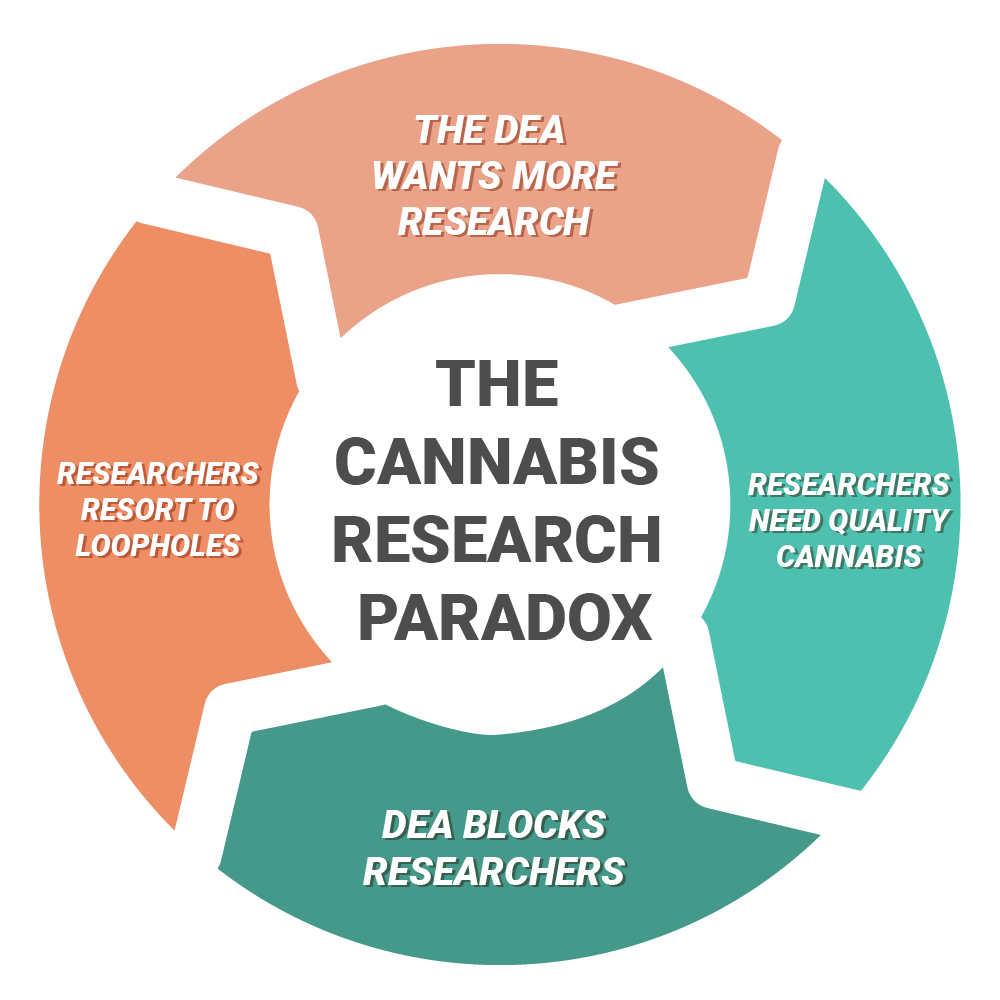
This sets up a paradox, in which practically no one can show through an FDA-approved clinical trial that the cannabis products on the market are safe or beneficial because researchers can’t legally study them. In 2016, following requests from scientists, the DEA announced that it would allow more facilities to cultivate cannabis for research. Jeff Sessions then became US Attorney General and in 2017 he halted the government’s plans to allow more growers. When members of Congress later pressed Sessions on the pending applications, he suggested that allowing more than one producer could put the country at risk of violating the U.N. Single Convention on Narcotic Drugs, a 1961 international treaty.
Finding Loopholes
Universities have gotten creative in their methods to legally study cannabis without procuring it from the DEA. For example, Washington State University researchers are conducting a study in which they ask participants to buy cannabis at a legal dispensary, go home and smoke it, and then take an Uber or Lyft to the lab to give a blood sample. “Controls To Enhance the Cultivation of Marihuana for Research in the United States” is a proposed Rule by the DEA introduced on March 23, 2020.
Finally a Way to Move Forward
The new rules proposed by the DEA were the result of an opinion written by lawyers in the DOJ’s Office of Legal Counsel in June 2018, while Sessions was still attorney general. That opinion was kept secret until scientists filed a lawsuit in early March against the department, which settled with the release of the document. The proposed regulations, according to the spokesman, “could permit a greater range of products available for scientific research.”
Is This a Telltale For What’s to Come?
Under the proposed rule, the “DEA would have the exclusive right of importing, exporting, wholesale trading and maintaining stocks of cannabis other than those held by DEA-registered manufacturers and distributors of medicinal cannabis or cannabis preparations. Further, this exclusive right would not apply to medicinal cannabis or cannabis preparations.”
Natasha has worked as a journalist in the cannabis scene for several years. She travels regularly in her tiny house school bus conversion to keep up to date with the ever-changing industry. Her experience is varied and eclectic.
Please call our customer service number (1-833-663-7284) or utilize our chat support. We are unable to answer this type of question in our blog comments.
I have been diagnosed with depression/anxiety and I have PTST and i recently traveled to Illinois. I visited a cannabis store there and it was an amazing because I bought flower and the THC capsules and the flower helped me so much with all 3 of my diagnosed issues and the capsules helped me with my insomnia. I have been to a lot of Dr.s and i could never get the proper medicine for my anxiety and my insomnia because I am a recovering addict and now I am trying to get a medical card in VA and now because of this pandemic, things are put on hold. I think if people just understood how much THC helps people, they would get a move on it and not put it on hold. I think we all have been waiting long enough for some kind of actually help, I know at least that’s how i feel and i’m sure there are thousand more who feel the same.
Please call our customer service number (1-833-663-7284) or utilize our chat support. We are unable to address this type of issue in our blog comments.
In the confusing landscape of state-by-state medical marijuana legalization and federal prohibition lies a patient’s pursuit of a better quality of life, balanced with an unrestricted financial livelihood. In workplaces across many different medical marijuana legal states, no law guarantees that a valid, card-carrying MMJ patient status exempts an employee from termination or discrimination stemming…
It feels like every other day, a fresh slang term pops up in the cannabis lexicon, and today, we’re looking at an entry that’s all over TikTok and Reddit – Yart! Spoiler alert: it has everything to do with the humble vape cart (and how challenging it is to talk about cannabis on social media). …
The final stage of life often brings profound challenges for both patients and their families. For patients in hospice and palliative care, common symptoms not only affect the physical body but also their mental well-being. While traditional medications may dull pain, they often come with heavy sedation, confusion, and loss of clarity. Fortunately, medical cannabis…
The old “lazy stoner” stereotype is quickly fading. We now see bodybuilder moms using cannabis for better sleep, runners getting in the zone with the help of weed, and many other examples of cannabis being used in ways that counter the unmotivated stereotypes of the past. As legal access to the plant increases, more people…
If you’re planning to get a medical marijuana card in 2026, you might be wondering whether you need to meet with a certified cannabis doctor—either online or in person. Still, finding a qualified medical marijuana doctor near you can feel overwhelming and confusing if you’re not sure where to start. This guide shows you exactly…
The statements made regarding cannabis products on this website have not been evaluated by the Food and Drug Administration (FDA). Cannabis is not an FDA-approved substance and is still illegal under federal law. The information provided on this website is intended for educational purposes only and is not intended to diagnose, treat, cure, or prevent any disease. It is not intended as medical advice and should not be considered as a substitute for advice from a healthcare professional. We strongly recommend that you consult with a physician or other qualified healthcare provider before using any cannabis products. The use of any information provided on this website is solely at your own risk.