Your medical cannabis journey simplified: find partnered dispensaries, explore pricing options, earn rewards, and get answers to FAQs, all in one spot.
If you’re a fan of Haribo sweets, you might be in for a surprise when next you taste a bag of its gummies. The brand is currently in the spotlight because some consumers, including kids, got sick after enjoying gummies from a bag of Haribo Happy Cola F!ZZ. Even wilder, investigations revealed that the gummies in question contained cannabis.
What Really Happened?
In late May 2025, several residents of the Twente region in eastern Netherlands, including young children, fell ill after eating Haribo gummies. Their symptoms included dizziness and other health complaints, and the Dutch police say the children got the worst of it.
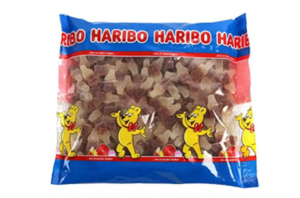
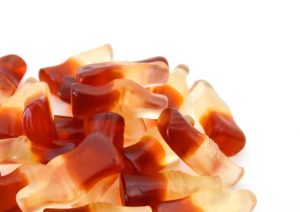
Investigations revealed that the culprit candy was Haribo’s Happy Cola F!ZZ, which is a cola-bottle-shaped and flavored gummy. The Netherlands Food and Consumer Product Safety Authority (NVWA) tested samples from the bag of gummies consumed by the victims and found traces of cannabis.
In response to these shocking findings, Haribo issued a public recall on May 29, 2025, for allHappy Cola F!ZZ gummies sold in 1-kilogram (1,000-gram) bags in the Netherlands. Specifically, bags with a best-before date of January 2026 and product code “L341-4002307906,” which are the same batch and type consumed by the victims. The NVWA has also warned consumers in the country to avoid buying the 1,000-gram F!ZZ pack.
The extensive recall may seem like overkill, considering cannabis contamination was found in only three bags of Haribo’s Happy Cola F!ZZ. However, in a statement to PEOPLE, Haribo made it clear that “The safety of our consumers is our highest priority and Haribo takes this incident very seriously, which is why a recall has been issued in the Netherlands.“
Photo Credit: Haribo
What Caused It?
How exactly cannabis got into a bag of sweets from one of the top candy makers is still a mystery. Some speculators suspect that it was a bad batch accidentally made by Haribo. However, laboratory tests performed by the brand on warehoused batches, raw materials, and products didn’t find cannabis or irregularities in the manufacturing process.
Other speculators believe the contaminated products were actually counterfeits, which is a bigger problem than you think. This would explain why Haribo found no traces of cannabis in its production line. Lastly, there’s the possibility of sabotage, but for now, uncertainty still surrounds how the contaminated batch of Haribo sweets came to be.
See If You Qualify For Medical Marijuana -Select Your State!
Select Your State
Alabama
Alaska
Arizona
Arkansas
California
Colorado
Connecticut
Delaware
Florida
Georgia
Hawaii
Idaho
Illinois
Indiana
Iowa
Kansas
Kentucky
Louisiana
Maine
Maryland
Massachusetts
Michigan
Minnesota
Mississippi
Missouri
Montana
Nebraska
Nevada
New Hampshire
New Jersey
New Mexico
New York
North Carolina
North Dakota
Ohio
Oklahoma
Oregon
Pennsylvania
Rhode Island
South Carolina
South Dakota
Tennessee
Texas
Utah
Vermont
Virginia
Washington
West Virginia
Wisconsin
Wyoming
Never miss a post
Get updates on cannabis culture, new research, and expert insights
The Latest on the Haribo F!ZZ Recall
Since recalling the batch of gummies with the same production code as the three affected bags, no other Netherlanders have reported issues. To ensure no potentially contaminated bags remain in circulation, the candy maker is offering refunds to customers who return recalled packs to Haribo by mail.
On June 18, 2025, the Netherlands Forensic Institute (NFI) concluded its investigation into the Haribo cola candies. It reported finding no cannabis or related substances in the batches from the confectionery brand’s production or distribution process.
But it’s not over. Investigations by the Public Prosecution Service are still ongoing to figure out why the children became unwell and whether Haribo should be held accountable. We’ll update you as soon as new information emerges. For now, the confectionery giant guarantees that all its products, aside from the recalled ones, are safe to consume.
Is Cannabis Contamination Common?
No, cannabis contamination in the non-cannabis food industry is, in fact, uncommon. In most cases, cannabis ends up in food products intentionally, usually in regulated markets where edibles are legally produced and sold. These products must follow strict dosage and safety rules. Also, clear labels mark such products as cannabis-infused, and stores don’t keep them on the same shelves as regular foods.
Facts like these are what make the Haribo incident so unusual. But while food contaminated with cannabis is rare, it does happen. The most common scenario involves unscrupulous imitation brands offering cannabis edibles with the same packaging as well-known brands. Such products have raised serious concerns about accidental consumption.
For instance, cases of children within and outside the U.S. unintentionally ingesting such cannabis-infused products have become more common. There was also an incident in August 2023 where six children in the Netherlands required hospitalization after ingesting sweets containing THC. To be clear, these kids ate the candy, not knowing they were cannabis treats.
Photo Credit: iStock
Should You Go Looking for Cannabis-Contaminated Sweets for a Cheap High?
No, you shouldn’t because you have no idea what else might be in the product. “Cannabis-contaminated” means the product was never meant to contain cannabis in the first place. That means the sweets could also have other unknown or harmful substances or unsafe levels of THC.
For your safety, stick to legally made, clearly labeled, and tested cannabis products so you know their exact cannabinoid content. Better yet, make your own cannabis-infused treats using one of our recipes, like our canna-lollipop recipe.
Tobi Moyela is an avid cannabis enthusiast who enjoys creating helpful, educational content that helps others better understand cannabis, especially its potential uses and benefits. When he's not researching or writing for brands, you can find him watching anime, cooking, or reading his latest fiction finds.
In the confusing landscape of state-by-state medical marijuana legalization and federal prohibition lies a patient’s pursuit of a better quality of life, balanced with an unrestricted financial livelihood. In workplaces across many different medical marijuana legal states, no law guarantees that a valid, card-carrying MMJ patient status exempts an employee from termination or discrimination stemming…
It feels like every other day, a fresh slang term pops up in the cannabis lexicon, and today, we’re looking at an entry that’s all over TikTok and Reddit – Yart! Spoiler alert: it has everything to do with the humble vape cart (and how challenging it is to talk about cannabis on social media). …
The final stage of life often brings profound challenges for both patients and their families. For patients in hospice and palliative care, common symptoms not only affect the physical body but also their mental well-being. While traditional medications may dull pain, they often come with heavy sedation, confusion, and loss of clarity. Fortunately, medical cannabis…
The old “lazy stoner” stereotype is quickly fading. We now see bodybuilder moms using cannabis for better sleep, runners getting in the zone with the help of weed, and many other examples of cannabis being used in ways that counter the unmotivated stereotypes of the past. As legal access to the plant increases, more people…
If you’re planning to get a medical marijuana card in 2026, you might be wondering whether you need to meet with a certified cannabis doctor—either online or in person. Still, finding a qualified medical marijuana doctor near you can feel overwhelming and confusing if you’re not sure where to start. This guide shows you exactly…
The statements made regarding cannabis products on this website have not been evaluated by the Food and Drug Administration (FDA). Cannabis is not an FDA-approved substance and is still illegal under federal law. The information provided on this website is intended for educational purposes only and is not intended to diagnose, treat, cure, or prevent any disease. It is not intended as medical advice and should not be considered as a substitute for advice from a healthcare professional. We strongly recommend that you consult with a physician or other qualified healthcare provider before using any cannabis products. The use of any information provided on this website is solely at your own risk.