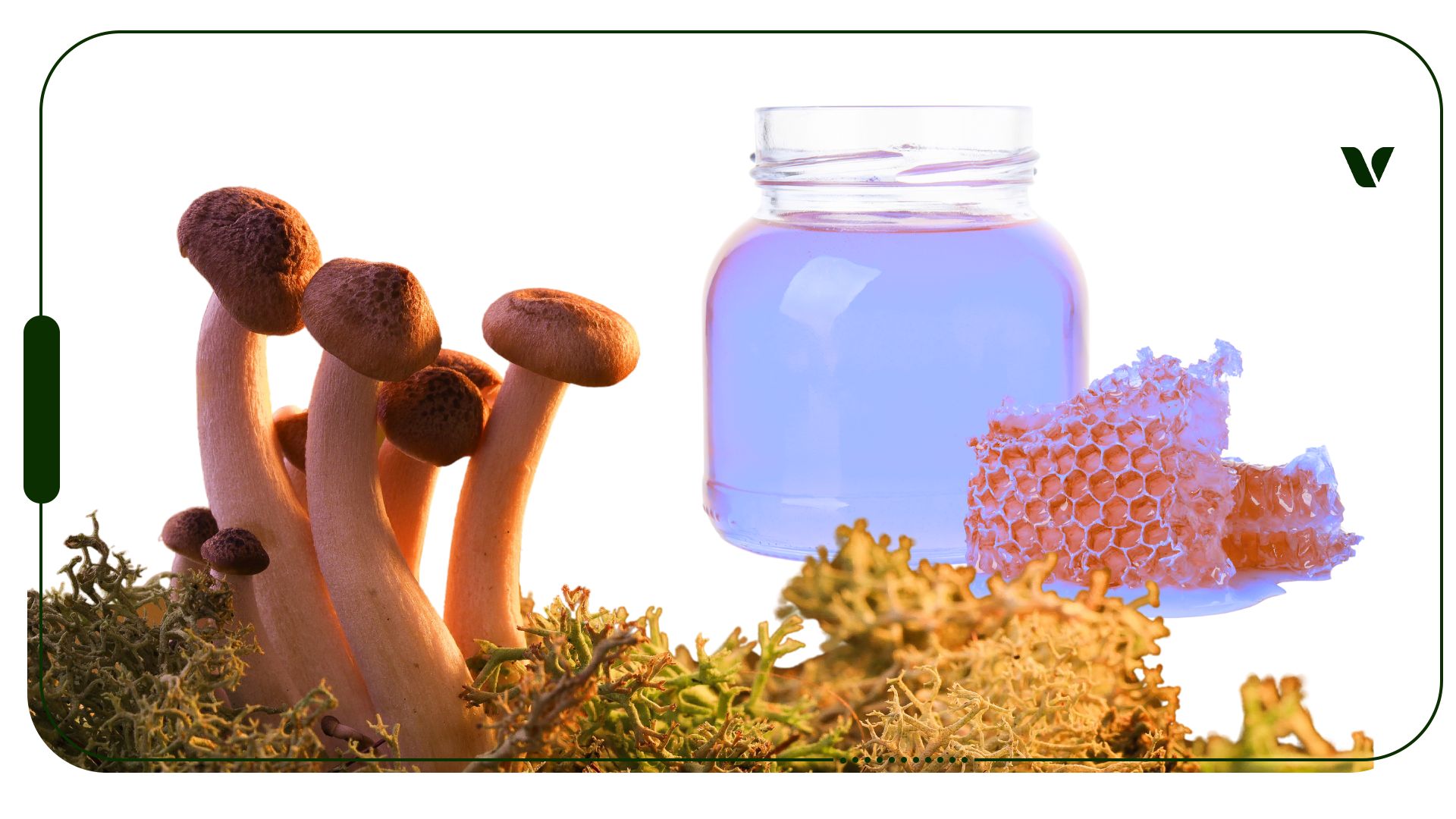
Blue honey is honey infused with psilocybin mushrooms, and it has been used as a method of preserving and consuming magic mushrooms for decades. If you want to understand what it is, why the preparation works, and how to make it at home, this guide covers all of it.
What Is Blue Honey?
Blue honey gets its name from a chemical reaction that happens when psilocybin-containing mushrooms are cut, bruised, or broken down. When the cellular structure of a Psilocybe species mushroom is disrupted, psilocin, the dephosphorylated metabolite of psilocybin and the compound primarily responsible for psychedelic effects, oxidizes on contact with air. This oxidation produces a blue or blue-green discoloration in the mushroom tissue, and that color can transfer into the surrounding honey over the infusion period.
The biochemistry behind this reaction has been documented in peer-reviewed research. A 2020 study on enzymatic bluing in Psilocybe species showed that the bluing is caused by psilocin oligomers formed through enzymatic activity, not simple chemical degradation. The mushroom tissue is producing these pigments as part of a natural enzymatic process when cell walls are disrupted.
The preparation itself has a documented history. A 1998 forensic toxicology paper describing Psilocybe cubensis honey confiscated at the Dutch-German border by Bogusz and colleagues recorded honey infused with Psilocybe cubensis. This places this preparation in a measurable historical and forensic context rather than treating it as a recent internet phenomenon.
One point worth setting expectations on: the finished honey will not necessarily look vivid blue. The oxidation reaction that causes the color is most visible in the mushroom tissue itself. Once the mushrooms are strained out and the honey is filtered, the resulting product may appear amber, slightly greenish, or subtly altered in color rather than a deep blue. The bluing confirms that psilocin-containing mushroom material was present and that cellular disruption occurred. It is a sign the preparation is working as expected.
Why Honey Preserves Psilocybin
Before making blue honey, it helps to understand why honey works as a preservation medium in the first place. Not every liquid or carrier will maintain the potency of a psilocin-containing preparation over time, and honey has specific properties that make it more suitable than most alternatives.
Honey has a very low water activity, typically around 0.6, which means there is very little free water available to support microbial growth or enzymatic degradation. Most bacteria and fungi require a water activity above 0.85 to survive, so a properly sealed honey preparation resists the microbial breakdown that would quickly degrade a water-based extraction. This is the same property that allows raw honey to last for years in a sealed container without spoiling.
Psilocin, the active compound you want to preserve, is sensitive to both oxidation and heat. Honey’s thick viscosity limits oxygen contact once the jar is sealed, which slows the oxidative breakdown of psilocin after the infusion is complete. The infusion process itself introduces some oxidation, which is what causes the bluing, but sealing the finished preparation limits further degradation.
The temperature at which you infuse matters. Raw honey should be kept below 104 to 115 degrees Fahrenheit during preparation. Above that range, you begin degrading the heat-sensitive compounds you are trying to preserve, and you also destroy honey’s natural enzymes and antimicrobial properties. For raw honey specifically, lower and slower is the right approach.
For honey selection, raw wildflower honey is the standard choice and works well. Any high-quality raw, unheated honey serves the preservation function. Manuka honey, with its potency graded by the Unique Manuka Factor (UMF) rating system, has stronger antimicrobial properties that may offer additional shelf stability, though the core preservation mechanism comes from low water activity rather than specific antimicrobial compounds.
The key is using honey that has not been heat-processed before you begin, since commercially processed honey has already had its natural enzymes deactivated.
How to Make Blue Honey at Home
Making blue honey requires minimal equipment, but the ratios and temperature control matter more than most guides acknowledge. A commonly referenced starting ratio is 20 grams of dried mushrooms per 400 grams of honey. That works out to roughly one gram of dried mushroom material per 20 grams of honey, which produces a preparation with a measurable, predictable concentration per serving.
Ingredients
- 400 grams of raw honey (wildflower or another raw, unheated variety)
- 20 grams of dried Psilocybe cubensis mushrooms, ground to a fine powder
- Optional: a small amount of lemon juice to aid extraction, though this will affect flavor and speed up the onset
Tools
- A clean, dry glass jar with an airtight lid
- A kitchen scale accurate to at least one gram
- A spice grinder or mortar and pestle
- A double boiler or a heat-safe bowl placed over a pot of warm water
- A fine mesh strainer or cheesecloth (optional, for straining out plant material)
- A food thermometer
Step-by-Step Instructions
- Grind the dried mushrooms to a fine powder using a spice grinder or mortar and pestle. Finer powder increases the surface area in contact with the honey, which improves extraction.
- Warm the honey gently using a double boiler or a bowl set over a pot of warm water. Use your thermometer to keep the temperature between 95 and 104 degrees Fahrenheit. Never let it exceed 115 degrees.
- Add the powdered mushroom material to the warm honey and stir thoroughly to distribute it evenly.
- Maintain the mixture at 95 to 104 degrees Fahrenheit for one to two hours, stirring occasionally. The honey will begin to show blue or greenish discoloration from the psilocin oxidation reaction.
- Remove the mixture from heat and allow it to cool slightly before transferring it to your glass jar.
- You can strain the mixture through a fine mesh strainer or cheesecloth to remove the solid mushroom material, or leave the powder in. Leaving the powder in preserves all material but produces a grittier texture. Straining produces a cleaner product but removes some material from the final preparation.
- Seal the jar tightly, label it with the date and the ratio used, and store it as described in the following section.
The blue discoloration that appears during the infusion process confirms that psilocin-containing material is present and that the enzymatic reaction has occurred. You should see this during the stirring stage. If you notice the honey is very fragrant and has shifted color during infusion, the process is working as expected.
Understanding how food intake affects cannabis effects also applies here: consuming blue honey on a full versus an empty stomach will noticeably change how quickly it takes effect, because the honey is an oral preparation that passes through the digestive system before psilocin enters the bloodstream.
Is Blue Honey Legal?
Psilocybin is a Schedule I controlled substance under the Controlled Substances Act, 21 U.S.C. § 812, as listed on Cornell Law School’s LII, which means it is federally illegal in the United States to manufacture, possess, or distribute. That classification applies to psilocybin in any form, including preparations like blue honey. Understanding Schedule I drugs and what that classification means in practice is relevant context before proceeding with any preparation.
At the local level, some jurisdictions have taken a different position. Denver, Colorado; Oakland and Santa Cruz, California; and Ann Arbor, Michigan have each decriminalized personal possession of psilocybin mushrooms, meaning law enforcement in those cities has been directed to treat it as a low enforcement priority. Oregon passed Measure 109 in 2020, establishing a regulated therapeutic use framework for psilocybin that allows licensed service centers to administer it under supervision, though home manufacture remains outside that framework.
Laws in this area are changing more rapidly than in almost any other area of drug policy. The legal status in your specific city, county, and state may differ from the federal position and from what is described here. Verify the current legal status in your jurisdiction before proceeding.
You may also want to understand whether drug tests can detect psychedelics, since psilocybin is not detected by standard immunoassay drug panels but may appear on specialized extended panels.
How to Use and Store Blue Honey
Storing blue honey correctly directly affects how long it remains potent. The preparation should be kept in an airtight glass jar, away from direct light and away from heat sources. Glass is preferable to plastic because it does not absorb compounds or allow micro-aeration the way some plastics can over time. A cool, dark cabinet or a pantry shelf away from the stove works well.
Under proper storage conditions, honey’s low water activity inhibits microbial growth, and a well-sealed preparation typically remains stable for several months to over a year. Psilocin potency may decrease gradually over time, particularly with exposure to heat or light, so minimizing both extends the effective life of the preparation. Labeling the jar with the date of preparation and the ratio used helps you track freshness and estimate potency per serving with greater accuracy.
One factor that catches people off guard is onset time. Blue honey is an oral psilocybin preparation, which means it takes 30 to 90 minutes to take effect after consumption, depending on your metabolism, your body weight, and whether you have eaten recently. Do not re-dose before that window has passed. The delay is not a sign that the preparation has lost potency.
Heat is the primary practical concern when using blue honey. Psilocin degrades at elevated temperatures, so adding blue honey to a very hot liquid will reduce its effectiveness. If you are stirring it into tea or another warm drink, let the drink cool to a comfortable drinking temperature before adding the honey. Direct consumption from a spoon or use as a topping on room-temperature food preserves potency better than cooking.
Common use applications for blue honey include:
- Consumed directly from a spoon in a measured amount
- Stirred into warm (not hot) tea or another beverage after it has cooled below 104 degrees Fahrenheit
- Used as a topping on room-temperature food such as yogurt, fruit, or toast
- Added to smoothies or cold preparations where heat is not a factor
If you are also interested in how combining cannabis and psilocybin affects the experience, there is specific guidance on how the two interact and what to consider before combining them.
If you are exploring cannabis as a legal alternative or adjunct to other wellness approaches, speak with a licensed cannabis doctor through Veriheal to understand your options in your state.
Note: The content on this page is for informational purposes only and is not intended to be professional medical advice. Do not attempt to self-diagnose or prescribe treatment based on the information provided. Always consult a physician before making any decision on the treatment of a medical condition.
Note: Veriheal does not support illegally consuming therapeutic substances such as cannabis but acknowledges that it transpires because of the current illicit status, which we strive to change by advocating for research, legal access, and responsible consumption. Always consult a physician before attempting alternative therapies.
Frequently Asked Questions
What is blue honey made of?
Blue honey is honey infused with dried psilocybin mushrooms, typically Psilocybe cubensis. The “blue” in the name refers to the blue or blue-green discoloration that occurs when psilocin in the mushroom tissue oxidizes on contact with air during preparation.
How much mushroom do you use to make blue honey?
A commonly used ratio is 20 grams of dried, ground mushrooms per 400 grams of raw honey. This produces a preparation where each gram of honey contains roughly 0.05 grams of mushroom material, making it easier to estimate a dose by weight.
Does blue honey actually preserve psilocybin?
Blue honey typically preserves psilocin content well when stored correctly. Honey’s low water activity limits microbial growth, and its thick viscosity slows oxidation once the jar is sealed. Potency may decrease gradually over time, particularly with heat or light exposure, so airtight storage in a cool, dark location extends the effective shelf life.
How long does blue honey last?
A properly sealed blue honey preparation stored away from heat and light typically remains stable for several months to over a year. Psilocin potency may decline gradually over that period. Label your jar with the date of preparation and the ratio used so you can track how old the preparation is.
Is blue honey legal in the United States?
Psilocybin is a Schedule I controlled substance under federal law, making blue honey illegal to manufacture, possess, or distribute at the federal level. Some cities have decriminalized personal possession of psilocybin mushrooms, and Oregon has established a regulated therapeutic framework, but home manufacture falls outside those frameworks. Verify the current legal status in your specific jurisdiction before proceeding.
Why does blue honey turn blue?
The blue color comes from psilocin oxidizing when mushroom cell walls are disrupted. Psilocin forms oligomers through enzymatic activity in damaged mushroom tissue, producing blue-green pigments. This is a sign that psilocin-containing material was present and that the cellular disruption needed for infusion occurred.
Can you cook with blue honey?
Cooking with blue honey is not recommended if you want to preserve its potency. Psilocin degrades at elevated temperatures, so high heat will reduce the effectiveness of the preparation. Use blue honey in room-temperature or warm applications only, and add it to drinks after they have cooled to below 104 degrees Fahrenheit.
Author, Share & Comments