Your medical cannabis journey simplified: find partnered dispensaries, explore pricing options, earn rewards, and get answers to FAQs, all in one spot.
December 3, 2019 08:00 pm ETEstimated Read Time: 4 Minutes
Cannabis, like many drugs in the world, draws split opinions from every country, but what about religions? Believe it or not, there are some religions that not only accept cannabis within its culture, but they celebrate it. These religious groups can be found all around the world, and they are all using cannabis to their advantage.
Taoism
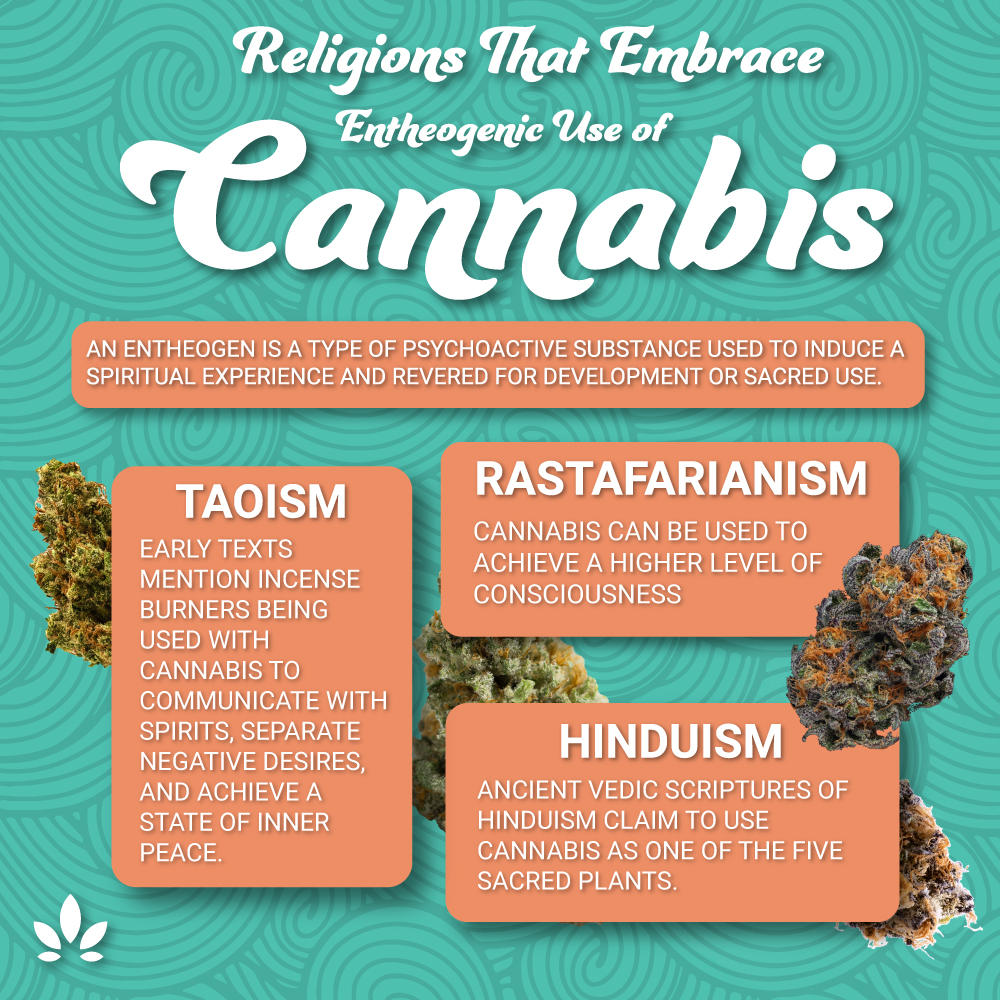
Taoism, the ancient Chinese philosophy and religion, is one of the oldest religions to openly use cannabis in their religious practices. Dating back to the 4th century BC, this belief is mainly recognized for its foundation of balance, often found in the yin and yang symbol. Early texts mention censers, otherwise known as incense burners, being used with cannabis to communicate with spirits, separate negative desires, and achieves a state of inner peace.
Hinduism
Another religion that is just as old, if not older, than Taoism is Hinduism, with the practice being developed between the 5th and 3rd centuries. Hinduism, the third-largest religion, is mainly practiced throughout Asia and its surrounding areas. The belief system includes a wide range of philosophies, all of which are practiced as dharma, also known as the way of life. Around 3000 years ago, ancient Vedic scriptures of Hinduism claim to use cannabis as one of the five sacred plants, according to the Vedas. These herbs were used to liberate the body and rid all bad spirits and fear. There are three different spiritual practices in which Hinduists use cannabis. First, with a milky drink derived from cannabis leaves, known as bhang. Second, a type of hash that is made from resin, known as ‘charas’. Finally, through the smoking bud leaves, most commonly known as ganja. The word ganja is believed to originate from Hindu culture, stemming from the word angaja, or “body-born.”
See If You Qualify For Medical Marijuana -Select Your State!
Select Your State
Alabama
Alaska
Arizona
Arkansas
California
Colorado
Connecticut
Delaware
Florida
Georgia
Hawaii
Idaho
Illinois
Indiana
Iowa
Kansas
Kentucky
Louisiana
Maine
Maryland
Massachusetts
Michigan
Minnesota
Mississippi
Missouri
Montana
Nebraska
Nevada
New Hampshire
New Jersey
New Mexico
New York
North Carolina
North Dakota
Ohio
Oklahoma
Oregon
Pennsylvania
Rhode Island
South Carolina
South Dakota
Tennessee
Texas
Utah
Vermont
Virginia
Washington
West Virginia
Wisconsin
Wyoming
Never miss a post
Get updates on cannabis culture, new research, and expert insights
Rastafarianism
A little more modern, Rastafari, founded in the 1930s, used cannabis in many ceremonies. Many people know Rastafari as the belief that is centered around cannabis and often associate Bob Marley with the religion. Using cannabis is one of the principal rituals of the religion, but not everyone is required to use it. Most Rastafarians use cannabis in their everyday life, including in their tea, spices, and as medicine. The religious belief is that cannabis can be used to achieve a higher level of consciousness.
Cultural Entheogenic Uses
A handful of religions use cannabis as an entheogen. An entheogen is a type of substance used to induce a spiritual experience and revered for development or sacred use. Often an entheogen is used to achieve enlightenment and a higher level of consciousness. The earliest reference of cannabis being used in religious contexts can be found in the Vedic period, dating back to 2000 BC. Greek mythology references cannabis use as a way to eliminate sorrow. The Greek historian Herodotus mentioned the use of the drug in ceremonies of the Scythians. Other religious groups who have referenced cannabis at one point include Mexicans, Mayans, Aztecs, African tribes, German paganists, and Egyptian culture.
Other Groups That Embrace Cannabis
There are many groups to arise from the popularization of cannabis. The first official registered church was founded in 2015 by Bill Levin and named it First Church of Cannabis. This church even has a set of guidelines to follow by, known as the “Deity Dozen.” The twelfth amendment on this list fully embraces cannabis culture, citing “Cannabis, “the Healing Plant” is our sacrament.” Other groups that resemble this church but might not have religious affiliations include the THC Ministries, Temple 420, Green Faith Ministries, Cantheism, the Cannabis Assembly, Sisters in the Valley, the Church of the Universe, and the Free Cannabis Church of Honolulu.
Joey Reams is a freelance journalist who studied at San Francisco State University. He specializes in writing about music, business, travel, culture, and cannabis. You can find him at concerts, rock climbing or finding the next best place to eat.
Oklahoma’s medical-only dispensary market gives licensed patients access to a wide range of cannabis products, but every purchase must follow OMMA rules. This guide explains how to find licensed dispensaries, what identification to bring, purchase and possession limits, product testing, pricing, and what to expect during a visit.
Oklahoma’s advertised $25 medical marijuana card renewal covers the physician evaluation, but patients must also pay a separate OMMA license fee. This guide explains the full renewal cost, reduced-fee eligibility, required documents, online renewal steps, processing times, and the new physician recommendation requirement.
An Oklahoma medical marijuana card provides legal protection under state law, but it can still affect employment, commercial driving, firearms, privacy, and federally regulated situations. This guide explains the main consequences to consider before applying, including workplace drug testing, CDL rules, insurance, housing, and registry privacy.
Getting a medical marijuana card in Oklahoma can be completed online, with no specific qualifying condition required for adult applicants. This guide covers eligibility, telehealth evaluations, required documents, OMMA application steps, fees, processing times, and what patients can do once approved.
A same-day telehealth appointment in Oklahoma can get you a physician recommendation quickly, but OMMA still needs to process your medical marijuana license application. This guide explains the timeline, required documents, costs, and when you can legally visit a dispensary while waiting for the physical card.
The statements made regarding cannabis products on this website have not been evaluated by the Food and Drug Administration (FDA). Cannabis is not an FDA-approved substance and is still illegal under federal law. The information provided on this website is intended for educational purposes only and is not intended to diagnose, treat, cure, or prevent any disease. It is not intended as medical advice and should not be considered as a substitute for advice from a healthcare professional. We strongly recommend that you consult with a physician or other qualified healthcare provider before using any cannabis products. The use of any information provided on this website is solely at your own risk.