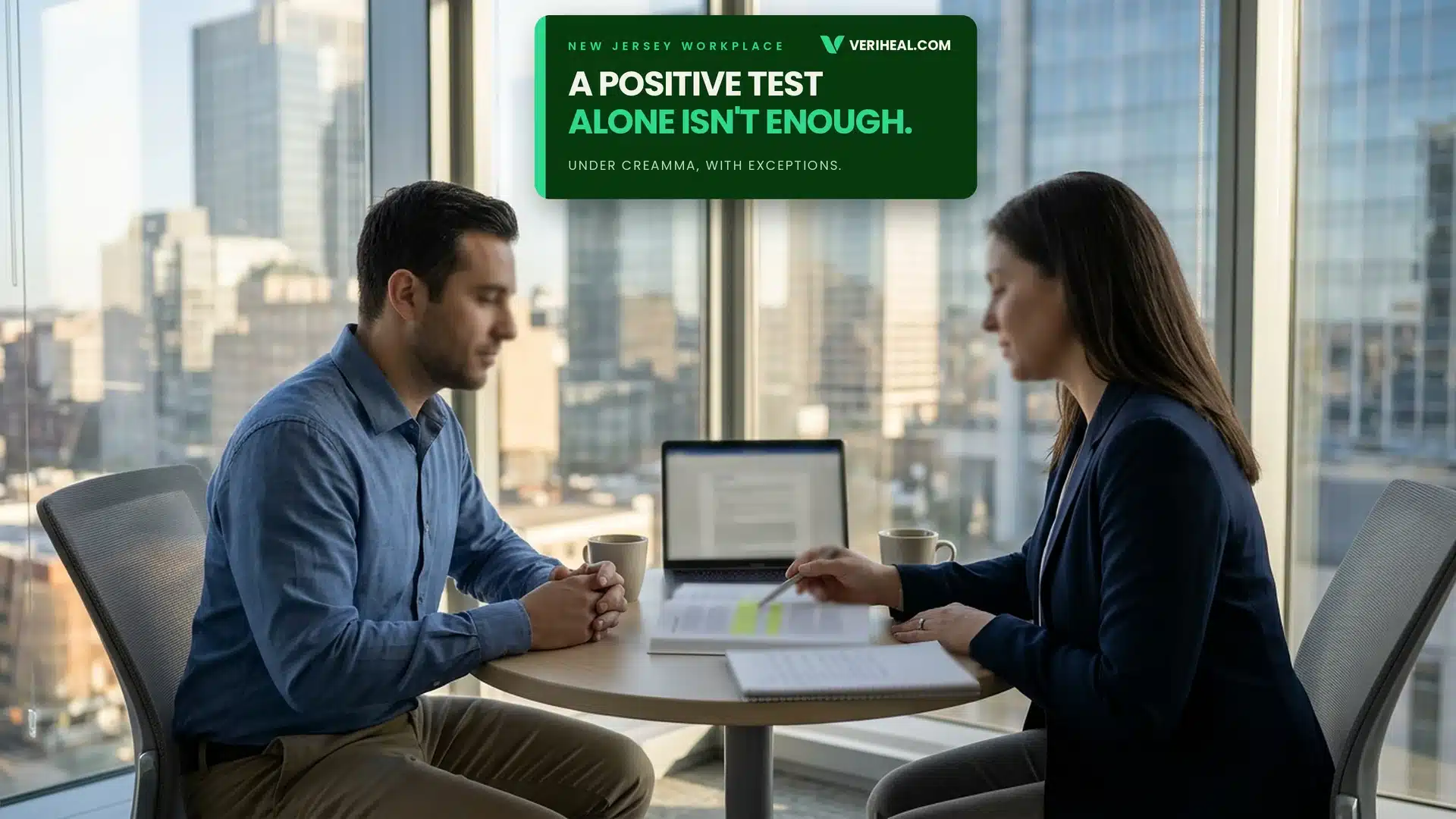
New Jersey’s cannabis law bars most employers from refusing to hire or taking adverse action against an employee for using cannabis. Employers can still keep a drug-free workplace and test in some situations. Two New Jersey Supreme Court cases involving medical marijuana add more detail.
This guide explains what the law says, what those two cases decided, and what to ask your employer. It is general information, not legal advice, so use it to understand your options and bring your questions to an employment attorney. By the end, you will know where your protection starts and where it stops.
Note: Laws and pending legislation may change. For advice about your situation, consult a licensed New Jersey employment attorney.
What Does CREAMMA Say About Jobs?
The Cannabis Regulatory, Enforcement Assistance, and Marketplace Modernization Act (CREAMMA) was signed into law on February 22, 2021. According to the state’s summary, its employment provision does two things. It protects you from adverse action for using cannabis:
No employer shall refuse to hire or employ any person or shall discharge from employment or take any adverse action against an employee with respect to compensation, terms, conditions, or other privileges of employment because that person does or does not smoke, vape, aerosolize or otherwise use cannabis items.
It also protects you from adverse action over a test result:
An employee shall not be subject to any adverse action by an employer solely due to the presence of cannabinoid metabolites in the employee’s bodily fluid from engaging in conduct permitted under [the law].
In plain terms, that means:
- Hiring and firing: An employer cannot refuse to hire you or fire you for using cannabis.
- Pay and terms: It cannot change your pay, terms, conditions, or privileges for that reason.
- Test results: A positive test for cannabinoid metabolites alone cannot be the basis for adverse action.
The state’s workplace page adds that general cannabis use cannot be a determining factor for hiring or firing someone.
What Can Employers Still Do?
Employers keep some rights. The workplace page says employers can maintain a drug- and alcohol-free work environment. Under the CREAMMA summary, an employer may require a drug test in these situations:
- Reasonable suspicion: The employer suspects the employee used cannabis while doing work.
- Signs of intoxication: The employer sees observable signs of intoxication related to cannabis use.
- Workplace accidents: The employee was in a work-related accident that the employer is investigating.
Federal rules also matter. CREAMMA lets an employer that is subject to a federal contract revise its prohibitions to match federal law if following the state law would have a provable adverse impact on it. Jobs covered by federal drug-testing rules, such as some commercial driving jobs, follow federal standards. Read Veriheal’s guide on whether truck drivers can use medical cannabis. Healthcare workers can read Veriheal’s guide on whether nurses can have medical marijuana cards.
What Did the New Jersey Supreme Court Decide?
The state’s workplace page points to two New Jersey Supreme Court cases involving medical marijuana, and both are worth knowing if you hold a card.
The first is Wild v. Carriage Funeral Holdings, decided on March 10, 2020. A funeral director with cancer used medical marijuana and was fired. The Court held that the medical marijuana law does not require employers to accommodate use at work. It also held that the law does not shield actions that might violate the Law Against Discrimination, and one example is refusing to accommodate use outside the workplace.
The second is Hager v. M & K Construction, decided on April 13, 2021. The Court held that an employer in that workers’ compensation case had to reimburse the cost of prescribed medical marijuana. That case concerned an injured worker, not a hiring decision.
What Should You Do If You Are a Patient With a Job?
Start with your employer’s written policies. Then ask human resources how the company handles medical cannabis. If a dispute arises, an employment lawyer can help.
For disclosure questions, read Veriheal’s guide on whether to tell your employer about your medical card. For privacy questions, read Veriheal’s guides on protecting your privacy and HIPAA as a medical cannabis patient and on whether a medical cannabis card shows up on a background check.
Should You Talk to a Lawyer First If You Own Firearms?
Anyone who owns a gun should think about getting legal advice before signing up for New Jersey’s medical marijuana program. Federal law has moved on some points since early 2026, and it has stayed put on others.
What shifted
- Rescheduling: Under a federal rule in effect since April 28, 2026, marijuana grown or sold under a state medical marijuana license sits in Schedule III. Any marijuana outside a state medical license or a Food and Drug Administration (FDA)-approved product is still Schedule I.
- The Hemani decision: The Supreme Court ruled in United States v. Hemani on June 18, 2026. It found that charging a man under 18 U.S.C. § 922(g)(3) based only on his marijuana use was inconsistent with the Second Amendment. The justices agreed on the judgment, and the Court said its ruling was narrow.
- The ATF letter: The Bureau of Alcohol, Tobacco, Firearms and Explosives (ATF) pulled its 2011 open letter. The letter had told dealers that a medical marijuana card was a reason to turn down a sale.
What is the same
- The statute: Section 922(g)(3) is still on the books.
- The paperwork: ATF Form 4473 has not changed, so you still need to answer its drug-use question honestly.
- The guidance: The ATF has not published anything in place of the old letter, so the federal risk is still real.
An attorney can tell you where you stand. For more, read Veriheal’s guide on medical cannabis patients and gun rights.
How Can Veriheal Help You Get a New Jersey Card?
Your rights as a patient start once you are registered, so your evaluation comes first. Veriheal connects you with a New Jersey physician for an online video evaluation. Your physician can tell you whether any in-person follow-up applies to you. To see what a card offers, read the benefits of a medical marijuana card.
Veriheal’s evaluation costs $199, and you can split the fee into interest-free installments. Every Veriheal evaluation comes with a “get approved or your money back” policy. The state card is separate: $0 for digital or $10 for physical, paid to the state. Find a medical marijuana doctor to start your New Jersey evaluation today.
Note: The content on this page is for informational purposes only and is not intended to be professional medical advice. Do not attempt to self-diagnose or prescribe treatment based on the information provided. Always consult a physician before making any decision on the treatment of a medical condition.
Note: Veriheal does not support illegally consuming therapeutic substances such as cannabis but acknowledges that it transpires because of the current illicit status, which we strive to change by advocating for research, legal access, and responsible consumption. Always consult a physician before attempting alternative therapies.
Frequently Asked Questions
Can my employer fire me for medical cannabis use in New Jersey?
No, a New Jersey employer generally cannot fire you for using cannabis. CREAMMA bars most adverse actions based on cannabis use, and the state says general use cannot decide a hiring or firing. Employers can still keep a drug-free workplace and act on impairment at work.
Can my employer refuse to hire me because I use cannabis in New Jersey?
No, under CREAMMA a New Jersey employer generally cannot refuse to hire you because you use cannabis. Employers subject to a federal contract or federal rules may follow federal law instead.
Can a positive drug test alone get me fired in New Jersey?
No, under CREAMMA an employee cannot face adverse action solely because a test finds cannabinoid metabolites from conduct the law permits. The employer needs a basis beyond the test result.
Can New Jersey employers drug test for cannabis?
Yes, a New Jersey employer may require a cannabis drug test in some situations. These include reasonable suspicion of use while working, observable signs of intoxication, or a work-related accident the employer is investigating.
Can I use medical cannabis at work in New Jersey?
No, you cannot use medical cannabis at work in New Jersey. In Wild v. Carriage Funeral Holdings, the Supreme Court held that the medical marijuana law does not require employers to accommodate use in the workplace.
What was the Wild v. Carriage Funeral Holdings case about?
Wild v. Carriage Funeral Holdings was a New Jersey Supreme Court case about a funeral director with cancer who used medical marijuana. On March 10, 2020, the Court decided that the law does not shield actions that might violate the Law Against Discrimination.
Do I have to tell my employer I have a medical card?
Telling your New Jersey employer about your medical card is your decision, and it depends on your job and your workplace policies. Veriheal’s guide on whether to tell your employer about your medical card covers the trade-offs.
Author, Share & Comments