If you live with PTSD, West Virginia’s law names your condition directly, so you don’t have to argue that it belongs. Post-traumatic stress disorder (PTSD) is one of 15 serious medical conditions in the state’s Medical Cannabis Act, and a registered physician decides whether your diagnosis fits. Veriheal connects you with a West Virginia physician for an online video evaluation through its West Virginia medical cannabis program.
This guide covers what physicians look for, how to apply, what it costs, and what veterans should know. By the end, you’ll know what to do first.
Does PTSD Qualify for a Medical Cannabis Card in West Virginia?
PTSD is a named qualifying condition in West Virginia. The state’s Medical Cannabis Act lists it among 15 serious medical conditions, and the Office of Medical Cannabis (OMC) publishes the same list. The condition must be diagnosed as part of your continuing care, and a registered physician decides whether your diagnosis qualifies.
Appointments can be in person or online, since the OMC lists telehealth companies with registered West Virginia physicians. Anxiety isn’t on the list, but PTSD is.
What West Virginia Physicians Look For When Certifying PTSD Patients
A certifying physician is trying to understand your whole history, not just match you to a label. The clearer your records are about your diagnosis and the treatment you’ve tried, the smoother your visit tends to go. Where you are in that process shapes what to bring, so find the situation that sounds most like yours:
If You Have a Formal PTSD Diagnosis
Records from a psychiatrist, psychologist, or other clinician are the most direct documentation. Bring treatment notes, your medication history, and any therapy summaries you have. A short timeline of what you’ve tried and how it went can also help your physician see the full picture.
If You Have VA Records but No Civilian History
VA mental health records and rating documents can still help your certifying physician understand your history, even if you’ve never seen a civilian provider. Ask the VA for copies before your visit, since records can take time to arrive. Bring them with you so your physician can review them together.
If You Have Never Received a Formal Diagnosis
You can still start the conversation, and many people begin here. West Virginia requires the condition to be diagnosed as part of your continuing care, so ask your physician how they handle a first-time evaluation. Expect questions about your symptoms, how long they’ve lasted, and how they affect your day, and be as open as you’re comfortable being.
How Do You Get a Card for PTSD in West Virginia?
Getting your card takes two stages: your physician certifies your condition, and then you register with the state. The OMC walks through the process on its patients page, and here is how it looks in practice:
- Gather your records: Collect diagnosis notes, treatment history, and VA records if you have them.
- See a registered physician: The physician must be registered with the OMC, hold a valid West Virginia license, and complete a four-hour course.
- Get certified: The physician sends the certification electronically.
- Apply online: Upload a passport-quality photo, a photo ID, proof of residency, and your certification, then pay the $50 fee.
- Wait for review: The OMC reviews applications within 30 days.
- Download your card: If approved, you download your digital card, valid for one year.
For timing, read Veriheal’s guide on how long it takes to get a medical card. For the online route, read Veriheal’s guide on how to get your medical marijuana card online.
What It Costs and How to Apply for the Fee Waiver
Two costs apply. The state charges a $50 application fee, which goes to the state, not to Veriheal, and it applies to renewals as well. Your physician’s evaluation is the second cost, and Veriheal keeps it simple with a $149 fee that can be split into interest-free installments.
If money is tight, a hardship waiver can cover the state fee:
| Requirement |
Detail |
| Income threshold |
Below 200% of the federal poverty level |
| What the waiver covers |
The $50 state application fee |
Request it during your application and provide proof of income, such as a pay stub or proof of benefit eligibility. The OMC asks you not to send payment while you request the waiver. For the broader value of the card, read Veriheal’s guide on the benefits of a medical marijuana card.
Which Cannabis Products Are Available to PTSD Patients in West Virginia?
West Virginia approves specific forms of medical cannabis, and smoking isn’t one of them. How you take a product also changes how it works. The National Cancer Institute notes that inhaled cannabinoids enter the bloodstream quickly, while oral THC passes through the liver first. The OMC lists these approved forms:
- Oral forms: Pills, oils, tinctures, and liquids.
- Topical forms: Gels, creams, and ointments, plus dermal patches.
- Vaporization or nebulization: Including dry leaf or plant form.
A few limits apply to how much you can buy and grow:
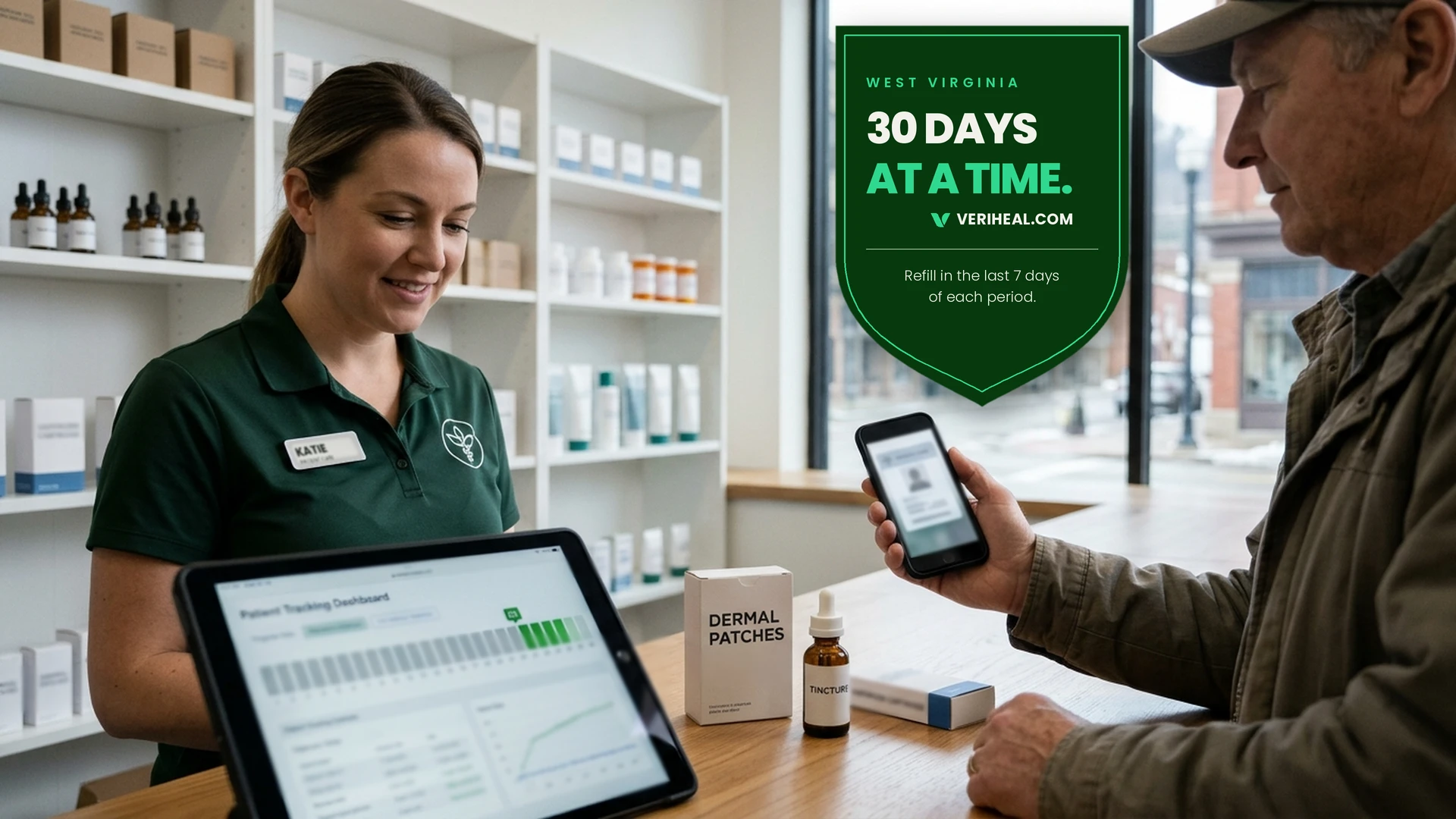
- Purchase limit: Up to 6 ounces of flower or 60 grams of concentrate per rolling 30-day period, unless your physician sets a different limit.
- Home growing: Not allowed without a state permit.
The research on cannabis and PTSD is still limited. A systematic review of cannabinoids for mood disorders, anxiety disorders, and PTSD found one small trial of 10 patients in which adding THC to standard medication reduced nightmares. Overall, it concluded that the evidence is insufficient, so talk with your physician about what to expect.
Using Medical Cannabis Alongside Your Existing Mental Health Treatment
A card doesn’t replace your current care. If you work with a therapist or take medication for PTSD, tell your certifying physician and your prescriber about both. A PubMed review of cannabinoids and cytochrome P450 enzymes found that the liver enzymes that break down THC also process many medications, though its authors say the clinical effect in patients is still unclear.
Your care team can only help if they know what you’re considering. Many people feel uncertain about adding cannabis to a complicated treatment history, and that’s a reasonable thing to raise at your visit. For related reading, see Veriheal’s guide on states that offer medical cannabis for mental health conditions.
A Note for Veterans: What You Need to Know Before You Apply
Veterans often face a few extra questions before they apply, from who can certify them to how a card might affect a federal job. None of these should stop you, but they’re easier to handle when you know about them upfront. Three points are worth knowing before you book:
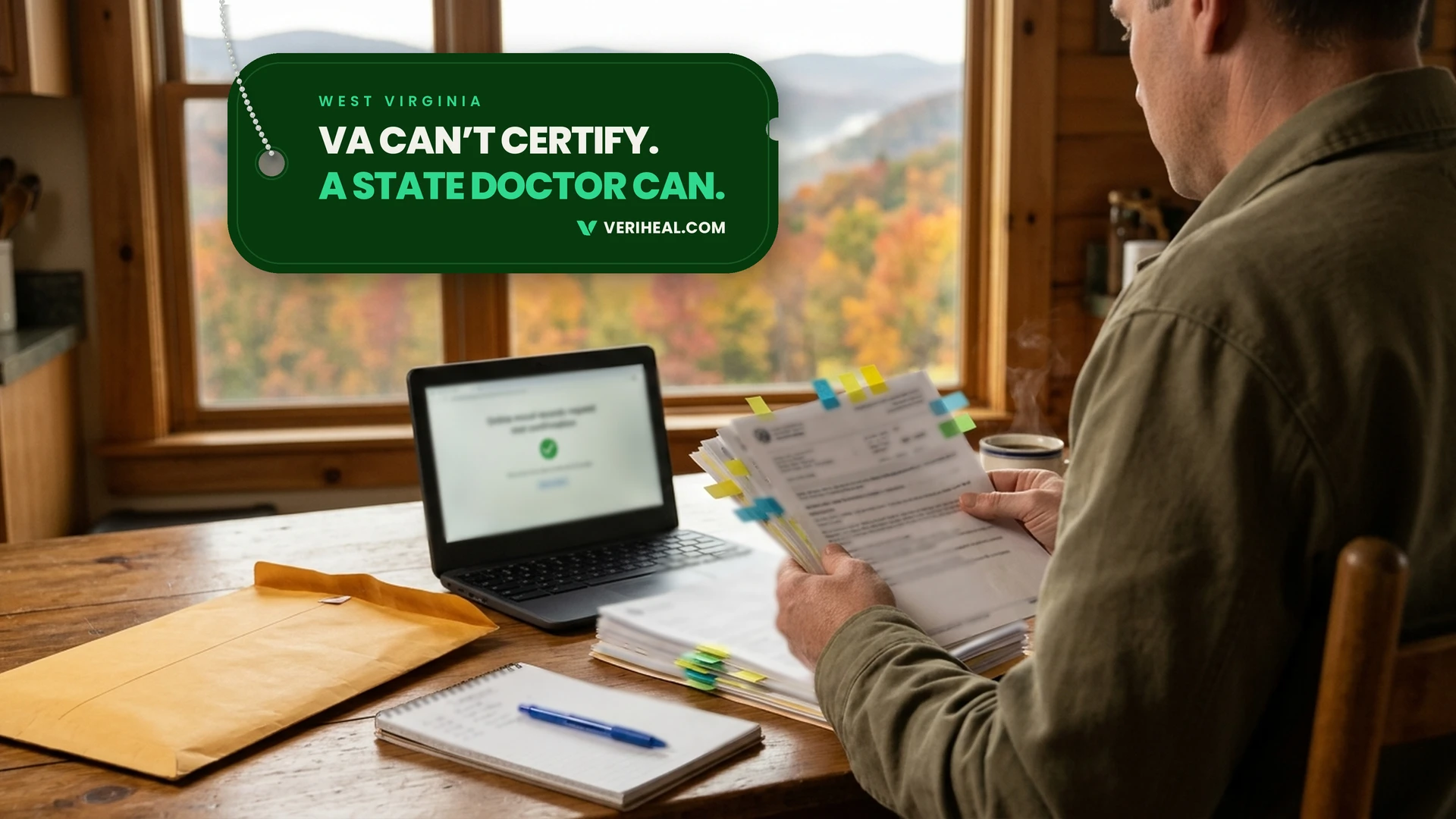
Your VA Doctor Cannot Certify You
VA policy prohibits VA providers from completing forms or registering veterans for state-approved marijuana programs, according to NORML’s report on the policy. You’ll need a separate OMC-registered physician. The same policy says veterans must not be denied VA services solely for taking part in a state program.
Your VA Records Can Still Help
Your VA paperwork can’t certify you, but it can help the physician who does. A VA rating letter, mental health record, or treatment summary shows your history in one place, which can save time during the visit. Ask your VA team for copies ahead of your appointment, since records can take a while to arrive. Even a short summary helps your physician see what you’ve already tried.
Federal Employment and Security Clearance Considerations
State protections don’t override federal rules. Federal employees and contractors should check their employer’s policy before enrolling, since a state card doesn’t shield you from federal testing standards. Veriheal covers related questions in its guide on whether a medical cannabis card shows up on a background check. A licensed attorney or benefits counselor can help if your job is at stake.
What Workplace Protections Apply?
West Virginia law says an employer cannot discharge, refuse to hire, or otherwise discriminate against an employee solely because of their certified status. The rule is in section 16A-15-4. It has limits:
- Use at work: Employers don’t have to allow use on their premises.
- Impairment: Employers can discipline an employee who is under the influence at work.
- Safety-sensitive tasks: The Act lets employers bar patients from tasks that could be life-threatening or risk public safety while impaired, according to the National Law Review.
For related questions, read Veriheal’s guide on telling your employer about your medical card.
Does Insurance Cover Medical Cannabis for PTSD?
Plan to pay for medical cannabis out of pocket, since insurance doesn’t cover it. Cannabis itself isn’t an FDA-approved drug, and the April 2026 move to Schedule III for state-licensed medical marijuana didn’t change that. Your current PTSD care can stay in place, and your providers can help you decide whether to change anything.
Who Changed What? Firearms Rules for West Virginia Patients
Veterans and gun owners often ask about firearms, and the answer depends on who you ask. Each part of the federal system moved differently:
- The DEA: State-licensed medical marijuana moved from Schedule I to Schedule III on April 28, 2026, under Federal Register rule 2026-08176. Marijuana outside a state medical license, and outside FDA-approved products, stays in Schedule I.
- The Supreme Court: In United States v. Hemani, decided June 18, 2026, the Court unanimously held that prosecuting someone under 18 U.S.C. § 922(g)(3) based solely on marijuana use was inconsistent with the Second Amendment. The Court called its decision narrow.
- The ATF: The Bureau of Alcohol, Tobacco, Firearms and Explosives (ATF) rescinded its 2011 open letter, which had told dealers a medical card was grounds to refuse a sale. It hasn’t issued replacement guidance, so dealer practices may vary, and ATF Form 4473 is unchanged.
- Congress: Section 922(g)(3) remains federal law, so a false answer about drug use still carries real federal risk.
A licensed attorney can explain how this applies to you before you apply. For more detail, read Veriheal’s guide on medical cannabis patients and gun rights.
How Can Veriheal Help With PTSD Certification in West Virginia?
If you’re unsure whether your history fits, the evaluation is the place to find out. Your physician decides whether certification fits your care, and Veriheal backs the visit with a “get approved or your money back” policy.
When you’re ready, find a medical marijuana doctor online.
Note: The content on this page is for informational purposes only and is not intended to be professional medical advice. Do not attempt to self-diagnose or prescribe treatment based on the information provided. Always consult a physician before making any decision on the treatment of a medical condition.
Note: Veriheal does not support illegally consuming therapeutic substances such as cannabis but acknowledges that it transpires because of the current illicit status, which we strive to change by advocating for research, legal access, and responsible consumption. Always consult a physician before attempting alternative therapies.
Frequently Asked Questions
Is PTSD a qualifying condition for a medical cannabis card in West Virginia?
Yes, post-traumatic stress disorder is a named qualifying condition under West Virginia’s Medical Cannabis Act. A registered physician decides whether your diagnosis qualifies. The condition must be diagnosed as part of your continuing care.
How do I get a medical cannabis card for PTSD in West Virginia?
A registered West Virginia physician certifies your condition, then you apply to the Office of Medical Cannabis online and pay the $50 fee. The OMC reviews applications within 30 days.
How much does it cost to get a medical cannabis card in West Virginia?
A West Virginia medical cannabis card costs $50 in state fees, plus your physician’s evaluation fee. Veriheal’s evaluation is $149 and can be paid in installments. If your income is below 200% of the federal poverty level, you can request a waiver of the state fee.
Can I see a doctor online to get my West Virginia medical cannabis card for PTSD?
You can see a doctor online for your West Virginia card, since the OMC lists telehealth companies with registered West Virginia physicians. Your physician must still be registered with the OMC and hold a valid West Virginia license.
How long does it take to get a medical cannabis card in West Virginia?
The OMC reviews applications within 30 days, then you download your digital card from its portal. Your card is valid for one year.
Can my employer fire me for being a medical cannabis patient?
West Virginia law bars firing or discrimination solely because of your certified status, but employers can still discipline impairment at work. Federal rules may apply in some jobs.
Is anxiety a qualifying condition in West Virginia?
Anxiety isn’t on the state’s list of 15 serious medical conditions, but PTSD is. Your physician can discuss which diagnosis fits your history.
Author, Share & Comments