If getting to a dispensary is the hardest part of your care, delivery can change that, but New York doesn’t promise it everywhere. The Office of Cannabis Management (OCM) says some registered organizations deliver and others don’t, so your address and your dispensary decide. Veriheal connects you with a New York health care provider for an online video evaluation, which gets you the certification you need first.
This guide covers who delivers, how to check your area, what to have ready, and what to do if delivery doesn’t reach you. By the end, you’ll know how to plan before you order.
Is Medical Cannabis Home Delivery Legal in New York?
New York allows medical home delivery, but only through registered organizations that choose to offer it. The OCM’s program FAQs say some registered organizations offer delivery. Its dispensing facilities page adds that registered organizations handle all aspects of delivery.
That means no statewide guarantee. Delivery areas and possible fees come from each organization, so you’ll need to contact the one you want to use.
What Do You Need Before You Order?
Delivery starts with a certification from a New York certifying health care provider. It includes a registry ID, which replaces the physical card the OCM no longer issues. According to the OCM’s patients page, you can be certified in person or by telehealth, and Veriheal’s guide on telemedicine for medical cannabis explains how the online route works. Once you’re certified, gather these before you order:
- Your certification: It includes your registry ID.
- A government-issued photo ID: Registered organizations must verify your identity with both.
- A delivery address in range: Each organization sets its own delivery area.
How Do You Find a Dispensary That Delivers?
The OCM’s dispensing facilities page lists every location with a Home Delivery column marked Yes or No. Use it to build a shortlist, then call each organization to confirm. Ask about:
- Delivery area: Whether it reaches your address.
- Fees: The OCM notes that fees are possible.
- Hours: These vary by location.
- Products: Organizations don’t all sell the same forms.
Where Is Medical Cannabis Delivery Available in New York?
Delivery depends on which organization runs the location, so the map looks different from region to region. The OCM’s dispensing facilities page marks every location Yes or No for home delivery. This snapshot reflects that page at the time of writing, so check it for updates before you plan around a location.
New York City
Queens is the only borough with locations marked for delivery. The listed Manhattan, Brooklyn, Bronx, and Staten Island locations are marked No, so patients there may need a caregiver or an organization in a neighboring county.
Long Island
Nassau County has locations marked for delivery, which gives patients in the western part of the island options. The listed Suffolk County location is marked No, so Suffolk patients should call to confirm before they count on delivery.
Westchester and the Hudson Valley
Orange County has a location marked for delivery. The listed Westchester and Dutchess County locations are marked No, so patients in those counties will want to ask about any service area that might reach them.
Upstate New York
Delivery varies widely upstate:
- Capital Region: Saratoga County has a location marked for delivery. The listed Albany County locations are marked No.
- Western New York: Monroe County locations are marked for delivery. The listed Erie County location is marked No.
- Central New York: An Onondaga County location is marked for delivery, while others in the county are marked No.
- North Country: Clinton County has a location marked for delivery.
Delivery areas are set by each organization, so confirm your address even when your county shows a Yes.
Medical vs. Recreational Delivery in New York
Medical and adult-use cannabis are separate systems, and certification changes what you pay and what you can buy:
- Who delivers: Medical delivery comes from registered organizations. Adult-use retailers are licensed separately.
- Tax: Adult-use retail sales carry a 13% retail excise (9% state, 4% local). Medical sales fall under a separate 3.15% excise tax that the law places on the registered organization.
- Purchase limits: A certified patient may buy up to a 60-day supply, or 3 ounces of cannabis or 24 grams of concentrate, whichever is greater.
At $200 a month, a 13% retail excise comes to $26 a month, or $312 a year. To compare more, read Veriheal’s guide on medical vs. recreational cannabis taxes and the benefits of a medical marijuana card. The OCM’s FAQs don’t describe any scheduling priority for medical patients, so ask each organization about its delivery timing.
What Can You Order?
Your options depend on the organization, since the OCM says registered organizations don’t all sell the same products. A delivery order can include these forms, which the OCM lists as examples:
- Vaporization: Vape cartridges and pens, ground plant, and whole flower.
- Oral forms: Capsules, tablets, tinctures, oral spray, oral powder, and lozenges.
- Topical: Transdermal patches.
Your provider may set a lower limit on your certification, and organizations must follow it.
What to Have Ready When Your Delivery Arrives
The OCM requires registered organizations to verify your identity with your active certification and a government-issued photo ID. Plan for the same check at your door. Keep these within reach:
- Your registry ID: Printed or on your phone.
- Your photo ID: Government-issued and current.
- Your order details: Confirmation and any fee quoted.
Fees, minimums, and delivery windows come from the organization, so ask when you order.
What If Delivery Is Not Available?
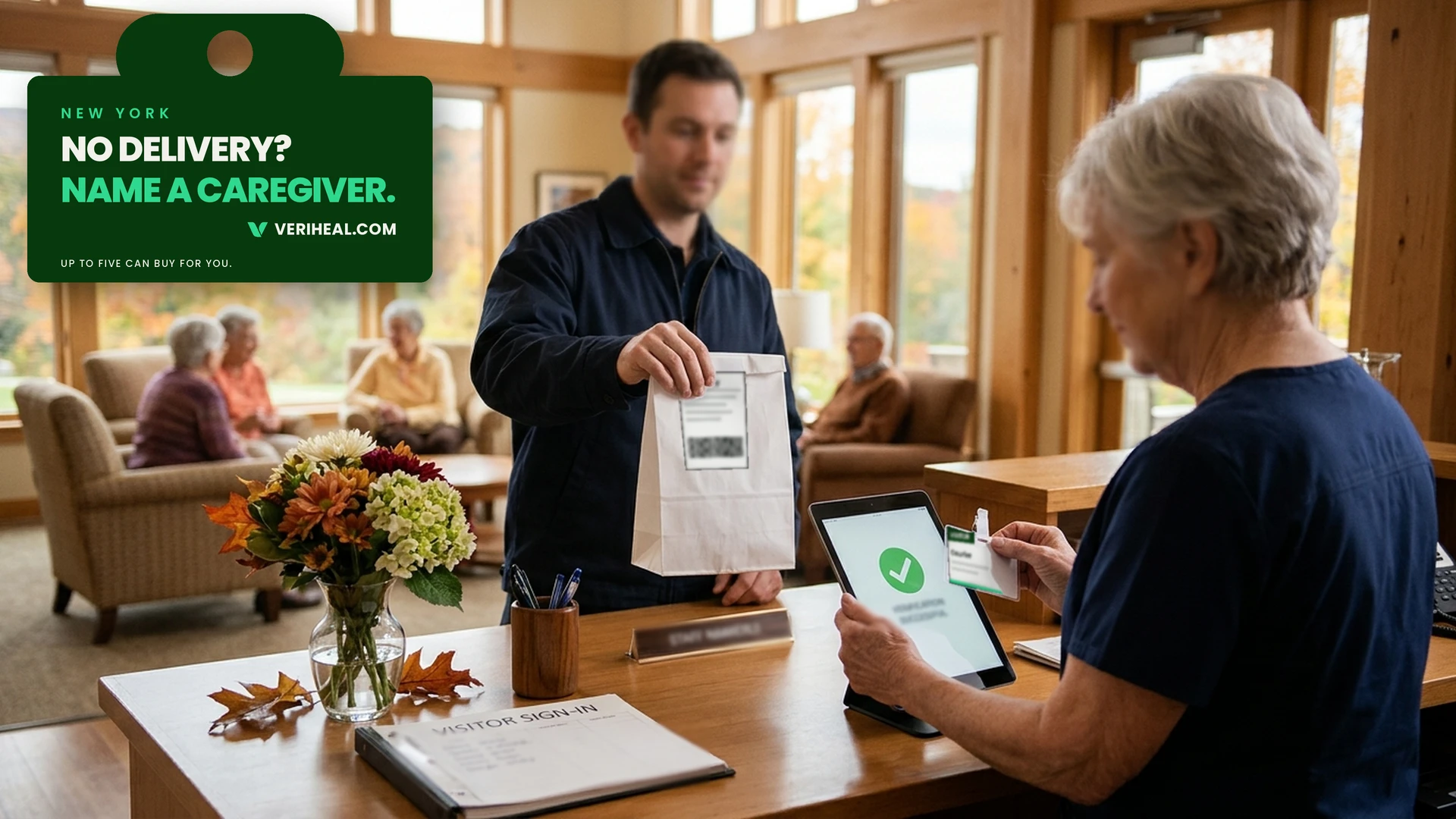
If delivery doesn’t reach your address, a designated caregiver can bridge the gap. You can name up to five caregivers, and each one registers with the OCM after you designate them, according to its designated caregivers page. A caregiver can then buy from a dispensary and bring your medicine to you, which helps when you can’t travel yourself. If you live in a facility, some organizations will deliver directly to a facility that has registered as your caregiver.
Does Privacy Matter With Delivery?
Delivery means sharing your details with a dispensary. Veriheal explains what happens to them in its guide on what dispensaries do with your information. For work and records questions, read Veriheal’s guide on whether a medical cannabis card shows up on a background check.
How to Get Started With Medical Cannabis Delivery in New York
Delivery can feel out of reach until you’re certified, but getting there takes only four steps, and the first one can happen from home. Once your provider certifies you, the rest comes down to choosing an organization that delivers to your address. Here is how it works:
- Book a visit: Choose a certifying provider, in person or by telehealth. The OCM publishes a list of providers on its Open Data page.
- Get certified: If your provider finds cannabis appropriate, they issue your certification and registry ID.
- Choose an organization: Pick one that delivers to your address.
- Place your order: Share your registry ID and photo ID.
For a general timeline, read Veriheal’s guide on how long it takes to get a medical card. For the online route, read Veriheal’s guide on how to get your medical marijuana card online.
What Does Getting Certified Cost?
New York doesn’t charge a state fee to enroll as a patient or caregiver, so your main cost is the provider’s evaluation. Veriheal keeps that step simple, with a $149 evaluation fee that can be split into interest-free installments.
What Should Certified Patients Know About Firearms?
Federal firearms rules changed in 2026, but in separate steps that don’t line up neatly, so it helps to see them in order. Each step loosened one piece of the picture without removing the risk for medical patients who own guns. Here is how the year unfolded:
- April 28: State-licensed medical marijuana moved from Schedule I to Schedule III under Federal Register rule 2026-08176. Marijuana outside a state medical license, and outside FDA-approved products, stays in Schedule I.
- June 18: In United States v. Hemani, the Supreme Court unanimously held that prosecuting someone under 18 U.S.C. § 922(g)(3) based solely on marijuana use was inconsistent with the Second Amendment. The Court called its decision narrow.
- Afterward: The Bureau of Alcohol, Tobacco, Firearms and Explosives (ATF) rescinded its 2011 open letter, which had told dealers a medical card was grounds to refuse a sale.
The steps leave important gaps, and three facts haven’t moved:
- The statute: Section 922(g)(3) remains federal law.
- The form: ATF Form 4473 is unchanged, so a false answer about drug use still carries real federal risk.
- The guidance: The ATF hasn’t issued replacement guidance, so dealer practices may vary.
A licensed attorney can explain how these rules apply to you before you enroll. For more detail, read Veriheal’s guide on medical cannabis patients and gun rights.
How Can Veriheal Help You Get Certified for Delivery?
Delivery starts only after certification, so the evaluation is your first step. Your provider decides whether certification fits your care, and Veriheal backs the visit with a “get approved or your money back” policy.
Start your New York evaluation with Veriheal or find a medical marijuana doctor online.
Note: The content on this page is for informational purposes only and is not intended to be professional medical advice. Do not attempt to self-diagnose or prescribe treatment based on the information provided. Always consult a physician before making any decision on the treatment of a medical condition.
Note: Veriheal does not support illegally consuming therapeutic substances such as cannabis but acknowledges that it transpires because of the current illicit status, which we strive to change by advocating for research, legal access, and responsible consumption. Always consult a physician before attempting alternative therapies.
Frequently Asked Questions
Can I get medical cannabis delivered in New York?
Yes, New York medical cannabis can be delivered to your home when your registered organization offers the service. The Office of Cannabis Management (OCM) says some organizations deliver and others don’t, so a quick call to confirm they serve your address saves you a wasted order.
Is medical cannabis delivery available statewide in New York?
Delivery isn’t available at every location. The OCM’s dispensing facilities page marks each location Yes or No for home delivery, and each organization sets its own delivery area and fees.
How do I know if a dispensary delivers to me?
Check the OCM’s dispensing facilities page, then call the organization and ask about your address. The OCM tells patients to contact organizations directly about delivery areas and possible fees.
Do I need a certification before delivery?
Yes, you need a certification from a New York certifying health care provider before any organization can serve you. Your certification carries a registry ID, which you use with a government-issued photo ID.
Can a caregiver buy medical cannabis for me instead?
Yes, designated caregivers can buy on your behalf. A patient may designate up to five caregivers, and each caregiver registers after the patient designates them.
How much does New York’s medical cannabis program cost?
New York charges no state fee to enroll as a patient or caregiver, so your main cost is the provider’s evaluation. Veriheal’s online video evaluation is $149, and you can split it into interest-free installments.
Author, Share & Comments