Your medical cannabis journey simplified: find partnered dispensaries, explore pricing options, earn rewards, and get answers to FAQs, all in one spot.
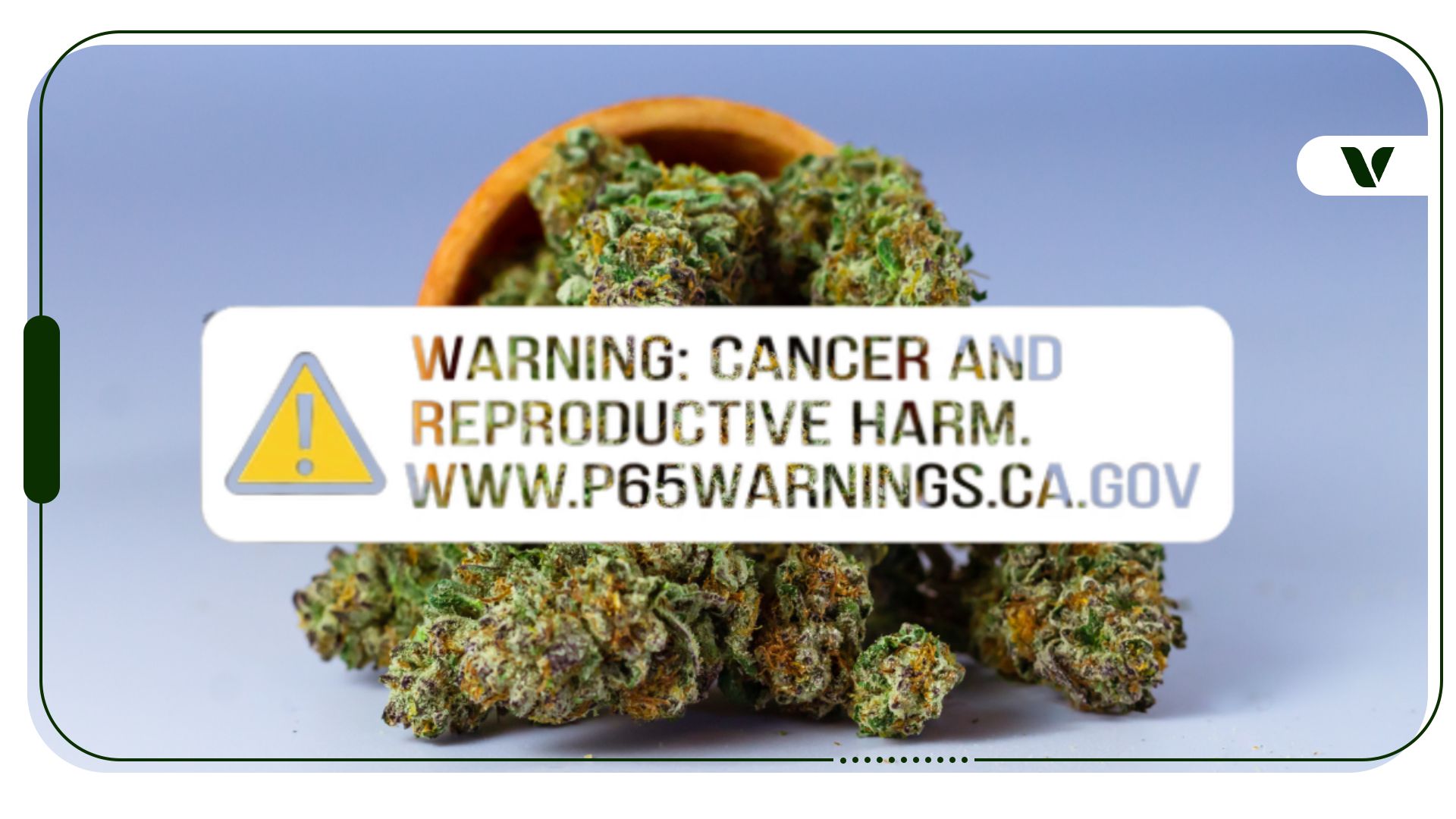
Have you ever seen a Proposition 65 warning on your cannabis products? If you’re in California, you may be familiar with this label. The state mandates this warning on all products that may potentially expose consumers to chemicals known to cause cancer or reproductive harm. If you’re wondering why your cannabis has a Prop 65 warning, read on.
What Is A Proposition 65 Warning?
Proposition 65, also known as the Safe Drinking Water and Toxic Enforcement Act of 1986, is a California-specific law enacted decades ago. It’s meant to protect the state’s drinking water from contamination with chemicals known to cause cancer or reproductive harm. The law requires businesses to disclose any potential exposures to chemicals.
If you see a product with a Prop 65 label, it means that it may expose people to carcinogenic or otherwise harmful chemicals. The list of toxic chemicals is extensive, spanning over 900 different substances. Items include naturally occurring and synthetic chemicals found in pesticides, household products, food, dyes, drugs, and solvents.
California law requires all products to disclose the use of these potentially harmful chemicals, unless the exposure is low enough to pose no significant risk. The Office of Environmental Health Hazard Assessment (OEHHA), which is part of the California Environmental Protection Agency (CalEPA), typically determines whether chemicals meet requirements for placement on the list.
Why Does My Weed Have A Prop 65 Warning?
If you’re in California and purchase legal cannabis products, you’ll likely see a Prop 65 warning on the label. Here’s what the state says about its decision to include cannabis on the list:
“Cannabis (marijuana) smoke is on the Proposition 65 list because it can cause developmental harm and cancer.
During pregnancy, smoking cannabis or being heavily exposed to cannabis smoke can harm the development of the child. It may affect the child’s birthweight, behavior, and learning ability.
Smoking cannabis or being exposed to cannabis smoke may increase the risk of cancer.
Proposition 65 requires businesses to determine if they must provide a warning about significant exposure to listed chemicals.”
The fact sheet goes on to explain that cannabis smoke contains thousands of different chemicals, including ones found on the Proposition 65 list. These include tetrahydrocannabinol (THC), which may impact the baby during pregnancy. Additionally, the list includes other cancer and/or reproductive-harm-causing ingredients like benzene (a known carcinogen that may form when heating cannabis), and heavy metals like cadmium, mercury, and lead, among others.
They also mention that many of the aforementioned chemicals are present in tobacco smoke, which is also on the Prop 65 list.
Now that you have a better understanding of why your cannabis product has the Prop 65 label, you may be concerned about the risks. Keep in mind that there are many conflicting studies and assertions around cannabis and cancer, with some suggesting that cannabis may raise the risk for certain cancers, while other evidence suggests cannabis may help manage or prevent other types of cancer.
A 2017 systematic review concluded that smoking cannabis doesn’t raise the risk of lung, head, and neck cancers in adults. They did, however, conclude that modest evidence suggests cannabis may be associated with one subtype of testicular cancer. Additionally, they found minimal evidence to suggest that cannabis use during pregnancy raises the risk of cancer in offspring.
See If You Qualify For Medical Marijuana -Select Your State!
Select Your State
Alabama
Alaska
Arizona
Arkansas
California
Colorado
Connecticut
Delaware
Florida
Georgia
Hawaii
Idaho
Illinois
Indiana
Iowa
Kansas
Kentucky
Louisiana
Maine
Maryland
Massachusetts
Michigan
Minnesota
Mississippi
Missouri
Montana
Nebraska
Nevada
New Hampshire
New Jersey
New Mexico
New York
North Carolina
North Dakota
Ohio
Oklahoma
Oregon
Pennsylvania
Rhode Island
South Carolina
South Dakota
Tennessee
Texas
Utah
Vermont
Virginia
Washington
West Virginia
Wisconsin
Wyoming
Never miss a post
Get updates on cannabis culture, new research, and expert insights
However, a more recent 2025 study found that patients with cannabis use disorder may be at a higher risk for developing head and neck cancers. Researchers noted that they need more studies to better understand the correlation.
In addition, another recently published study found a high correlation between frequent cannabis use and colon cancer mortality. However, this study does not present a causal relationship between cannabis and colon cancer, but focuses on the outcomes of those who have already developed the condition.
On the other hand, some researchers have found that cannabis may help fight against cancer. In one study, a cannabis-based drug killed 100% of pancreatic cancer cells without damaging any healthy cells. While promising, we need many more human-centered studies to determine if this could be a real treatment option.
California Recognizes Medical Cannabis Uses
While California law requires the Prop 65 label on cannabis products, that doesn’t mean that the state sees cannabis as solely a medical risk. In fact, California was the first state to legalize medical cannabis.
California recognizes 12 conditions for its medical cannabis program, including anorexia, anxiety, arthritis, cachexia (Wasting Syndrome), cancer, chronic pain, glaucoma, HIV/AIDS, migraine, persistent muscle spasms, seizures, and severe nausea.
Even though the state requires Prop 65 warnings on cannabis products, California also recognizes that cannabis may be used for a variety of medical conditions.
Do Other States Have Prop 65 Warnings?
Proposition 65 is unique to California, as it’s a state law that was passed several decades ago. No other states currently have laws that mimic the exact guidelines of Proposition 65.
However, you may see products with Prop 65 warnings outside of California. This is because some products with nationwide distribution place the warning on all products to ensure the label reaches California customers.
This doesn’t apply to cannabis, though. It’s illegal for cannabis products to cross state lines, meaning that California products with Prop 65 labels generally stay in their state of origin.
You may see different warning labels on your cannabis products in other states, though. Although each state with recreational weed has unique rules and regulations, all require some form of warning about cannabis use and pregnancy and breastfeeding. The placement and exact wording may vary from state to state, though.
Next time you pick up a California cannabis product and see a Prop 65 label, you can rest assured knowing that it’s just a part of the state law. Now that you know the meaning behind the label, you can make an informed decision about your consumption.
Macey is a freelance writer from Seattle. She's covered the cannabis industry extensively, emphasizing the economic opportunities for Indigenous entrepreneurs. Her writing focuses on the people, stories, and labors of love behind every venture.
According to the New York Times, 64 million gabapentin prescriptions were dispensed in 2016, with numbers continuing to rise each year. Many patients now explore medical cannabis as an alternative after experiencing gabapentin’s concerning side effects, including FDA warnings about serious respiratory problems. Both treatments target similar conditions like nerve pain and seizures, but they…
A same-day telehealth appointment in Oklahoma can get you a physician recommendation quickly, but OMMA still needs to process your medical marijuana license application. This guide explains the timeline, required documents, costs, and when you can legally visit a dispensary while waiting for the physical card.
Getting a same-day medical marijuana appointment in Florida can speed up the physician certification process, but first-time patients still need OMMU approval before visiting a dispensary. This guide explains the realistic timeline, required documents, potential delays, renewals, and how to verify a state-certified marijuana doctor.
Getting an Oklahoma medical marijuana card involves more than the advertised physician evaluation fee. This guide breaks down the full OMMA costs, reduced-fee options, online application process, provider requirements, and ways to avoid paying for an evaluation that does not meet state rules.
The statements made regarding cannabis products on this website have not been evaluated by the Food and Drug Administration (FDA). Cannabis is not an FDA-approved substance and is still illegal under federal law. The information provided on this website is intended for educational purposes only and is not intended to diagnose, treat, cure, or prevent any disease. It is not intended as medical advice and should not be considered as a substitute for advice from a healthcare professional. We strongly recommend that you consult with a physician or other qualified healthcare provider before using any cannabis products. The use of any information provided on this website is solely at your own risk.