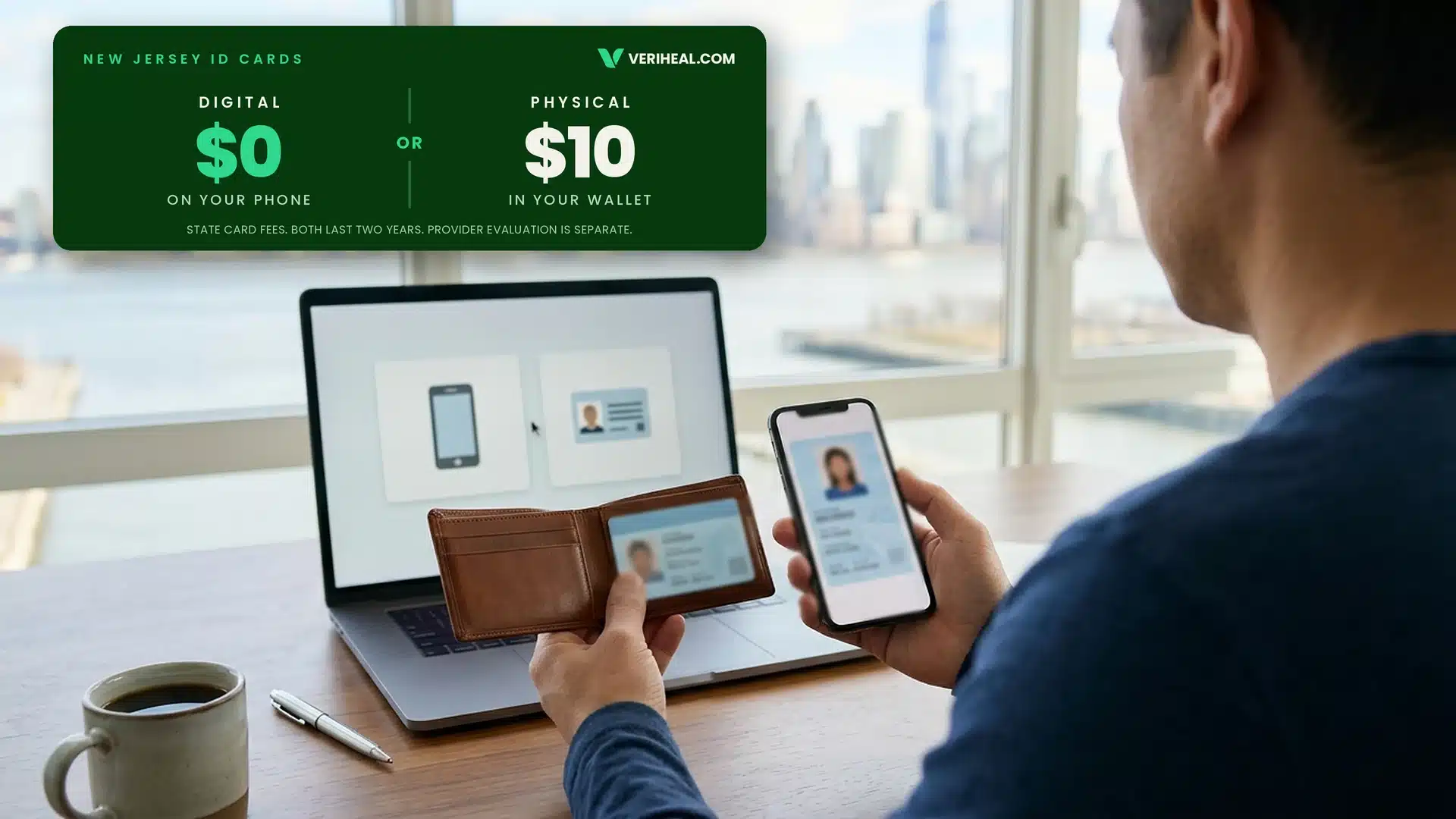
New Jersey gives you two card options, and both last two years. The digital ID card is free, and the physical ID card costs $10. You choose between them while you register for your New Jersey medical marijuana card through the state’s patient portal.
This guide compares the two formats side by side and shows which patients each one suits. It also covers renewal, lost cards, and a few practical points on privacy, work, firearms, and travel, so you can choose your card with confidence.
What Is the Difference Between a Digital and a Physical Card?
New Jersey’s Medicinal Cannabis Program offers a free digital ID card to new and renewing patients, while a physical ID card costs $10. Caregivers can choose either format too. The free digital option came after the Cannabis Regulatory Commission (CRC) cut the registration fee to $10 in December 2023. The program now has a no-cost way to carry your ID.
Your digital ID is available in your patient portal once you log in. According to the CRC’s patient FAQs, you can save a picture of it to your phone or print the PDF. If you’d rather carry a card, you can pay the $10 fee for a physical one. Here’s how the two formats compare:
|
Digital card |
Physical card |
| Cost for the two-year term |
$0 |
$10 |
| Cost at renewal |
$0 |
$10 |
| How you carry it |
A picture saved on your phone, or a printout of the PDF |
A printed card for your wallet |
| Where you find it |
In your patient portal after you log in |
Printed after you register and pay the $10 fee |
| Validity |
Two years |
Two years |
The $10 goes to the state, not to Veriheal. Your provider evaluation is a separate cost. For more background, read Veriheal’s guide on what a medical marijuana card looks like.
Which Card Should You Choose?
Your best choice depends on how you like to carry an ID. The two profiles below show who each format tends to suit.
Who Should Choose the Digital Card?
The digital card fits you best if one or more of these sounds like you:
- You want the lowest cost: The digital card is free, and it still lasts two years.
- You keep your documents on your phone: You can save a picture of your ID to your phone and print the PDF as a paper copy.
- You’d like to skip the renewal fee too: The digital card is free at renewal as well.
If you’re unsure which to pick, start with the free digital card. You can ask for a physical card at renewal if you’d rather carry one.
Who Should Choose the Physical Card?
A physical card makes more sense if any of these describe you:
- You like a card in your wallet: A printed card sits with your other IDs.
- You’d rather not rely on your phone: A printed card doesn’t depend on your phone’s battery or signal.
- You already carry one: If you like your current physical card, you can request another at renewal for $10.
If you’d rather carry a card than a file, the physical card is the better fit. You pay the $10 fee once for each two-year term.
Can You Have Both Cards?
The CRC’s pages don’t say outright whether you can hold both formats at once. The patient FAQs say every patient has access to a digital ID in the portal and can also choose to pay $10 for a physical ID. If you want a digital primary and a physical backup, call the Patient Services Unit at (609) 292-0424 to confirm before you count on it.
How Do You Get Either Card?
Both cards start the same way, with a provider’s authorization. A participating health care provider gives you an Authorizing Healthcare Practitioner Statement, which lists a reference ID number and a registry ID number. You use those numbers to set up your patient portal account, finish registration, and pick your card type.
The state registration page says you’ll need your two ID numbers, proof that you live in New Jersey, a photo taken within the last 60 days, and the name of the Alternative Treatment Center (ATC) where you plan to buy. A current New Jersey government-issued ID covers the residency proof. Otherwise, you can submit two other proofs, such as a utility bill from the last 90 days.
Neither the registration page nor the patient FAQs give a set processing time for new cards. You can follow your application status in the portal, and Veriheal’s guide on how long it takes to get a medical card covers the general timeline.
How Long Do the Cards Last, and How Do You Renew?
Both cards expire after two years. You can start renewing up to 60 days before your current card runs out, according to the CRC’s patient FAQs. Existing patients and caregivers can ask for a free digital card during renewal, according to the CRC’s Existing Patients page, while a physical card carries a $10 charge. Over time, that means the digital card costs $0 at each renewal and the physical card costs $10.
What If You Lose Your Card or Phone?
The two formats handle a loss differently. Your digital ID stays in your patient portal, and the Existing Patients page lists viewing your active electronic ID among the things you can do after logging in. For a lost physical card, the same page says you can make payments for replacement ID cards in the portal. It doesn’t list a replacement fee or turnaround time, so contact the Patient Services Unit before you pay.
Does a Medical Card Show Up on a Background Check?
Here’s what the CRC says about who can see your enrollment. It doesn’t share enrollment information unless you consent in writing, and that rule covers employers who ask the program to verify you’re a patient.
To give that consent, you complete a Release of Records Form in the patient portal. For a closer look at screenings, read Veriheal’s guide on whether a medical cannabis card shows up on a background check.
What Do Employers Need to Know About Your Card?
Your job is a separate question from your privacy. The CRC describes cannabis and employment as a complex issue. Its workplace page says general cannabis use can’t be the deciding factor when an employer hires or fires someone, but employers can still keep a drug- and alcohol-free workplace.
For specifics, the CRC points to two New Jersey Supreme Court cases. Wild v. Carriage Funeral Holdings (2020) is its reference on employment, and Hager v. M & K Construction (2021) is its reference on workers’ compensation. It also suggests taking questions about your employer’s drug testing policies to your human resources department or an employment lawyer. If you’re weighing what to share at work, read Veriheal’s guide on whether to tell your employer about your medical card.
Should You Talk to a Lawyer First If You Own Firearms?
If you own firearms, add one step before you enroll in New Jersey’s program: talk with a lawyer. The CRC says firearms rules aren’t its area and tells patients to check with their local police department. Here’s where five federal points stand today, and only the first three are changes:
- Justice Department action: In April 2026, the U.S. Department of Justice moved state-licensed medical marijuana from Schedule I to Schedule III. Recreational use stays in Schedule I.
- Supreme Court decision: In United States v. Hemani, decided unanimously on June 18, 2026, the Court held that charging someone under 18 U.S.C. § 922(g)(3) for marijuana use alone violates the Second Amendment.
- ATF open letter: The Bureau of Alcohol, Tobacco, Firearms and Explosives (ATF) rescinded its 2011 letter to dealers, which had made a medical card grounds for refusing a sale.
- Section 922(g)(3): The provision itself remains federal law.
- Form 4473: The ATF hasn’t revised the form or issued replacement guidance, so its drug-use question still calls for a truthful answer.
Before you enroll, a lawyer who handles firearms law can explain how these points fit your situation. Veriheal’s guide on medical cannabis patients and gun rights has more background.
Can You Use Your Card When You Travel?
A New Jersey card is a credential for New Jersey’s program, so whether another state recognizes it is that state’s decision. The CRC also tells patients not to carry medicinal cannabis across state lines. Check your destination’s rules before you plan a trip, and read Veriheal’s guide on traveling with a medical marijuana card.
How Can Veriheal Help You Get a New Jersey Card?
Before you can choose a card, a participating provider has to authorize you. Veriheal connects you with a New Jersey health care provider for an online video evaluation, which costs $199. You can split that fee into interest-free installments, and every evaluation comes with a “get approved or your money back” policy. The state card is a separate cost paid to the state: $0 for the digital card or $10 for the physical card. Curious what a card adds once you have it? Read Veriheal’s guide on the benefits of a medical marijuana card.
When you’re ready, book your New Jersey evaluation with Veriheal. After you’re approved, you can register with the state and choose the card that fits you.
Note: The content on this page is for informational purposes only and is not intended to be professional medical advice. Do not attempt to self-diagnose or prescribe treatment based on the information provided. Always consult a physician before making any decision on the treatment of a medical condition.
Note: Veriheal does not support illegally consuming therapeutic substances such as cannabis but acknowledges that it transpires because of the current illicit status, which we strive to change by advocating for research, legal access, and responsible consumption. Always consult a physician before attempting alternative therapies.
Frequently Asked Questions
Is the New Jersey digital medical card really free?
Yes, the New Jersey digital ID card costs $0 for new patients, renewing patients, and caregivers, according to the Medicinal Cannabis Program. You still need a provider evaluation before you can register, and that evaluation has its own cost.
How much does a medical card cost in NJ?
With Veriheal, a New Jersey medical card costs $199 using the free digital state card, or $209 with the $10 physical card. The $199 pays for your online video visit with a New Jersey health care provider, and you can split it into interest-free installments. Every evaluation also comes with a “get approved or your money back” policy.
Can I switch from a digital card to a physical card?
Yes, you can switch card types when you renew, and you can choose either the free digital card or the $10 physical card each time. The CRC’s pages don’t say whether you can switch partway through your two-year term. To find out, call the Patient Services Unit at (609) 292-0424.
How long is a New Jersey medical card valid?
Both the free digital card and the $10 physical card expire after two years. You can start renewal up to 60 days before that date, and you choose your card type again at renewal.
Will a New Jersey medical card appear on a background check?
Not through the CRC unless you give your written consent. The CRC releases enrollment information only after you complete a Release of Records Form in the patient portal. Its pages don’t describe how every type of background check treats a card, so read Veriheal’s guide on whether a medical cannabis card shows up on a background check for more.
Can I get a medical card online in New Jersey?
Yes, you can get a New Jersey medical card online, since providers can authorize patients through telehealth and registration is completed in the CRC’s patient portal. Telehealth applies when it fits the standard of care for your condition.
What qualifies you for a medical card in NJ?
To qualify for a New Jersey medical card, you need a qualifying medical condition, such as chronic pain, anxiety, migraine, cancer, or glaucoma. The CRC keeps the full list on its Medicinal Cannabis Program page, and your provider decides whether your condition qualifies.
What makes you eligible for a medical card in NJ?
You’re eligible for a New Jersey medical card if you’re a state resident with a qualifying condition and a bona fide relationship with a participating provider. The CRC’s program page explains how to meet that relationship requirement.
Can I use my NJ medical card at any dispensary in the state?
The CRC requires your Medicinal Cannabis Program ID to buy from a dispensary’s medical menu, but its pages don’t say every dispensary accepts it. You choose an Alternative Treatment Center when you register, and you can change that choice in the portal. Check with your dispensary before you visit.
Author, Share & Comments