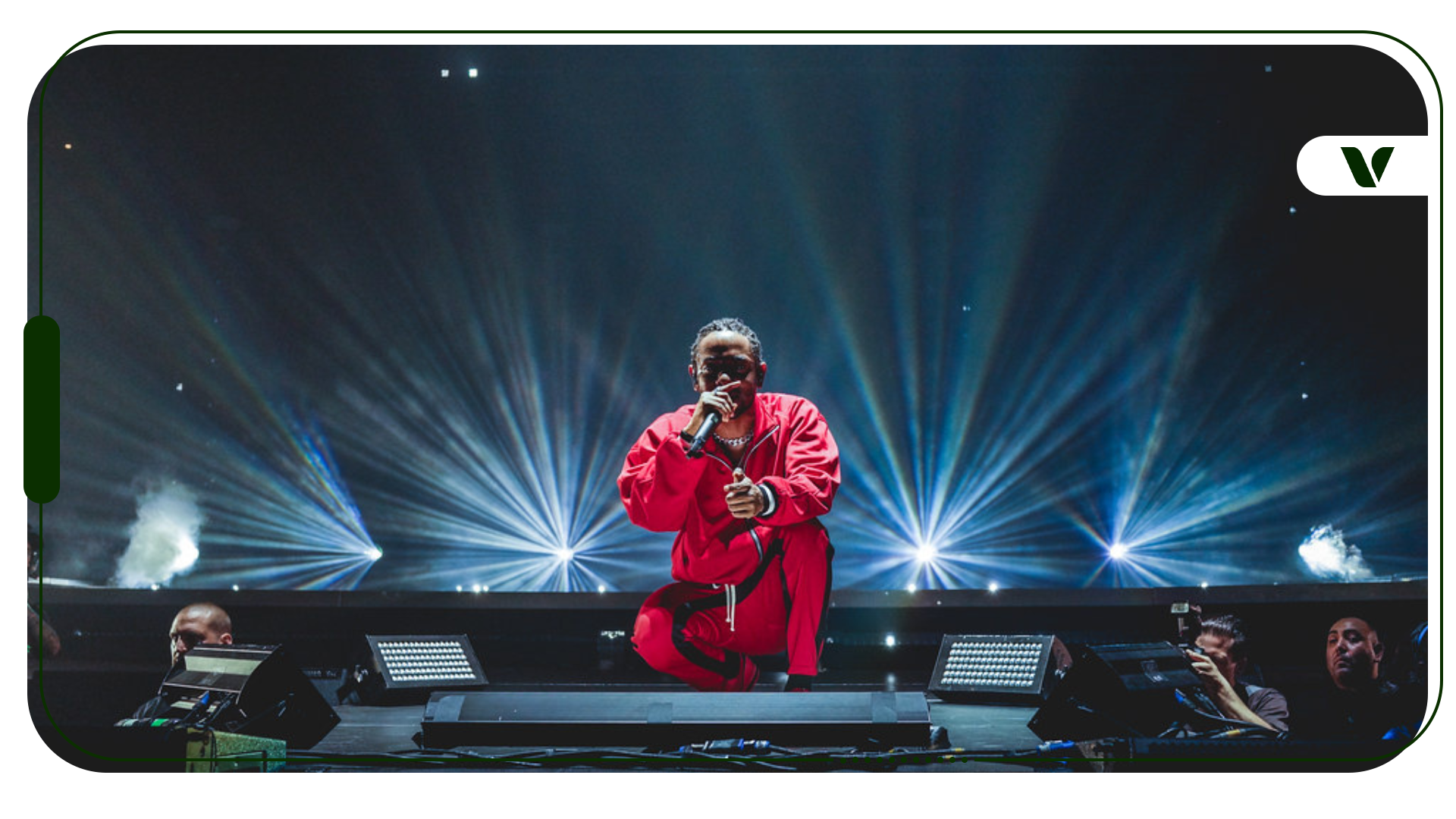
Kendrick Lamar references weed across his entire discography, but not always the way you expect. For a Pulitzer Prize-winning rapper whose catalog spans West Coast rap tradition, conscious hip-hop, and deeply introspective rap, cannabis is less a lifestyle accessory and more a recurring symbol he uses, questions, and ultimately steps back from.
That tension is what makes his marijuana lyrics worth examining. The Compton rapper who came up in the same tradition as Dr. Dre and Snoop Dogg built his reputation on lyrical storytelling that never lets a single image go unexamined, and weed is no exception.
How Kendrick Uses Weed Imagery Across His Discography
Cannabis references in hip-hop often work as shorthand for a specific lifestyle, but Kendrick Lamar uses weed smoking imagery in at least three distinct ways across his catalog, and they do not all point in the same direction.
The first function is atmospheric. On early records, cannabis appears as part of the sensory texture of Compton street life, rooted in the G-funk tradition that shaped Kendrick’s sound. Songs like “The Recipe” place weed alongside sunshine and women as ingredients in a California fantasy, drawing directly from the West Coast rap mythology Kendrick inherited. The imagery here is celebratory and communal, not personal confession.
The second function is social pressure. On good kid, m.A.A.d city, the environment around Kendrick smokes even when he is uncertain. Weed becomes part of what the city asks of you, part of belonging to a place and a crew. The pressure is ambient rather than explicit, which is what makes it so effective as a narrative device.
The third function is the identity function. On “H.O.C.” from Overly Dedicated, Kendrick positions himself explicitly as someone who does not smoke but whose music has become the soundtrack for people who do. That song is the clearest statement of his actual relationship with cannabis, and understanding it reframes every other weed reference in his work.
1. “The Recipe”: Cannabis as California Fantasy
“The Recipe” is the most straightforward weed reference in Kendrick Lamar’s catalog, and that directness is part of its appeal. The 2012 single, recorded with Dr. Dre, leans fully into the California mythology both artists represent. The opening lines name women, weed, and weather as the three ingredients that make Los Angeles worth defending.
The drug use and personal growth tension that defines much of Kendrick’s later work is entirely absent here. This is weed as atmosphere, as place-making, as West Coast identity. It functions the same way a beach or a palm tree might in another song, a symbol that locates the listener geographically and culturally.
What makes it interesting in retrospect is how cleanly it captures a version of Kendrick that later albums walk away from. By the time *good kid, m.A.A.d city* arrived later that year, the California imagery had gotten more complicated, and the weed with it.
2. “Growing Apart (To Get Closer)”: Weed as Emotional Distance
“Growing Apart (To Get Closer)” from good kid, m.A.A.d city uses cannabis differently than “The Recipe” does. The track, featuring Drake, is slower and more inward-looking, and the weed smoking imagery here serves as a buffer between people rather than a shared celebration.
The title itself does the interpretive work. Growing apart and getting closer are not opposites in Kendrick’s framing. They describe the dynamic of a relationship where emotional distance and physical intimacy coexist, where substances fill the space that honest conversation does not. It is one of the subtler cannabis references in hip-hop from that era, less about the drug itself and more about what it enables people to avoid.
This is weed as emotional shorthand, a detail that reveals character and context without being the explicit subject. It fits the broader strategy of good kid, m.A.A.d city, which treats street life and culture as an environment that shapes its characters without reducing them to it.
3. “Poe Man’s Dreams (His Vice)”: Not the Cannabis Anthem You Think It Is
“Poe Man’s Dreams” from Section.80 carries a subtitle that telegraphs Kendrick’s actual argument before the song begins. The vice in question is ambition, not cannabis, but the two are entangled throughout the track in ways that reward close listening.
Kendrick raps about dreaming from a position of poverty, and the substances that appear in the song, including weed, are framed as both comfort and trap. The track belongs to the tradition of introspective rap that treats drug use as a response to structural conditions rather than a personal failing or a lifestyle choice. That framing is consistent with Kendrick’s position across Section.80, his first major-label debut, which approached substance use in rap music with the same analytical distance he would later bring to race, religion, and grief.
The song does not celebrate cannabis use. It locates it within an economic and emotional context that makes the behavior legible without endorsing it. That distinction matters for understanding where Kendrick stands relative to the weed-as-celebration tradition he grew up in.
4. “Kush & Corinthians”: Where Cannabis Meets Spiritual Doubt
“Kush & Corinthians (His Pain)” from Section.80 is the most direct collision in Kendrick’s catalog between cannabis references and religious imagery. The title pairs a slang term for cannabis with a book of the Bible, and the song does not resolve that tension so much as sit inside it.
Kendrick’s lyrical storytelling on this track treats weed and scripture as things that exist in the same breath for the people around him, both reaching for something beyond the everyday. The “His Pain” subtitle points toward a male subject whose spiritual searching and substance use are symptoms of the same unresolved wound. Conscious hip-hop has a long tradition of this kind of sacred-and-profane pairing, but Kendrick handles it with more ambivalence than most, neither condemning the user nor endorsing the use.
The song’s place in the Section.80 sequence matters. Coming early in Kendrick’s TDE Top Dawg Entertainment era, it establishes his tendency to use cannabis as a symbol of something larger rather than as subject matter in itself. Weed here is a window into a character’s interior life, not a lifestyle detail.
5. “FEAR.”: Weed in the Landscape of Survival
“FEAR.” is one of the most structurally ambitious tracks on the DAMN. album, moving through three ages of fear across three verses. The cannabis reference arrives in the third verse, where Kendrick imagines what his 17-year-old self feared: being broke, being controlled, and not surviving long enough for any of it to matter.
The line about rolling up exists inside that survival landscape, not as a celebration of cannabis but as one detail in a portrait of a teenager trying to manage circumstances that feel unmanageable. By the time Kendrick wrote “FEAR.” for the DAMN. album, his relationship with cannabis had already shifted significantly, which makes the lyric retrospective rather than confessional. He is not describing a current habit. He is reconstructing the psychology of a younger version of himself.
That retrospective quality is what separates the marijuana lyrics on DAMN. from the ones on Section.80 or good kid, m.A.A.d city. Earlier in his career, the references were ambient and present-tense. On DAMN., they are memory and distance. The sobriety and self-reflection that characterize his later work had already reshaped how he wrote about the substances around him.
Kendrick Lamar’s Cannabis Lyrics, Album by Album
No competitor has mapped weed-related references across Kendrick’s full discography from Section.80 through GNX. The table below is a working reference for fans doing discography research, showing where cannabis appears thematically in each era and what it represents in that album’s context.
|
Album
|
Notable Track(s)
|
Thematic Function of Cannabis
|
|
Section.80 (2011)
|
“Poe Man’s Dreams,” “Kush & Corinthians”
|
Social and spiritual symptom; weed as response to poverty and spiritual uncertainty
|
|
good kid, m.A.A.d city (2012)
|
“The Recipe,” “Growing Apart (To Get Closer)”
|
Atmospheric West Coast identity; weed as emotional buffer in relationships
|
|
Overly Dedicated (2010)
|
“H.O.C.”
|
Explicit statement of non-smoking identity; weed as other people’s soundtrack
|
|
To Pimp a Butterfly (2015)
|
None significant
|
Cannabis imagery largely absent; political consciousness and jazz-rooted sound displaced street-imagery lyrics
|
|
DAMN. (2017)
|
“FEAR.”
|
Retrospective memory; weed as detail in a portrait of adolescent survival psychology
|
|
Mr. Morale and The Big Steppers (2022)
|
Referenced in passing
|
Sobriety and self-reflection dominate; drug use framed through trauma and recovery lens
|
|
GNX (2024)
|
Regional flex references
|
Returns to California atmospheric imagery without the introspective weight of middle-era work
|
*To Pimp a Butterfly* deserves a specific note here. The album is one of Kendrick’s most politically and musically ambitious records, built on jazz, funk, and spoken word rather than the sample-based production of good kid, m.A.A.d city. The shift away from street-imagery lyrics is not accidental. By 2015, Kendrick was processing race, systemic inequality and incarceration rates in the United States, and his own complicated position as a successful artist from Compton. Cannabis had no real role to play in that argument.
Mr. Morale and The Big Steppers follows a similar logic. The album treats drug use and personal growth as inseparable from trauma processing, which means substances appear in the context of therapy and reckoning rather than as cultural atmosphere. The sobriety and self-reflection arc that began with “H.O.C.” reaches its fullest expression there.
Does Kendrick Lamar Actually Smoke Weed?
Kendrick Lamar does not currently smoke weed. He has said publicly, in more than one interview, that cannabis clouds his thinking rather than sharpens it, and that creative clarity matters more to him than the social or sensory experience of smoking. The earliest documentation of this position in his catalog is “H.O.C.” from Overly Dedicated, where he states explicitly that he does not smoke but that smokers gravitate toward his music.
In a GQ profile, Kendrick described his relationship with substances in terms of cognitive control. The same theme appeared in his HardKnockTV interview, where he discussed staying clear-headed as part of how he approaches writing and performance. Both sources point to the same conclusion: his abstention from cannabis is not a moral position so much as a practical one, rooted in how his mind works best.
That context reframes a significant portion of his marijuana lyrics. When Kendrick writes about weed, he is almost always writing about what it means to other people, what it signals culturally, what it costs socially, or what it reveals about the environment around him. He is an observer of cannabis culture embedded in it, not a participant in the sense that many of his peers are. Research on cannabis and creative cognition in adult users points toward variable effects on divergent thinking depending on frequency of use, which may help explain why artists arrive at such different conclusions about whether cannabis helps or hinders their work.
It is worth noting that individual responses to cannabis vary considerably, and Kendrick’s experience of it impairing his creative clarity is not a basis for generalizing cognitive effects to other users.
Kendrick Lamar’s Best Songs to Smoke To, Ranked by Fan Culture
Fan smoking culture has always had its own canon, distinct from critical rankings or album sequencing. The tracks below have become fixtures in that canon, and the reasons say something about what listeners are actually responding to in Kendrick’s catalog. For more best songs to smoke to across hip-hop and beyond, Veriheal keeps a running list.
- “Sing About Me, I’m Dying of Thirst” (*good kid, m.A.A.d city*, 2012): The eleven-minute closer moves through grief and prayer at a pace that rewards a slow, attentive listen. The production breathes, and the emotional weight lands differently without distraction.
- “u” (*To Pimp a Butterfly*, 2015): One of Kendrick’s most raw and disorienting tracks, “u” simulates psychological unraveling. Fans describe the experience of listening while high as unusually immersive, which is either a recommendation or a warning depending on where your head is.
- “The Art of Peer Pressure” (*good kid, m.A.A.d city*, 2012): The track’s narrative is built around group behavior and the pull of doing what everyone around you is doing. Its weed smoking imagery is literal and social, making it one of the few Kendrick tracks where smoking along feels contextually appropriate.
- “Backstreet Freestyle” (*good kid, m.A.A.d city*, 2012): High energy, minimal complication. The production is aggressive enough to anchor a session without demanding close reading.
- “Swimming Pools (Drank)” (*good kid, m.A.A.d city*, 2012): The DAMN. album does not have a more accessible entry point for new listeners, but this earlier track holds a specific place in fan culture for its hypnotic beat and its counterintuitively nuanced treatment of peer pressure and substance use.
- “LOYALTY.” (*DAMN.*, 2017): Rihanna’s presence and the track’s relatively accessible structure make it one of the more relaxed entries in Kendrick’s catalog. The DAMN. album overall ranks high in fan-smoking playlists for its production quality and relatively controlled emotional register compared to *To Pimp a Butterfly*.
Kendrick’s position as a non-smoker whose catalog has become central to cannabis listening culture is itself one of the more interesting facts about his career. Among celebrity cannabis advocates in the entertainment industry, he occupies a genuinely unusual position: someone whose music serves the culture without participating in it personally.
If you want to explore cannabis culture beyond the playlist, from Fetty Wap on cannabis use to how Kevin Durant changed the NBA’s weed policy, or revisit some of the most memorable silver screen cannabis characters in film history, Veriheal’s blog covers the intersections between cannabis and culture from every angle. And if you’re ready to explore legal cannabis access for yourself, connect with a licensed medical cannabis doctor through Veriheal today.
Note: The content on this page is for informational purposes only and is not intended to be professional medical advice. Do not attempt to self-diagnose or prescribe treatment based on the information provided. Always consult a physician before making any decision on the treatment of a medical condition.
Note: Veriheal does not support illegally consuming therapeutic substances such as cannabis but acknowledges that it transpires because of the current illicit status, which we strive to change by advocating for research, legal access, and responsible consumption. Always consult a physician before attempting alternative therapies.
FAQ
Does Kendrick Lamar smoke weed?
Kendrick Lamar does not currently smoke weed. He has stated in interviews with GQ and HardKnockTV that cannabis impairs rather than enhances his creative clarity, and he has maintained that position throughout his career. His 2010 track “H.O.C.” from *Overly Dedicated* documents this stance explicitly in lyric form.
What Kendrick Lamar song mentions weed the most directly?
“The Recipe,” a song recorded with Dr. Dre in 2012, is Kendrick’s most direct cannabis reference, naming weed as one of three ingredients that define Los Angeles. “H.O.C.” from *Overly Dedicated* is equally direct but takes the opposite position, with Kendrick describing himself as a non-smoker whose music appeals to those who do.
Why does Kendrick Lamar write about weed if he doesn’t smoke?
Kendrick grew up in Compton within a West Coast rap tradition where cannabis is part of the cultural atmosphere. His marijuana lyrics function as social observation and storytelling rather than personal confession, reflecting the environment he came from and the people around him without necessarily describing his own habits.
Does Kendrick Lamar reference cannabis on DAMN.?
Yes. The DAMN. album includes a reference in “FEAR.,” where Kendrick reconstructs the psychology of his teenage self. The cannabis reference there is retrospective rather than current, a detail in a portrait of adolescent fear and survival rather than a statement about his present relationship with the substance.
Which Kendrick Lamar album has the fewest cannabis references?
*To Pimp a Butterfly* (2015) contains the fewest significant weed references of any major Kendrick album. The record’s focus on race, politics, and jazz-rooted composition displaced the street-imagery lyrics of his earlier work, and cannabis imagery had no significant role in the arguments the album was making.
Author, Share & Comments