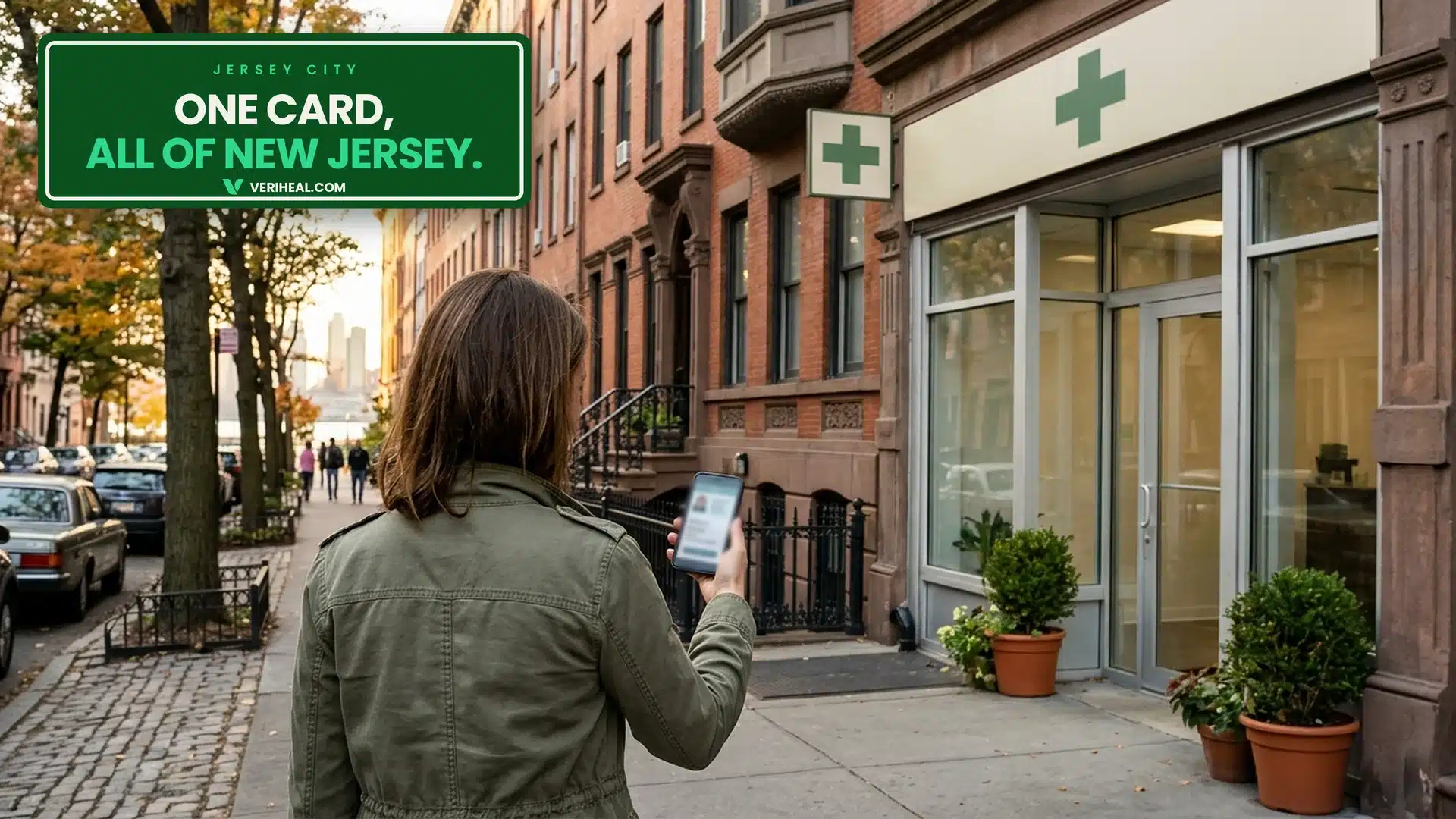
You can get a medical cannabis card in Jersey City through New Jersey’s Medicinal Cannabis Program. The state issues one card for the whole state, so the steps are the same in every city. You register online and can choose a free digital card or a $10 physical card.
This guide walks you through the registration steps, the qualifying conditions, and the two card types. You’ll also see how to choose a dispensary, how a card compares with recreational purchases, and how Veriheal can connect you with a New Jersey health care provider.
How Do You Get a Medical Cannabis Card in Jersey City?
The New Jersey Cannabis Regulatory Commission (NJ-CRC) runs the Medicinal Cannabis Program, which operates under state law, including the Jake Honig Compassionate Use Medical Cannabis Act signed in 2019. Registration starts with a participating health care provider, according to the state’s registration page. You must be a New Jersey resident and keep a bona fide relationship with your provider, as the program overview explains.
Here are the four steps to your card:
- See a participating provider: A registered provider diagnoses a qualifying condition. If you both agree cannabis may help, they give you an Authorizing Healthcare Practitioner Statement. Read Veriheal’s guide on telemedicine for medical cannabis in your state.
- Collect your registry numbers: The statement lists a reference ID number and a registry ID number. You need both to set up your account.
- Register in the patient portal: Create your account, upload your documents and photo, and name your dispensary.
- Choose your card: Pick a free digital ID card or a $10 physical card, then buy from a licensed dispensary.
You’ll need these items to finish registration:
- Registry numbers: The reference ID number and registry ID number from your provider’s statement.
- Proof of residency: A current New Jersey government-issued ID, or two other proofs of residency, such as a utility or cell phone bill from the last 90 days.
- A recent photo: A full-face photo taken within the last 60 days against a plain white background.
- Your dispensary: The name of the Alternative Treatment Center (ATC) where you plan to buy.
Which Conditions Qualify You for a Medical Cannabis Card in New Jersey?
You need a qualifying medical condition to enroll. The state lists 17 approved conditions in its patient FAQs. These are some of them:
- Cancer: Listed as an approved condition.
- Chronic pain: Listed as an approved condition.
- Anxiety: Listed as an approved condition.
- Post-traumatic stress disorder (PTSD): Listed as an approved condition.
- Seizure disorder, including epilepsy: Listed as an approved condition.
- Multiple sclerosis: Listed as an approved condition.
- Amyotrophic lateral sclerosis (ALS): Listed as an approved condition.
The full list also includes migraine, glaucoma, and Tourette syndrome. Opioid use disorder qualifies as a standalone condition, according to the state. Your participating provider confirms whether your diagnosis qualifies.
Should You Choose a Digital or a Physical Card?
New Jersey offers two kinds of ID card, and both are valid for two years, according to the state’ registration page. The digital card is free, and you can save it to your phone or print the PDF from your patient portal. The physical card costs $10.
Go digital if you want to keep your costs down. Go physical if you’d rather carry a card in your wallet. Either way, you can start your renewal up to 60 days before the card expires.
If you’d like to see an example, read Veriheal’s guide on what a medical marijuana card looks like. To plan your timeline, read the guide on how long it takes to get a medical card.
How Do You Pick a Dispensary Near Jersey City?
The state’s Find an Alternative Treatment Center page lists licensed medicinal dispensaries. You name your ATC during registration, so review the list before you finish setting up your account. The state also requires dispensaries that sell medicinal cannabis to give patients priority service.
Once you’ve started registration in the portal, you can visit a medical dispensary while the state reviews your application. Renewing patients aren’t eligible for this. Here’s what to bring on your first visit:
- Your Medicinal Cannabis Program (MCP) ID: You must present your digital or physical card to buy from the medical menu.
- A government-issued photo ID: Bring this if your registration is still under review.
Delivery is another option. The state says all medical and recreational dispensaries can choose to offer delivery, and separate cannabis delivery services also exist. Use the state’s dispensary finder to find licensed dispensaries and delivery services.
If your condition leaves you physically unable to visit an ATC, you can register up to two designated caregivers. A registered caregiver can buy medicinal cannabis for you without you present.
What Does a Card Save You in Jersey City?
Adults 21 and older can buy cannabis in New Jersey without a medical card. A card still changes what you pay and how much you can buy. The table below compares the two paths, using figures from the state’s patient benefits poster and patient FAQs.
| Feature |
Medical card |
Recreational (no card) |
| State sales tax |
0%, with municipal taxes up to 2% |
State sales and use tax applies |
| Purchase limit |
Up to 85 grams (3 oz) per 30 days, set by your provider’s recommendation |
28.35 grams (1 oz) per single transaction |
| Age |
No minimum age; patients under 18 register with a parent or legal guardian as caregiver |
21 and older |
The two limits are measured differently. The medical limit covers 30 days, while the recreational figure applies to each purchase. The state’s patient FAQs say the lack of sales tax makes medicinal cannabis cheaper than recreational. They also say medicinal cannabis is prioritized, so supply stays available for patients.
Veriheal compares both paths in its guides on medical versus recreational cannabis taxes and the benefits of a medical marijuana card.
Who Can See That You Have a Card?
The state doesn’t share enrollment information without your written consent, according to its patient FAQs. Sharing requires a Release of Records Form completed in your patient portal. Read Veriheal’s guide on whether a medical cannabis card shows up on a background check.
Workplace rules can be complicated. The state’s patient FAQs advise taking questions about employer drug testing to your human resources department or an employment lawyer. You can also read Veriheal’s guide on whether to tell your employer about your medical card.
Should You Talk to a Lawyer First If You Own Firearms?
If you own firearms, talk with a lawyer before you enroll in New Jersey’s Medicinal Cannabis Program. Federal firearms law shifted in 2026, but several points stayed the same. The state’s patient FAQs say firearms questions fall outside the NJ-CRC’s purview and point patients to their local police department.
What shifted in 2026:
- Rescheduling: On April 28, 2026, state-licensed medical marijuana moved from Schedule I to Schedule III, according to the Federal Register. Other marijuana stays in Schedule I.
- Court ruling: On June 18, 2026, the U.S. Supreme Court decided United States v. Hemani. It found that prosecuting Hemani under 18 U.S.C. § 922(g)(3), based solely on his marijuana use, was inconsistent with the Second Amendment. The judgment was unanimous, and the Court called its decision narrow.
- ATF letter: The Bureau of Alcohol, Tobacco, Firearms and Explosives (ATF) rescinded its 2011 open letter. That letter told dealers a medical marijuana card was reason to refuse a sale.
What has not changed:
- The law: Section 922(g)(3) is still federal law.
- The form: ATF Form 4473 is unchanged, so you must still answer its drug-use question truthfully.
- The guidance: The ATF has issued no replacement guidance.
A lawyer can explain how these rules apply to you. For more detail, read Veriheal’s guide on medical cannabis patients and gun rights.
How Can Veriheal Help You Get a Card in Jersey City?
Before you can register with the state, you need a participating provider to sign off on your condition. Veriheal makes that part simple by connecting you with a New Jersey health care provider for an online video evaluation. Your provider can also tell you whether any in-person follow-up applies to your situation.
The evaluation costs $199, and you can split the fee into interest-free installments. If you don’t get approved, Veriheal’s “get approved or your money back” policy has you covered. The state card is a separate cost, paid to the state: $0 for digital or $10 for physical.
Registration works the same in Jersey City as anywhere else in New Jersey, so you can get started from home. Start your New Jersey evaluation with Veriheal today, or find a medical marijuana doctor through Veriheal.
Note: The content on this page is for informational purposes only and is not intended to be professional medical advice. Do not attempt to self-diagnose or prescribe treatment based on the information provided. Always consult a physician before making any decision on the treatment of a medical condition.
Note: Veriheal does not support illegally consuming therapeutic substances such as cannabis but acknowledges that it transpires because of the current illicit status, which we strive to change by advocating for research, legal access, and responsible consumption. Always consult a physician before attempting alternative therapies.
Frequently Asked Questions
How do I get a medical cannabis card in Jersey City?
You get a Jersey City medical cannabis card through the New Jersey Medicinal Cannabis Program in four steps. A participating health care provider diagnoses a qualifying condition and gives you an Authorizing Healthcare Practitioner Statement. Then you register in the state’s patient portal, upload your documents and photo, name an ATC, and choose a card type. Veriheal connects you with a New Jersey health care provider for an online video evaluation.
Do you need a medical card for a dispensary in NJ?
No, you don’t need a medical card to buy cannabis from a licensed New Jersey dispensary if you’re 21 or older. A card still gives you a 0% state sales tax on medicinal cannabis and a purchase limit of up to 85 grams per 30 days, according to the state. Patients under 21 can also enroll, since the program has no minimum age.
What disqualifies you from getting a medical cannabis card in NJ?
To enroll in New Jersey’s Medicinal Cannabis Program, you need a qualifying condition diagnosed by a participating health care provider, so not having one keeps you from registering. The state lists 17 approved conditions, including chronic pain, anxiety, and PTSD. You also need proof of New Jersey residency.
What is the difference between the digital and the physical card?
The New Jersey digital medical cannabis card is free, and the physical card costs $10. Both are valid for two years, and you can save the digital card to your phone or print the PDF. Either card comes after you’re evaluated by a participating provider, and Veriheal connects you with a New Jersey health care provider for an online video evaluation.
Does Jersey City have its own medical cannabis card?
No, Jersey City doesn’t issue its own medical cannabis card, because the state issues one card for all of New Jersey. Jersey City residents follow the same registration steps as everyone else in the state.
Do medical cannabis patients pay sales tax in Jersey City?
Enrolled New Jersey patients pay a 0% state sales tax on medicinal cannabis. Municipal taxes on medicinal cannabis vary, up to 2%. Adult-use purchases carry the state sales and use tax.
How much medical cannabis can a New Jersey patient buy?
A New Jersey medical cannabis patient can buy up to 85 grams (3 oz) per 30-day period, and your provider sets the amount in your recommendation. Terminally ill patients are exempt from the maximum limits. Recreational buyers can purchase 1 oz (28.35 grams) in a single transaction.
Author, Share & Comments