Minnesota doesn’t make you choose between two words for your pain, because the state lists both chronic pain and intractable pain as qualifying conditions. A Minnesota health care practitioner decides whether yours fits, and the Office of Cannabis Management (OCM) enrolls you. Veriheal connects you with a Minnesota practitioner for an online video evaluation through its Minnesota medical cannabis program.
This guide covers how certification works, what to bring, what the card saves you, and how cannabis fits alongside your current pain care. By the end, you’ll know what to do first.
Does Chronic Pain Qualify for a Medical Cannabis Card in Minnesota?
Chronic pain qualifies, and so does intractable pain. The OCM’s qualifying conditions page lists both, and Minnesota added them in separate steps: intractable pain in 2016 and chronic pain in 2020. The list also includes a catch-all for any condition your health care practitioner has recommended, approved, or authorized cannabis to treat, so a pain presentation that doesn’t fit a label can still be considered.
A diagnosis alone isn’t enough. Your practitioner must certify that you have a qualifying condition, and you must be a Minnesota resident. Approval depends on your history and your practitioner’s clinical judgment, and no website can promise it.
Minnesota’s Medical Cannabis Certification Pathway: Step by Step
Certification starts with a practitioner, and enrollment finishes with the OCM. The OCM lays out the process on its page about how to become a medical cannabis patient:
- See a certifying practitioner: Minnesota-licensed physicians, physician assistants, and advanced practice registered nurses can certify patients once they’re registered with the OCM. Visits can be conducted by telemedicine, according to the OCM.
- Get certified: If you qualify, your practitioner certifies your condition in the Medical Cannabis Registry.
- Complete your enrollment: The OCM emails you an enrollment link. Submit your application and a photo ID within 90 days of certification, or your certification expires.
- Wait for the decision: The OCM must approve or deny enrollment within 30 days. The OCM suggests applying within the first 60 days to leave room.
- Pick up your medicine: Once approved, you can access your registry account and visit a medical cannabis dispensary.
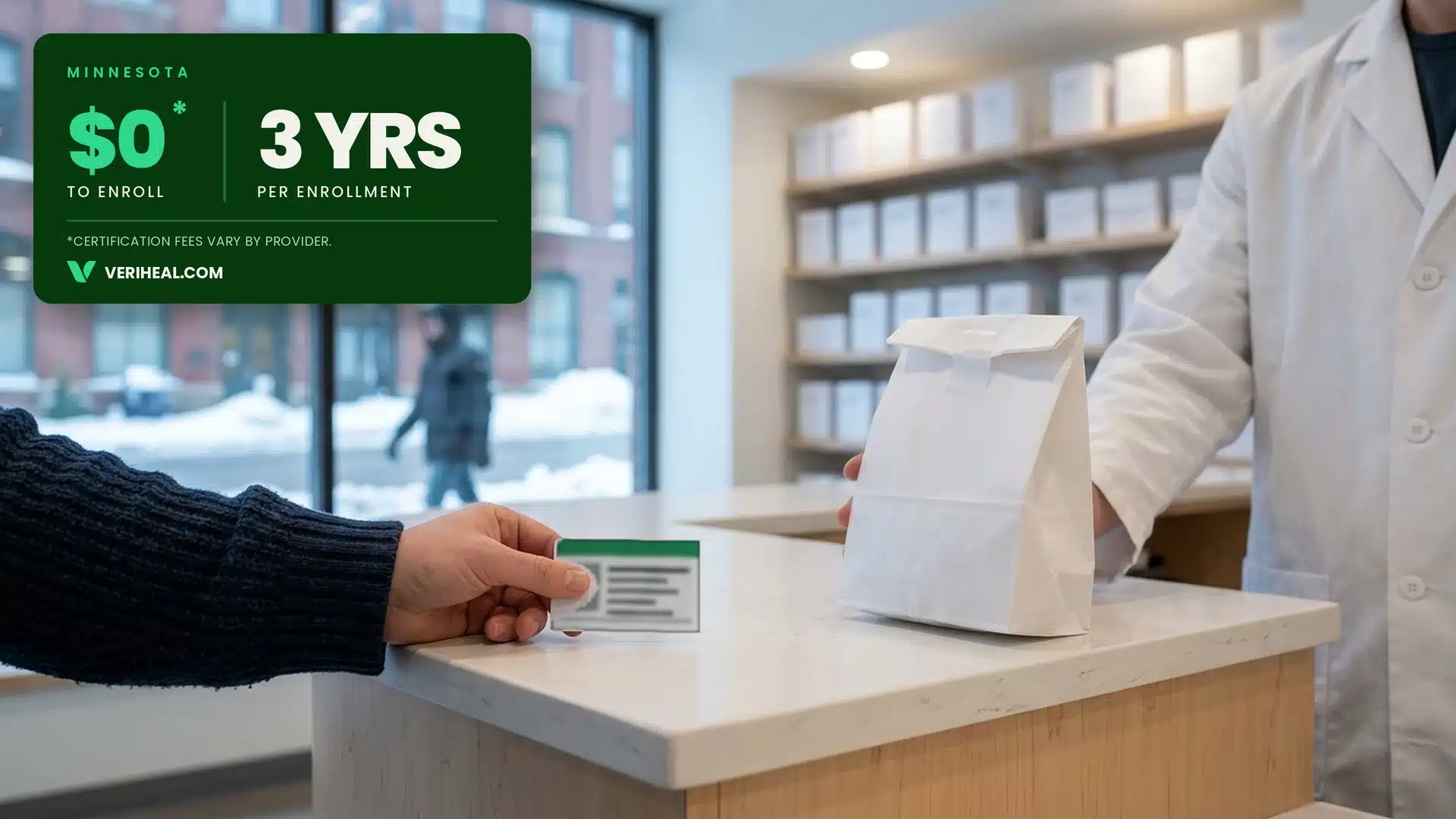
Your enrollment is valid for three years, and you reenroll with a new certification after that. For general timing, read Veriheal’s guide on how long it takes to get a medical card. For the online route, read Veriheal’s guide on how to get your medical marijuana card online.
What Documentation Does Your Certifying Provider Need?
Your practitioner needs to see your pain history, since chronic pain has no single test. Bring what you have from this list:
- Diagnosis records: Notes from your treating physician or pain specialist.
- Treatment history: Medications, physical therapy, injections, and other treatments you’ve tried, plus how they worked or why you stopped.
- Imaging and test results: MRI, X-ray, or nerve studies, where they apply.
- Prescription history: A record of pain medications, including any opioids or gabapentinoids.
Your certifying practitioner doesn’t have to be your current pain specialist, but certifying means attesting that they’re available to manage your condition on an ongoing basis. Your practitioner is judging whether cannabis is a reasonable next step in your full clinical picture.
A primary care provider can certify you if they’re a Minnesota-licensed physician, physician assistant, or advanced practice registered nurse enrolled in the registry. Ask before you book, because not every practitioner participates.
Why the Minnesota Medical Card Still Matters After Legalization
Adult-use cannabis is legal in Minnesota, but enrollment still changes what you pay and what limits apply. The main advantages:
- Tax: Medical items bought by or for an enrolled patient are exempt from the 15% cannabis gross receipts tax, under Minnesota Statutes section 295.81. The Department of Revenue also says medical cannabis isn’t subject to the general state sales tax.
- Possession limits: The adult-use possession limits don’t apply to enrolled patients whose products carry patient-specific labeling, under section 342.09.
- Practitioner guidance: Enrollment keeps a practitioner involved in your care, which matters for ongoing pain management.
At $200 a month, a 15% tax comes to $30 a month, or $360 a year, before sales tax. Patients in Tribal programs and visiting patients don’t get the exemption. For more, read Veriheal’s guides on medical vs. recreational cannabis taxes and the benefits of a medical marijuana card.
What Does Enrollment Cost?
Minnesota charges no state enrollment fee, according to the state’s patient enrollment process document, and enrollment is valid for three years. Your practitioner’s visit is the main cost. Veriheal keeps that step simple, with a $199 evaluation fee you can split into interest-free installments.
Timing matters here, since your certification needs to be dated within 90 days before you apply, according to section 342.52. Booking your visit close to when you’re ready to enroll keeps you inside that window.
Medical Cannabis and Your Existing Pain Management Plan
Chronic pain care is rarely one treatment, and many patients already see a specialist, take several medications, or both. Adding cannabis works best when everyone on your care team knows about it, so nothing is working against anything else. Three questions come up often, and each one is worth settling before you enroll:
- Do you need to tell your pain specialist? Yes. Cannabinoids and many medications use the same liver enzymes, according to a PubMed review of cannabinoids and cytochrome P450 enzymes, though its authors say it’s unclear how much this matters in patients. Tell every prescriber about everything you take. For a broader look at cannabis drug interaction considerations, read Veriheal’s guide on medications to avoid mixing with cannabis.
- Does certification mean changing your treatment? Not by itself. Minnesota law does require enrolled patients to keep receiving regularly scheduled treatment for their condition from a practitioner and to report changes. A small study of 21 chronic pain patients on morphine or oxycodone found that pain was significantly lower after five days of vaporized cannabis when the two groups were combined. The researchers saw enough promise to recommend larger, better-controlled trials, so it’s an early finding rather than settled evidence.
- What if your pain specialist doesn’t support cannabis? Certification comes from a separate practitioner, so your specialist’s view doesn’t decide it. Still, keep your specialist informed.
What Cannabis Products Are Available to Medical Patients in Minnesota?
Minnesota law covers medical cannabis flower and medical cannabinoid products, and the OCM lists the medical cannabis dispensary locations with hours and websites. Check it before you travel, because operators can change.
How you take a product matters. The National Cancer Institute notes that inhaled cannabinoids enter the bloodstream quickly, while oral THC passes through the liver first. The OCM’s page on whether dried flower is right for you is a good starting point, and dispensary staff can help match a format to your needs.
Does Insurance Cover Cannabis for Chronic Pain?
Plan to pay for medical cannabis out of pocket, since insurance doesn’t cover it. Cannabis itself isn’t an FDA-approved drug, and the April 2026 move to Schedule III for state-licensed medical marijuana didn’t change that.
Your current pain care can stay in place, and your own providers can help you decide whether to change anything. For privacy questions, read Veriheal’s guide on whether a medical cannabis card shows up on a background check.
What Does Each Federal Firearms Change Mean for Minnesota Patients?
Federal firearms rules shifted in 2026, and for medical cannabis patients who own guns, the headlines can be misleading. Marijuana’s federal status loosened for state-licensed medical use, the Supreme Court weighed in, and the ATF withdrew guidance dealers had relied on. None of that removes every risk, though, since each change comes with a catch. Here is what each one means in practice:
- Rescheduling: State-licensed medical marijuana moved from Schedule I to Schedule III on April 28, 2026, under Federal Register rule 2026-08176. In practice, marijuana outside a state medical license, and outside FDA-approved products, stays in Schedule I.
- The Supreme Court: In United States v. Hemani, decided June 18, 2026, the Court unanimously held that prosecuting someone under 18 U.S.C. § 922(g)(3) based solely on marijuana use was inconsistent with the Second Amendment. In practice, the Court called its decision narrow, so it doesn’t settle every case.
- The ATF: The Bureau of Alcohol, Tobacco, Firearms and Explosives (ATF) rescinded its 2011 open letter, which had told dealers a medical card was grounds to refuse a sale. In practice, the ATF hasn’t issued replacement guidance, so dealer practices may vary.
- The statute and the form: Section 922(g)(3) remains federal law, and ATF Form 4473 is unchanged. In practice, a false answer about drug use still carries real federal risk.
A licensed attorney can explain how this applies to you before you enroll. For more detail, read Veriheal’s guide on medical cannabis patients and gun rights.
How Can Veriheal Help With Pain Certification in Minnesota?
Living with long-term pain makes every appointment feel like a big decision, and this one doesn’t have to be. A Minnesota practitioner reviews your history and decides whether certification fits your care, and Veriheal backs the visit with a “get approved or your money back” policy.
If you’d like an answer sooner rather than later, find a medical marijuana doctor online.
Note: The content on this page is for informational purposes only and is not intended to be professional medical advice. Do not attempt to self-diagnose or prescribe treatment based on the information provided. Always consult a physician before making any decision on the treatment of a medical condition.
Note: Veriheal does not support illegally consuming therapeutic substances such as cannabis but acknowledges that it transpires because of the current illicit status, which we strive to change by advocating for research, legal access, and responsible consumption. Always consult a physician before attempting alternative therapies.
Frequently Asked Questions
How do I get a medical cannabis card for chronic pain in Minnesota?
A Minnesota-licensed practitioner certifies your condition in the state registry, then you complete enrollment with the Office of Cannabis Management within 90 days. The OCM decides within 30 days. After approval, you can pick up medical cannabis at a dispensary.
What conditions qualify for a medical cannabis card in Minnesota?
Chronic pain and intractable pain both qualify, along with conditions such as PTSD, cancer, and seizures. The OCM’s list also covers any condition for which your practitioner has recommended cannabis. Your practitioner decides whether your condition fits.
How much does a Minnesota medical cannabis card cost?
Minnesota charges no state enrollment fee, so your main cost is your practitioner’s visit. Veriheal’s online video evaluation is $199, and you can split it into interest-free installments.
Can a primary care doctor certify me for medical cannabis in Minnesota?
A primary care doctor can certify you if they’re a Minnesota-licensed physician, physician assistant, or advanced practice registered nurse enrolled in the registry. Not every provider participates, so ask before you book.
How long does it take to get a medical cannabis card in Minnesota?
Certification can happen at your visit, and the OCM then has up to 30 days to review your enrollment application. You must submit that application within 90 days of certification.
Do enrolled patients save on tax in Minnesota?
Enrolled patients in Minnesota are exempt from the 15% cannabis gross receipts tax on medical items. Patients in Tribal programs and visiting patients don’t get the exemption.
How long does Minnesota enrollment last?
Enrollment is valid for three years. You reenroll with a new certification from a practitioner, and the OCM says those visits can be conducted by telemedicine.
Author, Share & Comments