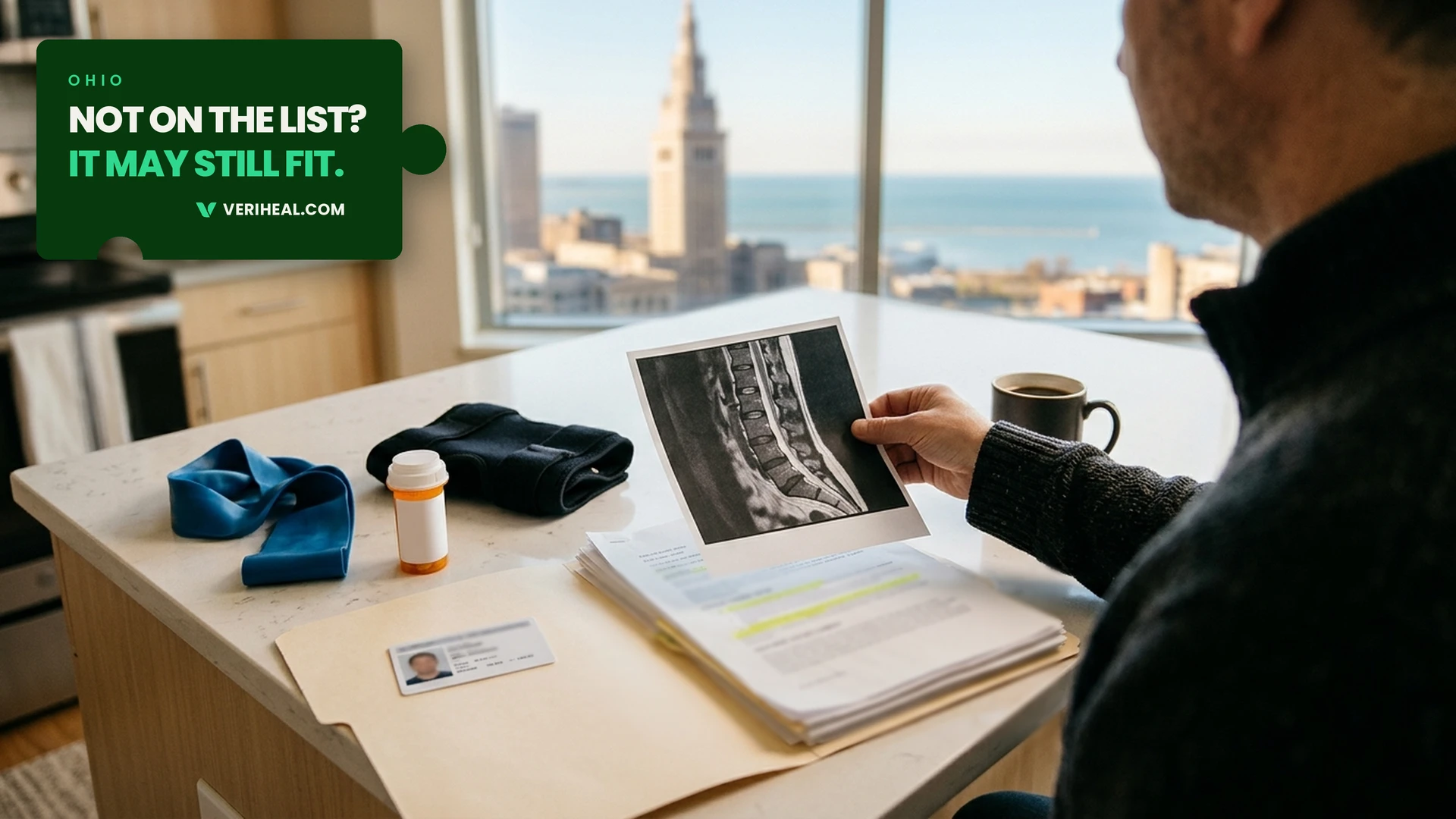
Ohio recognizes 26 qualifying conditions for medical marijuana, from cancer and epilepsy to PTSD and chronic pain, so there’s a good chance your diagnosis is already covered. Some conditions that aren’t named on the list can still count, too, since the State Medical Board treats several pain-related diagnoses as part of its chronic pain category.
This guide walks you through every condition on the list, explains how Ohio’s chronic pain standard works in practice, and clears up the conditions patients ask about most. You’ll also learn what to bring to your appointment and what happens after your physician certifies you, so you can walk in prepared and leave with a clear next step.
Who Qualifies for an Ohio Medical Marijuana Card?
Before you check the condition list, it helps to confirm you meet Ohio’s basic requirements. These apply to every patient in the Ohio Medical Marijuana Control Program (OMMCP), whatever the diagnosis:
- Ohio residency: You need to be an Ohio resident with proof of residency.
- Age: Adults 18 and older can register on their own, and patients under 18 can qualify with a registered caregiver.
- A qualifying condition: You need a diagnosis of at least one condition on Ohio’s list.
- A certified physician: Your recommendation must come from a physician who holds a certificate to recommend, which the State Medical Board issues under section 4731.30 of the Ohio Revised Code.
If you meet those four requirements, the next step is checking your diagnosis against the list below. Further down, you’ll find guidance on Ohio’s chronic pain standard and what to bring to your appointment.
The 26 Conditions That Qualify for Medical Marijuana in Ohio
Ohio’s list comes from section 3796.01 of the Ohio Revised Code, plus the conditions the State Medical Board has added since the program began. Here’s the full list in alphabetical order:
- AIDS
- Alzheimer’s disease
- Amyotrophic lateral sclerosis (ALS)
- Cachexia (wasting syndrome)
- Cancer
- Chronic traumatic encephalopathy (CTE)
- Crohn’s disease
- Epilepsy or another seizure disorder
- Fibromyalgia
- Glaucoma: For one patient’s perspective, read Veriheal’s story on cannabis for glaucoma.
- Hepatitis C
- Huntington’s disease
- Inflammatory bowel disease
- Irritable bowel syndrome
- Multiple sclerosis
- Pain that is either chronic and severe or intractable: Not every type of chronic pain qualifies, and the section below explains what this standard means.
- Parkinson’s disease
- Positive status for HIV
- Post-traumatic stress disorder (PTSD)
- Sickle cell anemia
- Spasticity
- Spinal cord disease or injury
- Terminal illness
- Tourette syndrome
- Traumatic brain injury
- Ulcerative colitis
The list can grow over time. The Board reviews petitions to add new conditions during set submission periods, and it decides them at public meetings. After its June 2025 vote, it announced the next period would run from November 1 to December 31, 2025. You can find the current list on the Board’s covered conditions page. Your physician will confirm whether your diagnosis qualifies.
Understanding Ohio’s Chronic Pain Standard
Chronic pain covers a wide range of situations, which is why it helps to know exactly what Ohio’s standard requires. Under the state’s statute, pain qualifies when it’s either chronic and severe or intractable, so ongoing pain that’s mild or well managed doesn’t meet the bar on its own.
The category is also broader than its name suggests. According to the State Medical Board’s position statement on covered conditions, several conditions fall under it rather than needing their own listing. These include arthritis, chronic migraines, complex regional pain syndrome, degenerative disc disease, and lupus where pain is present.
Documentation matters as much as the diagnosis itself. Under Ohio’s standard of care rule for certifying physicians, your physician must document a review of your past care. That review has to show that standard medical treatment was attempted or considered. Already diagnosed by another physician? Your certifying physician can confirm that diagnosis with a copy of your medical records or a detailed written summary.
Showing up without records makes it harder for your physician to confirm your diagnosis and document your treatment history. Before your appointment, gather what you can from this list:
- Prior treatment records: Notes on physical therapy, prescription pain management, or specialist referrals you’ve tried.
- Diagnostic imaging: Scans or imaging results, if they’re relevant to your condition.
- Treatment history: A summary from your primary care physician covering your diagnosis and care so far.
Do Anxiety, Autism, PTSD, and Migraines Qualify for Medical Marijuana in Ohio?
A few conditions cause more confusion than the rest. Some are on the list with specific requirements, while others aren’t on the list at all. Here’s where each one stands.
PTSD
PTSD is on Ohio’s list of qualifying conditions, and both military and civilian trauma can qualify. A formal PTSD diagnosis from a mental health professional strengthens your case, especially when you bring the records that document it.
Anxiety
Anxiety isn’t a qualifying condition in Ohio, even though many patients might expect it to be. PTSD is on the list, though, so if you’ve been diagnosed with PTSD or any other listed condition, you can qualify on that basis.
Autism Spectrum Disorder
Autism spectrum disorder isn’t on Ohio’s list. On June 11, 2025, the State Medical Board voted down a petition to add refractory autism spectrum disorder, according to its meeting announcement. A patient with autism who also has a separate qualifying condition can still qualify for that condition.
Cachexia and Wasting Syndrome
Cachexia, also called wasting syndrome, is on the list and covers significant unintentional weight loss tied to a chronic illness. It’s a syndrome linked to an underlying condition rather than a standalone diagnosis, which is why it often comes up for patients with cancer or HIV.
Chronic Migraines
Chronic migraines aren’t listed as a separate condition, but they still count. The State Medical Board has determined that they fall under the chronic and severe or intractable pain category, so a documented history of your migraine frequency and the treatments you’ve tried is what your physician will look for.
Chronic Traumatic Encephalopathy (CTE)
CTE is on Ohio’s list and applies to patients with a documented history of repetitive head trauma. It’s most commonly seen in veterans and contact-sport athletes, and records showing that history help support the diagnosis.
What Happens After Your Physician Certifies You
Getting certified is a big step, but it doesn’t activate your card on its own. Your physician’s recommendation starts the registration process, and you’ll finish it yourself:
- Your physician records the recommendation in the Medical Marijuana Patient & Caregiver Registry.
- You receive an email with instructions for completing your registration.
- You activate your registry account and pay the state fee, which is currently $0.01.
- You buy from a licensed Ohio dispensary once your registration is active.
Ohio’s registration fee is now just $0.01. The Division of Cannabis Control cut it from $50 a year on March 4, 2024. Its fee announcement also said the state plans to remove the fee completely. Check the registry for the current charge when you activate or renew. To plan your timeline, read Veriheal’s guide on how long it takes to get a medical card.
Once you’re registered, you also skip a 10% tax. Under Ohio Revised Code § 3780.22, adult-use cannabis sales carry a 10% excise tax. The Division of Cannabis Control says medical marijuana sales are exempt from it. Patients may also get dispensary discounts. Veriheal’s guide to the benefits of a medical marijuana card covers the rest.
If privacy is a concern, you’re not alone. Many patients want to know who can see their registration before they sign up. Veriheal’s guide on whether a medical cannabis card shows up on a background check answers the most common privacy questions.
Does an Ohio Medical Marijuana Card Work in Other States?
Your Ohio card is issued for Ohio’s program, and Ohio doesn’t accept medical marijuana cards from other states. Every other state sets its own rules for visiting patients, so whether your Ohio card is recognized elsewhere depends on where you’re going.
Those rules also change over time, and crossing state lines with cannabis can raise federal issues. Before you plan a trip, check Veriheal’s guides on which states accept out-of-state medical marijuana cards, traveling with a medical marijuana card, and medical marijuana card state-by-state updates.
How to Prepare for Your Ohio Medical Marijuana Appointment
A little preparation goes a long way toward a smooth certification. Here’s what to do before your visit:
- Gather your medical records, including your diagnosis and treatment history, especially if you’re qualifying for chronic pain.
- Bring proof of Ohio residency, such as a state-issued ID.
- Confirm your physician holds a certificate to recommend before you book.
- Be ready to describe your symptoms and how they affect your daily life, in plain language.
- Know what your physician’s role is, which is to assess whether your condition qualifies and document it, not to prescribe a specific product or dose.
Veriheal takes care of the third step by connecting you with an Ohio physician for a video evaluation, and your physician can tell you whether any in-person follow-up applies to you. The Ohio evaluation costs $199, you can split it into interest-free installments, and every evaluation comes with a “get approved or your money back” policy.
If your condition is on the list, you’re one appointment away from knowing where you stand. Book your Ohio evaluation with Veriheal and bring your records along, so your physician has what they need to review your case.
Note: The content on this page is for informational purposes only and is not intended to be professional medical advice. Do not attempt to self-diagnose or prescribe treatment based on the information provided. Always consult a physician before making any decision on the treatment of a medical condition.
Note: Veriheal does not support illegally consuming therapeutic substances such as cannabis but acknowledges that it transpires because of the current illicit status, which we strive to change by advocating for research, legal access, and responsible consumption. Always consult a physician before attempting alternative therapies.
Frequently Asked Questions
What are the qualifying conditions for medical marijuana in Ohio?
Ohio has 26 qualifying conditions for medical marijuana in 2026. They include cancer, PTSD, epilepsy, multiple sclerosis, Crohn’s disease, and pain that is either chronic and severe or intractable. The list comes from Ohio Revised Code section 3796.01, plus conditions the State Medical Board has added since. A certified physician confirms whether your diagnosis qualifies.
Does anxiety qualify for medical marijuana in Ohio?
No, anxiety isn’t a qualifying condition for medical marijuana in Ohio. PTSD is on the list, though, so a patient diagnosed with PTSD or any other listed condition can still qualify.
Does autism qualify for medical marijuana in Ohio?
No, autism spectrum disorder doesn’t qualify on its own in Ohio. The State Medical Board rejected a petition to add refractory autism spectrum disorder on June 11, 2025, but a patient with autism who also has a listed condition can qualify for that condition.
Do chronic migraines qualify for medical marijuana in Ohio?
Yes, chronic migraines can qualify in Ohio, even though they aren’t listed separately. The State Medical Board counts them under the chronic and severe or intractable pain category, so your physician will look for a documented history of your migraines and the treatments you’ve tried.
What disqualifies you from getting a med card in Ohio?
You can be turned down for an Ohio medical marijuana card if you don’t have a documented qualifying condition, can’t provide records that support it, or don’t meet the residency requirement. A physician can also decline to certify you if your condition doesn’t meet the state’s standard, such as pain that isn’t chronic and severe or intractable.
How hard is it to get a medical marijuana card in Ohio?
Getting an Ohio medical marijuana card is straightforward if you have a documented qualifying condition and the records to back it up. Preparation is the main hurdle, especially for chronic pain, since your physician has to document that standard treatment has been attempted or considered.
Can Ohio add new qualifying conditions?
Yes, the State Medical Board can add qualifying conditions after reviewing petitions submitted during set periods. It can also reject them, as it did with refractory autism spectrum disorder in June 2025. If you’re not sure where your diagnosis stands today, an Ohio physician can review it during a video evaluation through Veriheal, and you get your money back if you aren’t approved.
How much does it cost to register for medical marijuana in Ohio?
Registering for medical marijuana in Ohio costs just $0.01 in state fees, so your main cost is the $199 physician evaluation through Veriheal. The Division of Cannabis Control cut the fee from $50 a year in March 2024 and plans to remove it completely. Veriheal also lets you split the $199 evaluation into interest-free installments, so you don’t have to pay it all at once.
What are the changes in Ohio marijuana laws for 2026?
Ohio’s medical marijuana program now runs alongside adult-use cannabis, which voters approved through Issue 2 in November 2023. For patients, the biggest changes are financial: the state registration fee dropped to $0.01 in March 2024, and medical purchases are exempt from the 10% adult-use excise tax. The State Medical Board also reviewed new condition petitions from November 1 to December 31, 2025, and an online evaluation through Veriheal can confirm whether your diagnosis qualifies under the current list.
Author, Share & Comments