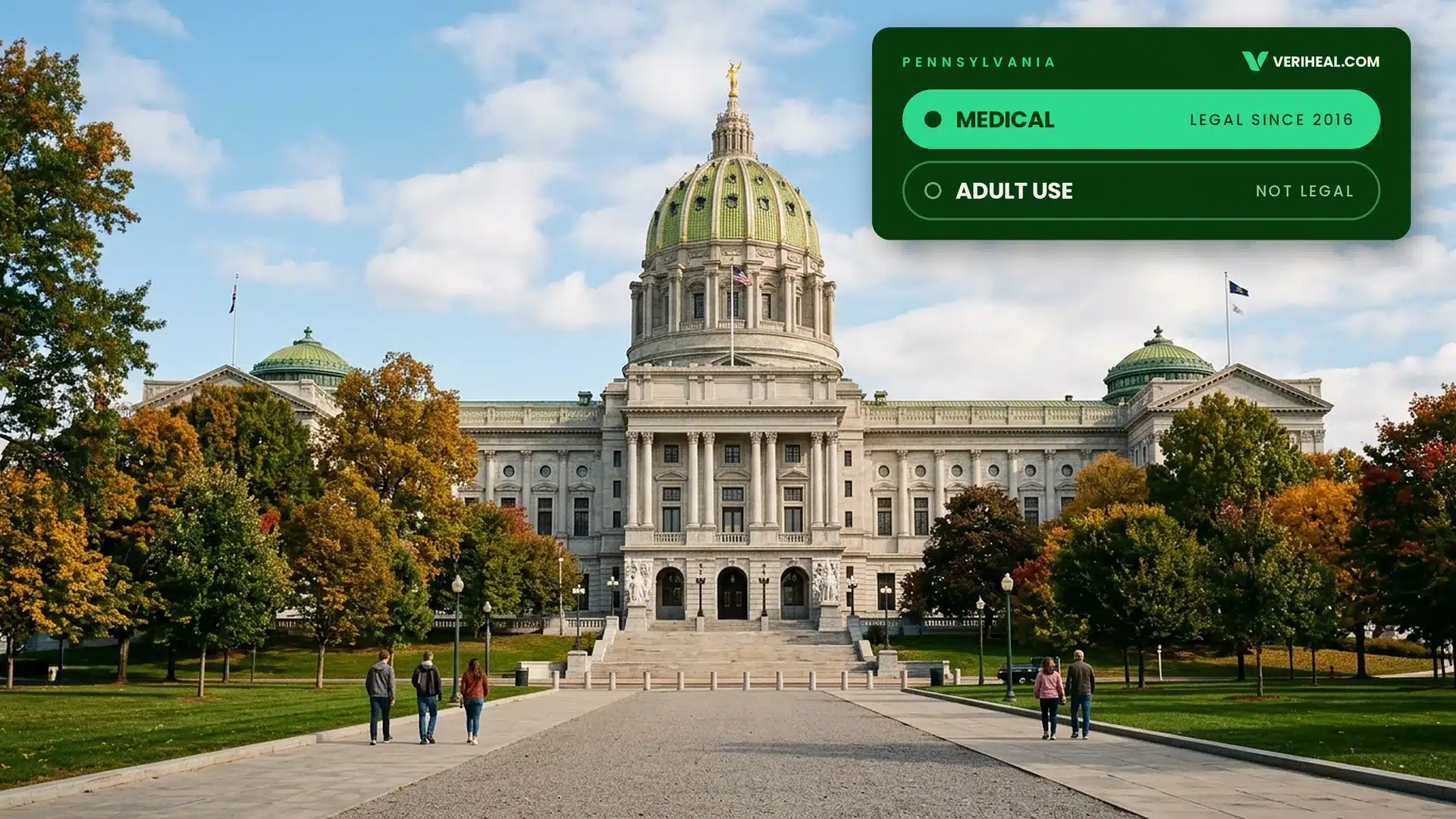
Yes, medical marijuana is legal in Pennsylvania. Governor Tom Wolf signed the Medical Marijuana Act, known as Act 16 of 2016, on April 17, 2016. The Pennsylvania Department of Health (DOH) has run the program ever since. To join the Pennsylvania medical marijuana program, you need a qualifying serious medical condition and a certification from an approved practitioner. Recreational cannabis, however, is still illegal in the state.
In this guide, you’ll see how the law has evolved since 2016, who qualifies, and how to register. You’ll also learn which job protections and federal rules apply to working patients, so you can join the program knowing exactly where you stand.
How Did Pennsylvania’s Medical Marijuana Law Develop?
Pennsylvania’s rules have shifted several times since 2016. Here are the changes that shape the program you’d join today:
| Year |
Milestone |
Law or action |
What it means for patients |
| 2016 |
Governor Tom Wolf signed the Medical Marijuana Act on April 17. |
Act 16 of 2016 |
Created the state’s program, run by the DOH, and made smoking medical marijuana unlawful. |
| 2018 |
Dry leaf became an approved form, effective May 17. |
DOH temporary regulations |
Patients could buy dry leaf, but only for vaporization. |
| 2021 |
The Superior Court decided Palmiter v. Commonwealth Health Systems on August 5. |
State court ruling |
Confirmed that patients can sue employers who discriminate against them for being certified. |
| 2021 |
The legislature amended the Medical Marijuana Act. |
Act 44 of 2021 |
Raised the purchase limit to a 90-day supply and let practitioners certify patients by phone or video. |
| 2023 |
Governor Josh Shapiro signed Act 63 on December 14. It took effect April 12, 2024. |
Act 63 of 2023 |
Let independent growers/processors and dispensaries apply for the other permit type. |
| 2026 |
State-licensed medical marijuana moved to Schedule III in April, and the Supreme Court decided United States v. Hemani in June. |
Federal actions |
Moved state-licensed medical marijuana into Schedule III and limited gun-law prosecutions based on marijuana use alone. |
Two of these changes get their own sections below. The Palmiter ruling covers your rights at work, and the 2026 federal changes matter if you own firearms.
Who Can Use Medical Marijuana in Pennsylvania?
To join the program, you need a serious medical condition certified by an approved practitioner, according to the DOH’s patients and caregivers page. The DOH lists these serious medical conditions:
- Neurological conditions: Amyotrophic lateral sclerosis (ALS), damage to the nervous tissue of the central nervous system with objective neurological indication of intractable spasticity and other associated neuropathies, dyskinetic and spastic movement disorders, epilepsy, Huntington’s disease, intractable seizures, multiple sclerosis, neurodegenerative diseases, neuropathies, Parkinson’s disease, and Tourette syndrome.
- Mental health and developmental conditions: Anxiety disorders, autism, and post-traumatic stress disorder (PTSD).
- Digestive conditions: Crohn’s disease and inflammatory bowel disease.
- Pain: Severe chronic or intractable pain of neuropathic origin, or severe chronic or intractable pain.
- Other conditions: Cancer (including remission therapy), chronic hepatitis C, glaucoma, human immunodeficiency virus and acquired immune deficiency syndrome (HIV/AIDS), opioid use disorder when conventional treatments are contraindicated or ineffective or when used alongside them, sickle cell anemia, and terminal illness.
Two more conditions appear on the DOH’s list with a limit attached. Moderate to severe traumatic brain injury with chronic symptoms and type II diabetes mellitus qualify only for Chapter 20 research purposes. Whatever your diagnosis, your practitioner is the one who confirms whether it qualifies. Patients under 18 can take part too, through a caregiver.
How Do You Register as a Patient in Pennsylvania?
Registration runs through the DOH’s online registry, and the department sets out four steps:
- Open your registry account: Register on the DOH website using a Pennsylvania driver’s license or state-issued ID and an active email address.
- Get certified: An approved practitioner confirms that you have a qualifying condition, and Act 44 of 2021 lets them see you by phone or video.
- Pay for your ID card: Pay the $50 fee to the state. If your certification email asks you to pay, do it within 60 days of the certification date, or the certification expires.
- Buy at a dispensary: Show your medical marijuana ID card at any Pennsylvania dispensary.
Once you’ve paid, the DOH asks you to allow 7 days for your card to be printed and another 14 days for it to arrive by mail. After that, two timelines keep your card active. Your practitioner decides how long your certification lasts, up to one year, and the $50 fee comes due once every 12 months, according to the DOH’s renewal page. For a broader view of timing, Veriheal’s guide on how long it takes to get a medical card can help.
You may not have to pay that fee at all. The Medical Marijuana Assistance Program (MMAP) waives it for patients enrolled in any of these state programs:
- Health coverage: Medicaid or the Children’s Health Insurance Program (CHIP).
- Food assistance: The Supplemental Nutrition Assistance Program (SNAP) or Women, Infants and Children (WIC).
- Prescription help for older adults: The Pharmaceutical Assistance Contract for the Elderly (PACE), including its Needs Enhancement Tier (PACENET).
Caregivers register with the DOH as well. A patient can name up to two, and each must be at least 21 unless the DOH authorizes otherwise. Caregivers also pass a criminal background check, and a drug sale or possession conviction within the last five years rules someone out.
What Forms of Medical Marijuana Are Legal in Pennsylvania?
Pennsylvania permits only certain forms of medical marijuana. The state’s regulation on forms of medical marijuana allows:
- Oral forms: Pills, oils, tinctures, and liquids.
- Topical forms: Gels, creams, and ointments.
- Inhaled forms: Forms meant for vaporization or nebulization, including dry leaf or plant form for vaporization.
Combustion is off the table. The Act makes smoking medical marijuana unlawful, which is why dry leaf is sold for vaporizing. Edible products aren’t sold either, though a patient or caregiver may mix medical marijuana into food when that helps the patient take it.
How Much Medical Marijuana Can You Buy?
A 90-day supply is the most a Pennsylvania dispensary can provide at one time, a limit that Act 44 of 2021 set. The state’s dispensary regulations put that amount at 192 medical marijuana units. Once you’ve bought a 90-day supply, the next one isn’t available until you’re down to your final 7 days’ worth.
Your own certification may be stricter. It can set a lower amount, and dispensaries have to honor any limits your practitioner places on forms or doses. For questions about how this applies to your products, ask your practitioner or the dispensary’s physician or pharmacist.
What Job Protections Do Pennsylvania Patients Have?
Pennsylvania’s law includes a specific protection for working patients. Under section 2103 of the Medical Marijuana Act, an employer can’t fire, threaten, refuse to hire, or otherwise discriminate or retaliate against you solely because you’re certified to use medical marijuana. That covers your pay, terms, conditions, work location, and privileges.
The Act didn’t spell out how an employee could enforce that rule. On August 5, 2021, the Superior Court addressed it in Palmiter v. Commonwealth Health Systems. It held that the Act gives employees an implied right to sue employers who violate it. According to Littler’s analysis of the ruling, it was the first binding opinion in Pennsylvania to recognize that right.
The protection has clear limits. The same section sets three of them:
- On their property: Employers don’t have to allow medical marijuana use on their property.
- Under the influence: Employers can discipline you for being under its influence at work, or for working under its influence when your conduct falls below the accepted standard for your position.
- Federal law: Employers aren’t required to do anything that would put them in violation of federal law, which matters in federally regulated jobs.
If your field is federally regulated, talk with an employment lawyer before you disclose your status. For more, read Veriheal’s guides on whether to tell your employer about your medical card and whether a medical cannabis card shows up on a background check.
Should You Talk to a Lawyer First If You Own Firearms?
A Pennsylvania certification doesn’t change how federal firearms law applies to you, so talk with a lawyer before you enroll if you own firearms. Some federal rules changed in 2026 and others didn’t, so it helps to separate the two. These are the rules that still apply:
- Section 922(g)(3): This federal drug-user provision continues to apply.
- Form 4473: When you buy a firearm, answer the form’s drug-use question honestly. The Bureau of Alcohol, Tobacco, Firearms and Explosives (ATF) hasn’t changed the form or issued replacement guidance.
And here’s what did change:
- The Hemani decision: In United States v. Hemani, decided unanimously on June 18, 2026, the Supreme Court held that a prosecution under Section 922(g)(3) for marijuana use alone violates the Second Amendment.
- ATF’s 2011 letter: Dealers had been told that a medical card was grounds to refuse a sale. The ATF has since rescinded that open letter.
- Schedule III: As of April 2026, state-licensed medical marijuana sits in Schedule III, according to the U.S. Department of Justice. Recreational marijuana is still in Schedule I.
A lawyer who handles firearms law can apply these rules to your own situation. For more, read Veriheal’s guide on medical cannabis patients and gun rights.
Can You Use Your Pennsylvania Card in Other States?
A card from another state won’t get you into a Pennsylvania dispensary. Dispensaries here can only serve patients and caregivers who present a valid medical marijuana ID card, and your Pennsylvania card works elsewhere only if that state agrees to honor it. Crossing state lines with cannabis can also raise federal legal issues, so look up the rules before you travel. For details, read Veriheal’s guides on which states accept out-of-state medical marijuana cards and traveling with a medical marijuana card.
How Can Veriheal Help You Get a Pennsylvania Card?
Your first step toward a card is a certification from an approved practitioner. Veriheal connects you with a Pennsylvania health care provider for an online video evaluation, which costs $199. You can split that fee into interest-free installments, and every evaluation comes with a “get approved or your money back” policy. The $50 state fee is separate and paid to the DOH. To see what a card can do for you once you have it, read Veriheal’s guide on the benefits of a medical marijuana card.
Book your Pennsylvania evaluation with Veriheal to find out whether you qualify. The visit happens by video, so you can start from home.
Note: The content on this page is for informational purposes only and is not intended to be professional medical advice. Do not attempt to self-diagnose or prescribe treatment based on the information provided. Always consult a physician before making any decision on the treatment of a medical condition.
Note: Veriheal does not support illegally consuming therapeutic substances such as cannabis but acknowledges that it transpires because of the current illicit status, which we strive to change by advocating for research, legal access, and responsible consumption. Always consult a physician before attempting alternative therapies.
Frequently Asked Questions
Can anyone go to a dispensary in Pennsylvania?
No, Pennsylvania dispensaries can only sell medical marijuana to registered patients and caregivers who present a valid ID card. Recreational buyers and visitors with out-of-state cards can’t buy, since Pennsylvania hasn’t legalized adult use and doesn’t accept other states’ cards.
What types of medical marijuana are legal in Pennsylvania?
Pennsylvania allows medical marijuana as pills, oils, tinctures, liquids, topicals, and forms for vaporization or nebulization, including dry leaf. Edibles aren’t an approved form, and smoking is unlawful.
Can you smoke in public with a medical card in PA?
No, a Pennsylvania medical card doesn’t allow smoking anywhere, since the Medical Marijuana Act makes smoking medical marijuana unlawful. Patients who use dry leaf have to vaporize it instead.
Can you smoke marijuana outside in Pennsylvania?
No, smoking marijuana outdoors isn’t legal for anyone in Pennsylvania. Recreational cannabis is illegal, and registered patients are barred from smoking their medical marijuana.
Is recreational marijuana legal in Pennsylvania?
No, recreational marijuana is still illegal in Pennsylvania. As of July 2026, Spotlight PA’s election coverage noted that all but one of Pennsylvania’s neighboring states had legalized adult use, while Pennsylvania had not.
Is medical marijuana covered by insurance in Pennsylvania?
No, health insurance doesn’t pay for medical marijuana, since the cannabis plant isn’t a Food and Drug Administration (FDA)-approved drug. That stayed true after state-licensed medical marijuana moved to Schedule III in April 2026. The DOH also warns that your certification visit may not be covered. Veriheal’s guide on whether medical marijuana is covered by insurance explains more.
Author, Share & Comments