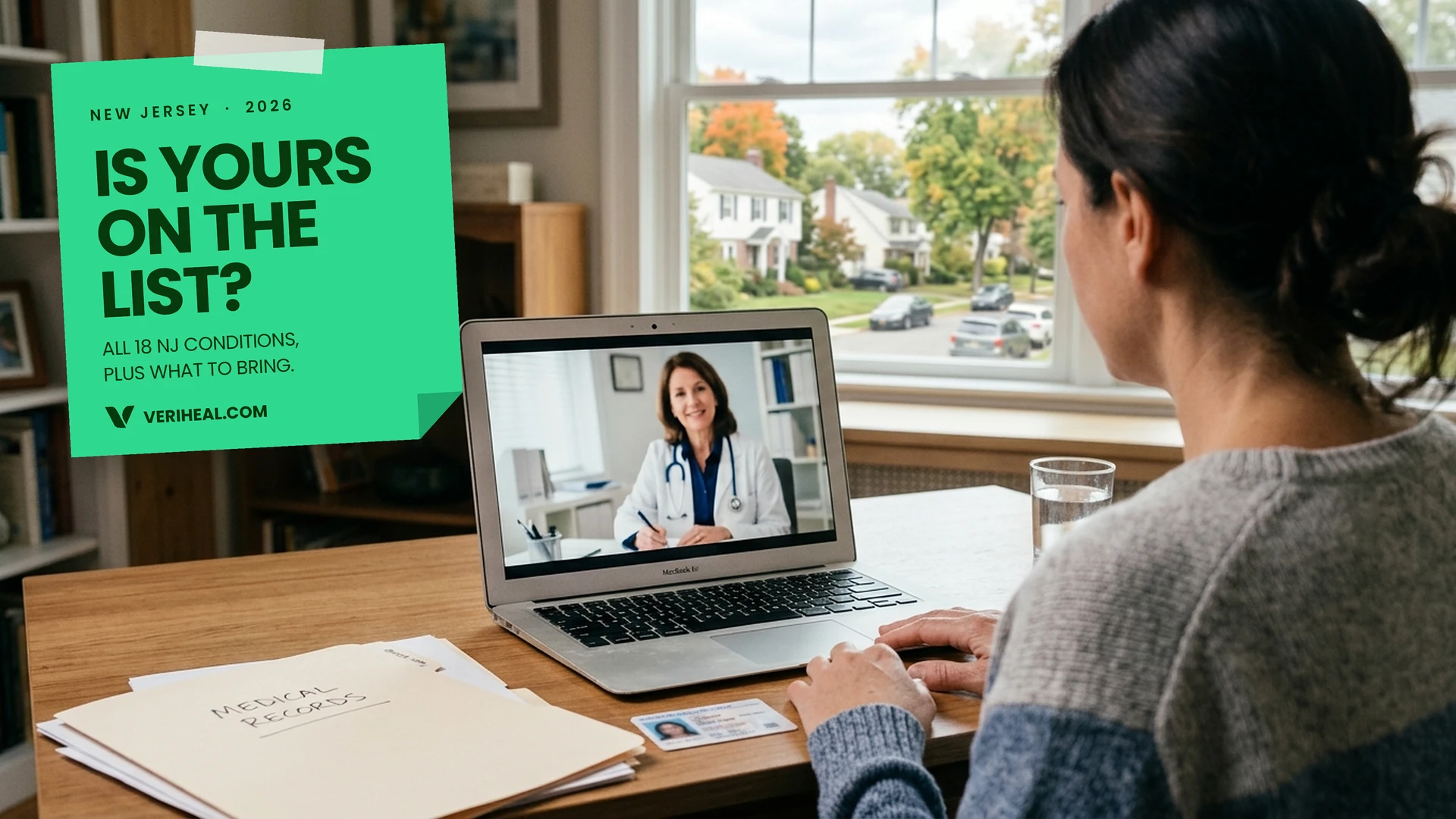
New Jersey’s Medicinal Cannabis Program covers 18 qualifying conditions as of January 2026, and if your diagnosis is on that list, you can apply for a medical marijuana card through a licensed certifying provider. This article walks through every qualifying condition, explains what documentation your doctor will look for, and covers what to do if your condition is not on the list.
What Conditions Qualify for a Medical Marijuana Card in New Jersey?
New Jersey’s Medicinal Cannabis Program covers 18 qualifying medical conditions under the Jake Honig Compassionate Use Medical Cannabis Act, administered by the New Jersey Cannabis Regulatory Commission. The list was most recently updated in January 2026 with the addition of sickle cell anemia under P.L. 2025 c.223. Before purchasing cannabis from a licensed alternative treatment center, a patient must receive written authorization from a CRC-registered certifying provider.
The 18 qualifying conditions are:
- Chronic Pain: A persistent pain condition that has not responded adequately to conventional treatment. Patients with a documented history of prior medications or therapies are well-positioned for certification.
- Anxiety: Covers several diagnosed anxiety subtypes, detailed further below, each evaluated against the same documentation standard.
- PTSD: Post-traumatic stress disorder qualifies under the program. Veterans and other patients often report cannabis use as a coping strategy for PTSD symptoms, a pattern documented in NIH-published research on cannabis-related coping among veterans with PTSD, though the certifying provider still requires a documented PTSD diagnosis from a licensed provider before authorization.
- Cancer: Any active cancer diagnosis qualifies, including cases where cannabis is being considered for symptom management alongside conventional oncology treatment.
- Migraine: Both chronic and episodic migraine qualify, particularly where standard preventive or abortive treatments have not provided adequate relief.
- Epilepsy / Seizure Disorder: Seizure disorders of any type qualify. Cannabinoid-based treatment for seizures already has federal precedent: the FDA has approved a purified CBD medication for certain severe seizure disorders, part of what the agency describes in its overview of cannabis research and drug approval.
- Multiple Sclerosis: MS qualifies under the program, with cannabis commonly considered for spasticity, pain, and sleep disruption associated with the condition.
- ALS (Amyotrophic Lateral Sclerosis): ALS qualifies, and certifying providers are permitted to issue authorization on an expedited basis given the progressive nature of the disease.
- Inflammatory Bowel Disease / Crohn’s Disease: Inflammatory bowel disease and Crohn’s disease qualify where conventional therapies have not fully controlled symptoms.
- Glaucoma: Qualifying on the basis of documented diagnosis; patients should note that a certifying provider may request confirmation from an ophthalmologist.
- HIV / AIDS: HIV and AIDS qualify under the program, including cases where cannabis is considered for appetite stimulation, nausea, or neuropathic pain.
- Muscular Dystrophy: Any form of muscular dystrophy qualifies; certifying providers will confirm the diagnosis through existing medical records.
- Tourette Syndrome: A documented diagnosis of Tourette syndrome qualifies for certification under the NJ Medicinal Cannabis Program.
- Opioid Use Disorder: NJ explicitly recognizes opioid use disorder as a qualifying condition under a harm-reduction framework. The National Institute on Drug Abuse’s cannabis research program includes funded studies on cannabis’s potential to reduce use of other substances, including opioids, though NJ’s own qualifying-condition status does not depend on any single study’s outcome.
- Terminal Illness: Any terminal diagnosis qualifies, and the CRC allows for expedited certification pathways for patients with limited life expectancy.
- Dysmenorrhea: Severe menstrual pain that has not responded to conventional treatment qualifies under this category.
- Sickle Cell Anemia: The newest condition on the list, effective January 2026, covering patients managing pain crises and other complications of the disease.
- Intractable Skeletal Muscular Spasticity: Spasticity that has not responded to conventional treatment qualifies, and this condition often overlaps with diagnoses such as MS or spinal cord injury.
Note: Always verify the current qualifying conditions list directly with the New Jersey Cannabis Regulatory Commission at nj.gov/cannabis before beginning the certification process. Cannabis laws and program conditions are subject to change.
The 3 Conditions NJ Patients Ask About Most
Being on the qualifying list and knowing whether you personally qualify are two different questions. For three conditions in particular, chronic pain, anxiety, and migraine, patients consistently want to understand what clinical documentation a certifying provider will actually look for, not just confirmation that the condition qualifies.
Chronic Pain
Chronic pain qualifies for the NJ medical marijuana program when it is persistent and has not responded adequately to conventional treatments. There is no specialist referral requirement to see a certifying provider, but the provider will typically review prior treatment records, including medications tried, how long they were used, and any documented treatment failure, before issuing an authorization.
“Not responded adequately” does not mean a single failed prescription. It means a documented pattern of prior treatment attempts that have not provided sufficient relief, which is a standard that most patients who have been managing chronic pain for any meaningful length of time will already meet through their existing records. If your primary care provider has been treating your pain and that history exists in your chart, you are likely well-positioned to pursue physician certification.
Anxiety
Generalized anxiety disorder, panic disorder, and social anxiety disorder all qualify under NJ’s medical marijuana program. A certifying provider will look for an existing anxiety disorder diagnosis from a mental health provider or primary care physician, evidence that standard treatments such as therapy, medication, or both have been attempted, and a clinical picture that connects symptom severity to functional impairment in daily life.
Self-reported anxiety without any prior treatment history is a less straightforward path than a documented record of treatment attempts. Patients who have worked with a therapist, tried medication, or both will find the certification process more direct. If you have been managing anxiety through your healthcare provider and that history is in your records, that documentation is exactly what a certifying provider needs to see.
Migraine
For migraine specifically, the documentation pattern mirrors chronic pain: a certifying provider will look for a diagnosis and a history of prior treatment attempts, whether from a neurologist, a headache specialist, or a primary care physician with migraine treatment on file.
Patients with records from a neurologist or headache clinic are particularly well-positioned, but a primary care diagnosis with treatment history is sufficient. If you have tried triptans, preventive medications, or other standard migraine therapies with limited results, that documented history supports your certification.
What If Your Condition Isn’t on the List?
If your diagnosed condition does not appear on NJ’s qualifying list, you have two meaningful options. Under N.J.S.A. 24:6I-3, any person can petition the New Jersey Cannabis Regulatory Commission to add a new condition, backed by supporting clinical evidence. Separately, patients whose primary diagnosis is unlisted may still qualify through a comorbidity, since a certifying provider authorizes based on the qualifying condition present, not the full diagnostic picture.
The comorbidity pathway. Many patients with conditions that are not on the NJ list also carry a qualifying comorbidity. A patient with fibromyalgia, for example, may also have documented chronic pain or anxiety disorder, both of which qualify. The certifying provider issues authorization based on the qualifying condition, which is both legally appropriate and clinically sound. A Veriheal-affiliated provider can review your full medical history to identify whether a qualifying condition exists alongside your primary diagnosis.
The petition pathway. Under N.J.S.A. 24:6I-3, any individual or physician can submit a petition to the CRC requesting that a new condition be added to the qualifying list. The petition must include clinical evidence supporting therapeutic benefit. The January 2026 addition of sickle cell anemia is the most recent example of this process producing a result, though petition review timelines vary and there is no guaranteed outcome or deadline.
What to do now. If you are unsure whether your condition or a related diagnosis qualifies, the most direct step is a consultation with a CRC-registered certifying provider who can assess your full medical history. Rather than attempting to self-determine eligibility, working through a provider gives you a definitive answer and, if you qualify, the authorization in a single appointment.
How a NJ Doctor Certifies Your Qualifying Condition
Understanding what happens during the certification appointment helps you prepare for it. A CRC-registered certifying provider is required to confirm that you have a qualifying diagnosis, review your prior treatment history, determine that conventional treatment has been inadequate where that standard applies, and complete the CRC’s practitioner attestation before issuing an authorization. The appointment is not a formality; it is a clinical review, and arriving prepared makes the process faster.
What to bring to your appointment:
- Prior diagnosis records from your treating physician or specialist
- A list of medications you have tried, how long you used them, and why you stopped
- Any specialist notes related to your qualifying condition
- A valid photo ID and proof of New Jersey residency
Veriheal connects patients with CRC-registered certifying providers, and the consultation can be completed via telemedicine for medical cannabis, which means you do not need to travel to a physical office. Once the provider completes the attestation and issues your authorization, the next step is registering with the CRC’s patient portal.
Getting Your NJ Medical Marijuana Card After Certification
Once your certifying provider issues a written authorization, you register with the New Jersey Cannabis Regulatory Commission through their online patient registry portal. After registration is approved, you receive a patient ID card that allows you to purchase cannabis from any licensed alternative treatment center in the state.
The benefits of holding a medical marijuana card in NJ are meaningful compared to purchasing recreationally. Medical patients receive a higher monthly purchase allowance, up to 84 grams, and are not subject to the same sales tax as recreational purchasers, which translates to real cost savings over time. You can also designate a caregiver registration for a trusted person to purchase on your behalf if you are unable to visit a dispensary.
The post-certification steps are:
- Receive written authorization from your certifying provider
- Register online through the CRC’s patient portal
- Receive your patient ID card by mail
- Purchase from any licensed alternative treatment center in NJ
It also helps to understand how long it takes to get a medical card so you can plan accordingly. Book your consultation with a Veriheal-certified physician and apply for your New Jersey medical marijuana card.
Note: The content on this page is for informational purposes only and is not intended to be professional medical advice. Do not attempt to self-diagnose or prescribe treatment based on the information provided. Always consult a physician before making any decision on the treatment of a medical condition.
Note: Veriheal does not support illegally consuming therapeutic substances such as cannabis but acknowledges that it transpires because of the current illicit status, which we strive to change by advocating for research, legal access, and responsible consumption. Always consult a physician before attempting alternative therapies.
Frequently Asked Questions
Do I need a referral from my doctor to get medical marijuana in New Jersey?
No referral is required. Patients can book directly with a CRC-registered certifying provider, including through telehealth, without a referral from their primary care physician. The certifying provider reviews your existing medical history and issues the authorization directly.
How much does it cost to get a medical marijuana card in NJ?
Costs include the certifying provider’s consultation fee and the state registration fee.
Can I use a medical marijuana card from another state in New Jersey?
New Jersey does not have a formal reciprocity program for out-of-state patients. Some dispensaries may accommodate visiting patients under limited circumstances, but this is not guaranteed statewide. For details on which states allow out-of-state patients to buy medical marijuana, including how NJ fits into the broader reciprocity landscape, see that linked guide.
Is medical cannabis covered by insurance in New Jersey?
No. Medicinal cannabis is not covered by any health plan in NJ, including Medicaid. For more on whether medical marijuana is covered by insurance at the federal and state level, that article covers the full picture.
Can I lose my job for using medical cannabis in New Jersey?
The Jake Honig Compassionate Use Medical Cannabis Act includes employment protection provisions under N.J.S.A. 24:6I-6.1 that prohibit adverse employment action based solely on a positive cannabis test for registered patients. A related, broader protection for off-duty cannabinoid metabolites exists under CREAMMA (N.J.S.A. 24:6I-52). Named carve-outs exist for safety-sensitive positions, and those exemptions are defined by the employer’s industry and role type. Patients facing workplace action should review their employer’s specific policies and consult an employment attorney.
Does having a medical marijuana card show up on a background check?
This is a common concern for registered patients. For a thorough answer on whether a medical cannabis card shows up on a background check, including how state databases are handled and what employers can and cannot access, that article addresses it in full.
Does a medical marijuana card affect my gun rights?
It’s genuinely unsettled right now. Federal law bars unlawful controlled substance users from firearms, but on June 18, 2026, the Supreme Court ruled in United States v. Hemani that prosecuting someone for marijuana use alone violates the Second Amendment, and the ATF has since rescinded its 2011 guidance treating a medical card as automatic grounds for denial. No clear replacement policy exists yet. Consult a firearms attorney rather than assume either the old or new rule is settled. See the full intersection of cannabis and gun rights for more.
Where can I learn more about the NJ medical marijuana program compared to other states?
The medical cannabis card state-by-state laws guide covers how NJ’s program compares to other state programs, including differences in qualifying conditions, possession limits, and reciprocity rules.
Author, Share & Comments